Where Is the Light Sensor on a Solar Garden Light? How to Find, Test and Fix It
Where the light sensor is on a solar garden light, why many use the panel itself as the sensor, how to test it, and how to fix lights that misbehave.
Key points
- Many solar garden lights have no separate sensor: the controller reads the solar panel's voltage and switches the LED on when it falls at dusk.
- Others use a small photoresistor (LDR), usually a pea-sized disc with a wavy line, next to the panel or on top of the head.
- To test it, cover the panel or sensor with your hand in the dark or shade; the light should come on within a few seconds.
- Our SL3530J005 solar wall light has a 6.8 Wp panel and a 3.7 V 8 Ah battery (about 29.6 Wh), which runs its 5 W LED for about 6 hours at full power.
“Where is the light sensor?” is one of the most common questions about solar garden lights, usually asked by someone whose light is on in the daytime or will not turn on at night. The answer surprises many people: on a lot of lights, there is no separate sensor at all. This guide explains how the light knows it is dark, how to find the sensor if there is one, and how to test and fix the common faults.
Two ways a solar light knows it is dark
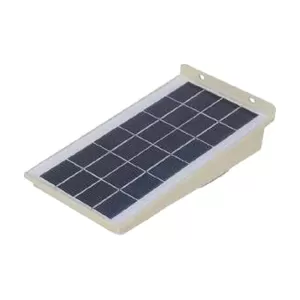
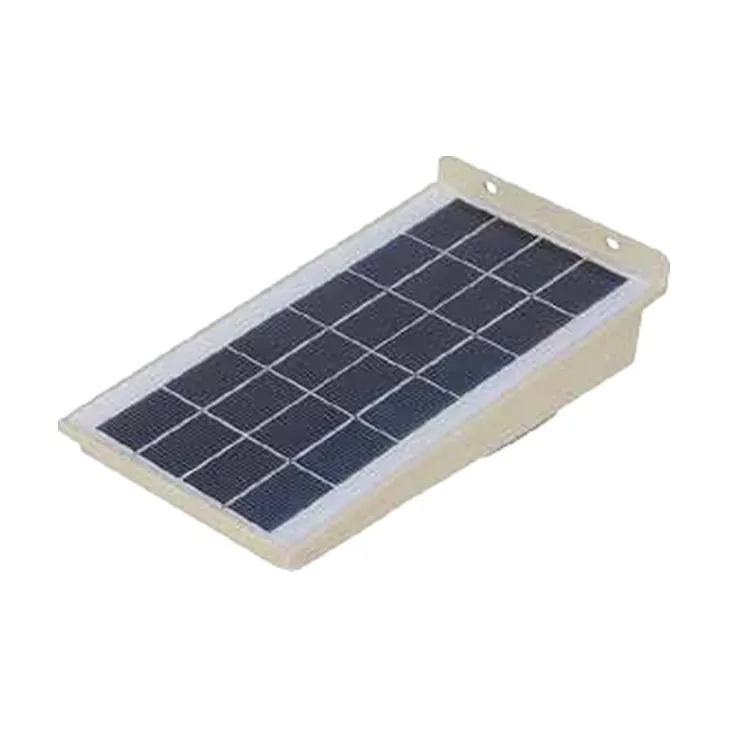
1. The panel is the sensor. A solar panel produces voltage whenever light falls on it. The light’s controller watches that voltage. When it falls below a threshold at dusk, the controller switches the LED on. At dawn the voltage rises and the LED switches off. Most small stake lights, string lights and many wall lights work this way. There is no separate part to find.
2. A separate photoresistor (LDR). Some lights use a light-dependent resistor: a small disc, about the size of a pea, with a wavy track on its face, mounted behind a clear window. Its resistance rises in the dark, and the controller reads it. You usually find it:
- next to the solar panel on the top of the light;
- on the side or top of the light head, facing upwards;
- on split lights, on the panel box rather than the lamp.
Our guide to the solar garden light circuit diagram shows both arrangements and where the controller sits.
How to test the sensor
- Make sure the switch is on. Many lights have an on/off switch under the head or on the base; some have a mode switch too.
- Check the battery has charge. After a sunny day it should.
- Cover the panel or the LDR completely. Use your hand or a folded dark cloth. In shade or indoors this works best.
- Wait a few seconds. Many controllers have a short delay to avoid flicker at dusk.
- The light should come on. Uncover it, and it should switch off again.
If it does not, the fault is in the battery, the controller or the LED, not the sensor’s position.
Light stays on in the daytime
| Cause | Fix |
|---|---|
| Panel or LDR dirty, covered by leaves or snow | Clean with a damp cloth; clear the area |
| Light installed in deep shade | Move it into direct sun |
| Panel facing away from the sun | Angle it towards the midday sun |
| Water inside the head | Dry it out, check seals |
| Failed controller | Replace the light or the controller board |
Light does not turn on at night
| Cause | Fix |
|---|---|
| Switch off | Switch on |
| Battery flat after cloudy days | Leave it to charge for a sunny day with the switch off |
| Battery worn out | Replace the battery; see our guide on how to change the battery in a solar garden light |
| Another light shining on the panel | Move the light or shield it from porch and street lights |
| Corroded contacts | Clean the battery contacts |
The third and fourth rows are the most common in practice. Batteries in cheap garden lights often wear out after one to two seasons.
Why the panel and battery size matter more than the sensor
A sensor only decides when the light switches on. How long it stays on depends on the panel and battery. Take our SL3530J005 solar wall light as an example:
- Solar panel: 5.5 V, 6.8 Wp
- Battery: lithium, 3.7 V, 8 Ah, about 3.7 × 8 = 29.6 Wh
- LED: 5 W, more than 100 lm/W
At full power, a full battery runs the 5 W LED for about 29.6 ÷ 5 ≈ 6 hours. The light’s controller stretches that by running at reduced output or switching to full brightness on movement, which is how it reaches 6–8 hours of lighting a night and 20–24 hours of operation from a full battery, as listed in its specification.
On the charging side, a 6.8 Wp panel on a day with about 4 peak sun hours, after typical controller and battery losses, puts back very roughly 15–20 Wh. That is enough for a night of reduced-output lighting but not for a full night at 5 W. That is why a light can seem “broken” in winter: the sensor works, but the battery is never fully charged.
Tips for retailers and installers
- Check how the light senses darkness before installing it near street lights or porch lights.
- Tell customers to switch off lights for storage so the battery is not drained in the box.
- Install in full sun, facing the equator, with the panel clear of overhanging plants.
- Choose replaceable batteries where possible; they extend the life of the product.
Our solar powered garden lights guide covers choosing lights by panel and battery size, and solar lights that stay on all night explains how to size them for long winter nights.
Bigger solar lights work the same way
Solar street lights use the same principle on a larger scale: the controller reads the panel voltage to detect dusk and dawn, often with a programmable delay and dimming schedule. For projects needing more than a garden light, see our solar street lights.
For bulk buyers
If you sell or install solar garden and wall lights in quantity, send us the use (path, wall, garden), the latitude of your market and the hours of light you need. We will suggest panel and battery sizes that work in your winter, not just in summer.
Sources
Frequently asked questions
Where is the light sensor on a solar light?
On many lights the solar panel itself is the sensor; there is no separate part. Others have a small round photoresistor next to the panel or on the light head. Look for a pea-sized disc with a wavy line under a clear window.
Why is my solar light on during the day?
Usually the panel or sensor is shaded, dirty or covered, so the controller thinks it is dark. It can also be a failed sensor or controller. Clean the panel, move the light into the sun and test again.
Why does my solar light not turn on at night?
Common causes: the switch is off, the battery is flat or worn out, or a nearby light (porch light, street light) shines on the panel or sensor and makes the controller think it is still day.
Can I cover the sensor to test the light during the day?
Yes. Cover the panel or the photoresistor completely with your hand or a dark cloth; most lights switch on within a few seconds if the battery has charge.