Solar Bollard Spacing: How Far Apart, How Many per Path, and the Energy Each One Needs
How far apart to space solar bollards for marking, even path lighting and steps, how many fit along 50 and 100 m, and the panel and battery each bollard needs by our solar calculator.
Key points
- Space 0.6 m bollards about 6–8 m apart to mark a path edge, 4–5 m for even light along it and 2–3 m at steps and entrances; solar bollards are usually dimmer, so stay at the closer end.
- Along a 100 m path, that means about 15 bollards at 7 m, 23 at 4.5 m or 34 at 3 m on one side.
- By our solar calculator, a 3 W bollard running 4 hours at full power and 8 hours at 30 % needs about 21 Wh a night, a 71 Wh lithium battery for 3 nights and a 10 W panel at 3.5 peak sun hours.
- A bollard top only holds a panel of a few watts, so check the real panel and battery figures before choosing spacing on brightness alone.
Solar bollards are popular for paths, driveways and parks because they need no trenching. The first question is always how far apart to put them. The answer depends on what you want them to do, and for solar there is a second question: whether each bollard can store enough energy to deliver the light the spacing assumes. This guide covers both, with solar bollard spacing tables and an energy calculation from our solar calculator.
Three jobs, three spacings
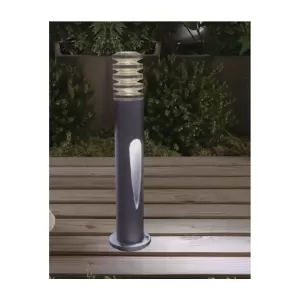
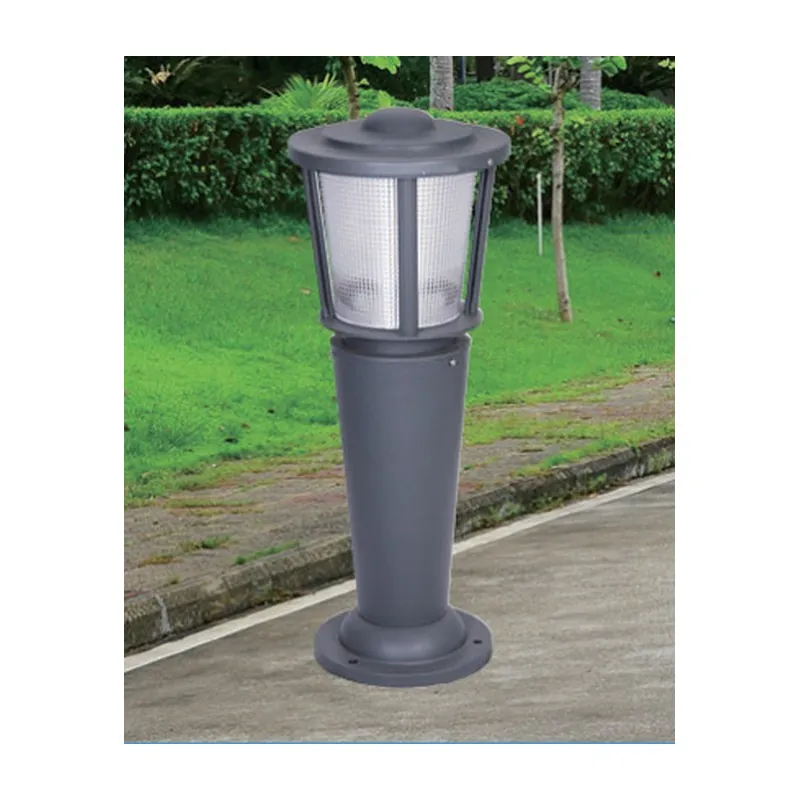
A 0.6 m bollard lights a small pool of ground around itself. It is not a street light, and its spacing is set by the effect you want:
| Job | Spacing (0.6 m bollard) | What it looks like |
|---|---|---|
| Marking the edge of a path | 6–8 m | A line of points showing the route; dark gaps between |
| Even light along the path | 4–5 m | Pools of light that just touch or overlap |
| Steps, ramps, entrances, junctions | 2–3 m | Continuous light where people may trip |
These figures come from our mains-powered lawn and bollard light, which runs at 3–30 W. Solar bollards for paths are usually at the low end, around 1–5 W, so choose the closer end of each range for solar.
Taller bollards (around 1 m) spread light further and can be spaced a little wider; very low marker lights need closer spacing. Our bollard lights guide compares heights and optics.
How many you need
Count one at each end of the path, then one per spacing. For one side of the path:
| Path length | At 7 m | At 4.5 m | At 3 m |
|---|---|---|---|
| 50 m | 8 | 12 | 17 |
| 100 m | 15 | 23 | 34 |
On paths wider than about 2.5 m, alternate the bollards from side to side at the same spacing measured along the path, rather than doubling them on both sides. Add extra units at every junction, step and change of level.
The solar part: energy per bollard
A bollard spaced for even light only works if it is still lit at 2 am in winter. We sized three bollard powers in our solar street light calculator, with 4 hours at full power after dusk, then 8 hours at 30 %, a driver efficiency of 90 %, lithium iron phosphate batteries at 3.2 V and three nights of autonomy:
| LED power | Energy per night | Battery for 3 nights | Panel needed at 3.5 peak sun hours |
|---|---|---|---|
| 2 W | about 14 Wh | about 47 Wh (15 Ah) | about 5.6 W |
| 3 W | about 21 Wh | about 71 Wh (22 Ah) | about 8.5 W |
| 5 W | about 36 Wh | about 119 Wh (37 Ah) | about 14 W |
At a sunnier 5.5 peak sun hours, the 3 W bollard needs only about 5.4 W of panel. Check your site’s winter value in the European Commission’s free PVGIS tool.
Here is the catch: the panel has to fit on top of the bollard. A square top 200 mm across holds roughly 6–8 W of modern monocrystalline cells. That is enough for a 2–3 W bollard in a sunny climate, and not enough for 5 W in a cloudy winter. A bollard that cannot recharge its battery will dim or switch off early, and the dark gaps the spacing was meant to avoid reappear.
What to ask a supplier
Many solar bollards are sold with a “lumen” or “watt” figure and no panel or battery data. Ask for:
- the real panel wattage and cell type;
- the battery chemistry, voltage and capacity (Wh or Ah);
- the lighting programme: hours at full power, dimmed level, motion sensing;
- the colour temperature and lumens at full power.
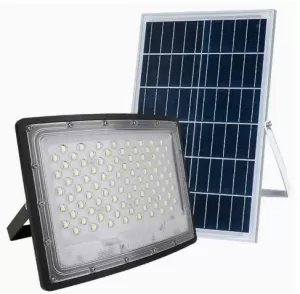
We publish exactly these figures for our solar flood lights, and we recommend asking for them for any solar light.
Getting the most from each bollard
- Place for sun first. A bollard under a tree or on the north side of a wall (south side in the southern hemisphere) will never charge fully. Move it, or use mains for that stretch.
- Charge before switching on. Our guide to charging solar lights the first time explains why a full first charge matters.
- Use motion sensing on quiet paths. Running at 30 % and rising to full when someone approaches stretches the battery a long way.
- Keep the panel clean. Leaves and dust on a small, flat panel cut the charge quickly.
Mains bollards when solar is not enough
For long park paths, shaded areas, or places that need reliable light all night every night, mains-powered bollards are often the better answer. They can be spaced on brightness rather than battery size, and one low-voltage or mains circuit feeds dozens of them. Our bollard light installation guide covers foundations and cabling. For long, open paths, low garden lights on 3 m poles spaced about 10 m apart can also cost less than a closely spaced bollard line.
Our pathway lighting guide and low-profile pathway lights guide show other layouts.
Quick spacing checklist
- Decide the job: marking, even light or safety at steps.
- Pick the spacing from the table, at the closer end for solar.
- Count units along each path, adding junctions and steps.
- Check each bollard’s real panel and battery against the energy table for your winter sun.
- Place each unit where its panel gets sun.
Send us your site plan and the lighting effect you want; we will propose spacing, quantities and whether solar or mains suits each part of the site.
Sources
Frequently asked questions
How far apart should solar bollards be?
About 4–5 m for even light along a path, 6–8 m if they only mark the edge, and 2–3 m at steps, ramps and entrances. Because solar bollards usually have a lower output than mains bollards, the closer end of each range is safer.
How many solar bollards do I need for a 50 m path?
About 8 at 7 m spacing, 12 at 4.5 m or 17 at 3 m, on one side, counting one at each end. On paths wider than about 2.5 m, place them on alternate sides.
How big a battery does a solar bollard need?
For a 3 W bollard running 4 hours at full power and 8 hours at 30 %, about 21 Wh a night; for three nights of autonomy with lithium iron phosphate, about 71 Wh, or about 22 Ah at 3.2 V, by our calculator.
Do solar bollards work in winter?
Only if the panel and battery are sized for winter sun. At 3.5 peak sun hours a 3 W bollard needs a panel of about 8.5 W; if the bollard's top panel is smaller, it will dim or run short on winter nights.