Solar Spot Lights for the Garden: Real Watts, Runtime by Sun Hours, and What They Can Light
Solar spot lights for gardens explained: the real power behind the labels, how long they run by sun hours, how much light reaches a tree or wall, and when a mains spotlight is better.
Key points
- Small solar spot lights typically have a panel of 1–5 W and a battery of a few watt-hours, so their real LED power is around 0.5–2 W, whatever the label says.
- By our battery calculation, a light with a 3 W panel and a 3.2 V, 3 Ah battery can run 1 W for 6 hours only where the weakest month gets about 4 or more sun hours.
- A 30° beam carrying about 150 lumens lights a spot about 1.6 m across at 3 m to roughly 60 lux, enough to pick out a shrub or a sign, not to flood a large tree.
- For tall trees, facades and long hours, a low-wattage mains spotlight gives ten to twenty times the light; solar suits accents far from a power supply.
Solar spot lights are the easiest way to add accent light to a garden: push a stake into the ground, point the head at a shrub, and you are done. They are also the garden product with the widest gap between the label and the result. This guide explains what is really inside a solar spotlight, how long it can run where you live, how much light actually reaches the thing you point it at, and when a mains spotlight is the better choice.
What is inside a solar spot light
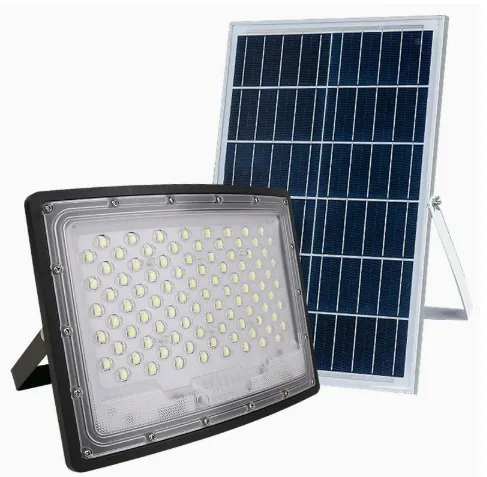
Every solar spotlight has four parts: a small solar panel (built in or on a cable), a rechargeable battery, a controller with a dusk sensor, and an LED head. The panel and battery set the energy budget; the LED cannot use more energy than they supply.
| Typical part | Small stake spotlight | Larger cable-panel spotlight |
|---|---|---|
| Panel | 0.5–2 W | 3–10 W |
| Battery | 3.2–3.7 V, 1–3 Ah (3–11 Wh) | 3.2 V, 3–10 Ah (10–32 Wh) |
| Real LED power | 0.2–1 W | 1–3 W |
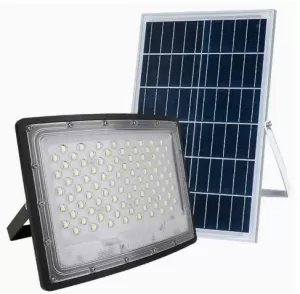
Labels such as “100 W solar spotlight” usually describe a count of LEDs or an “equivalent”, not the power drawn. Our solar flood light page shows the honest figures behind common labels: a unit sold as “25 W” typically has a 3 W panel and a 3.2 V, 3,000 mAh battery storing 9.6 Wh, enough for an average of about 0.8 W over 10 hours after a sunny day.
How long will it run? It depends on your sun
We ran typical spotlight sizes through our battery autonomy calculator, with lithium iron phosphate cells at 3.2 V, a simple PWM charger and the light on at constant power after dusk:
| Panel / battery | Light | Energy per night | Daily harvest at 2 / 3 / 4 / 5 sun hours | Balanced from |
|---|---|---|---|---|
| 3 W / 3 Ah | 1 W for 6 h | 6.7 Wh | 3.6 / 5.4 / 7.2 / 9.0 Wh | about 4 sun hours |
| 5 W / 5 Ah | 1.5 W for 6 h | 10.0 Wh | 6.0 / 9.0 / 12.0 / 15.0 Wh | about 4 sun hours |
| 5 W / 5 Ah | 1 W for 8 h | 8.9 Wh | 6.0 / 9.0 / 12.0 / 15.0 Wh | about 3 sun hours |
| 8 W / 8 Ah | 2 W for 6 h | 13.3 Wh | 9.6 / 14.4 / 19.2 / 24.0 Wh | about 3 sun hours |
“Sun hours” are peak sun hours in the month you care about; the EU’s free PVGIS tool gives them for any location. Two lessons from the table:
- In winter at higher latitudes (2 sun hours or less), none of these balance. The light runs on what is left in the battery and fades earlier each night. That is normal, not a fault. Our guide to outdoor solar lights that work in winter explains what helps.
- A bigger panel helps more than a bigger LED. The 5 W panel running 1 W for 8 hours balances at 3 sun hours, while the same panel running 1.5 W needs 4.
How much light reaches the target?
A spotlight concentrates its lumens in a cone. For a 30° beam, the lit spot at 3 m is about 1.6 m across (2 × 3 m × tan 15°), an area of about 2 m². If about 80% of 150 lumens lands in that spot:
150 × 0.8 ÷ 2.0 m² ≈ 60 lux
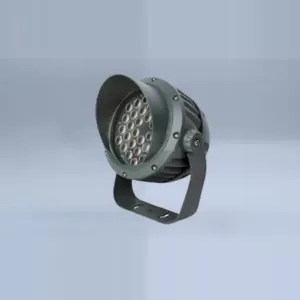
That is a clear, visible accent on a shrub, a statue or a sign, especially in a dark garden. For comparison, our mains landscape spotlight at 30 W and 100 lm/W emits about 3,000 lumens; with the same beam and distance it would put roughly 1,200 lux on the target, twenty times more. That difference decides what each is good for.
| Target | Solar spotlight | Mains spotlight |
|---|---|---|
| Shrub, statue, house number, sign | Good | Good (dimmed or low wattage) |
| Small tree up to about 4 m | Two or three units, narrow beams | One 10–30 W unit |
| Large tree, facade, flagpole | Too weak | 30–100 W, narrow beam |
| All-night security light | Rarely enough | Yes |
Our landscape spot lights guide covers beam angles and mains options in more detail.
Choosing a solar spotlight
- Separate panel on a cable (3–5 m) so the head can sit under a tree while the panel sits in the sun.
- Lithium iron phosphate battery, replaceable. Cheap units with sealed cells become landfill when the battery wears out.
- Warm white (2700–3000 K) for plants and stone; cool white makes foliage look grey.
- Narrow beam (15°–30°) for height, wider (60°) for low shrubs and walls.
- Modes: dusk-to-dawn at low output, or a fixed number of hours at higher output. Fewer hours at higher brightness often looks better.
- IP65 or better for the head and the panel junction.
Placement tips
- Aim from 1–2 m away for small shrubs, 2–3 m for small trees; closer than 1 m gives a hot spot.
- Hide the head behind a stone or low planting so people see the light, not the source.
- Keep panels clear of leaf litter and wipe them every few weeks.
- If you have the option on/off switch, use it to store units through a dull winter. Our guide to the solar light on/off switch explains why the switch exists.
When to choose mains instead
Choose a low-voltage or mains spotlight if you want to light trees above about 4–5 m, facades, flagpoles or water features; if the lights must run all night every night; or if the garden is shaded for most of the day. For projects that mix both, put solar on distant accents and mains near the house.
Buying for a project
Landscapers and retailers buying in volume should ask for the panel watts, the battery chemistry and Wh, the LED power and a measured lumen figure for each model, not just the label. We supply solar lights with these figures stated, and mains spotlights from 30 to 200 W for larger features; send us the quantities and the type of garden or site.
Sources
Frequently asked questions
How bright are solar spot lights for the garden?
Most give roughly 50–300 lumens in practice, limited by the panel and battery. That is enough to highlight a shrub, a statue or a house number at a few metres, but not to light a large tree or a whole wall evenly.
How long do solar spot lights stay on?
It depends on the battery and the sun. A typical small unit storing 8–10 Wh can run 1 W for 6–8 hours after a sunny day; after a dull winter day it may manage only a few hours.
Do solar spotlights work in shade?
Poorly. Many have a separate panel on a cable so the light can sit in shade while the panel sits in sun. Put the panel where it gets direct sun for most of the middle of the day.
What is the best way to uplight a tree with solar?
Use two or three spotlights with narrow beams rather than one wide one, put the panels in full sun on cables, and choose warm white. For trees above about 5 m, a mains spotlight is usually needed.