Low Voltage Bollard Lights: 12 V vs Mains, Voltage Drop and Layout
When to choose 12 V low voltage bollard lights and when mains bollards make more sense, with a worked voltage-drop comparison for ten bollards on a 30 m path.
Key points
- Low voltage (12 V) bollards are easy and safe for homeowners to install, but current is about 19 times higher than at 230 V for the same power, so cable size and run length limit them.
- Ten 5 W bollards on 12 V over a 30 m path draw about 4.2 A and lose about 1.9 V (15 %) on 2.5 mm² cable; ten 9 W mains bollards on 1.5 mm² lose about 0.3 V (0.1 %).
- Mains bollards like our BG-CP (3–30 W, AC 100–240 V, IP65) suit long paths, commercial sites and projects with an electrician; 12 V suits short garden runs.
- Whatever the voltage, check the spacing so light pools meet, and keep the beam low to avoid glare.
Bollard lights line paths, driveways and building entrances at about knee to hip height. The first decision is often the supply voltage: a 12 V low voltage system, or bollards connected directly to the mains. Both work. The best choice depends on the length of the run, who will install it and how much light is needed. This guide compares the two and works through the voltage drop that usually decides the matter.
Low voltage vs mains at a glance
| 12 V low voltage | Mains (AC 100–240 V) | |
|---|---|---|
| Installer | Often the homeowner | Electrician |
| Cable | Low voltage landscape cable, shallow burial | Mains-rated outdoor cable, deeper burial or duct, RCD |
| Current for the same power | High | Low |
| Practical run length | Short to medium | Long |
| Typical use | Gardens, small paths | Long paths, commercial sites, car parks, public spaces |
| Extra equipment | Transformer or driver | None at each bollard if the driver is built in |
Low voltage is attractive because it is safe to touch and simple to change. Mains is attractive because the cable carries the power efficiently over distance. Our guide to low voltage landscape lighting covers 12 V systems in general.
Why current matters
Power equals voltage times current. At 12 V, a given wattage needs about 19 times the current it needs at 230 V. Voltage drop in a cable is current times resistance, so the low voltage run loses far more volts, and each volt is a much bigger share of 12 V.
Worked example: ten bollards on a 30 m path
A garden path 30 m long, ten bollards about 3 m apart, fed from one end. The cable loop is 60 m (out and back).
Option A: 12 V, ten 5 W bollards
- total load: 50 W; current: 50 ÷ 12 = 4.17 A;
- 2.5 mm² copper, maximum 7.41 Ω/km (IEC 60228): 60 m loop = 0.445 Ω;
- worst case, all load at the far end: 4.17 × 0.445 = 1.85 V, or 15 % of 12 V.
Because the load is spread along the path, the real drop at the last bollard is roughly half that, about 0.9 V, or 8 %. That is still enough to make the last fixtures visibly dimmer on some products. The usual fixes are a thicker cable, feeding from the middle, a loop (feeding both ends), or a higher tap on the transformer.
Option B: mains, ten 9 W BG-CP bollards
- total load: 90 W; at 230 V and the BG-CP’s power factor above 0.9: about 0.43 A;
- 1.5 mm² copper, maximum 12.1 Ω/km: 60 m loop = 0.73 Ω;
- worst case: 0.43 × 0.73 = 0.31 V, or about 0.1 %.
The mains run delivers nearly twice the light (90 W against 50 W at similar efficacy) with a negligible drop on thinner cable. Over 100 m or more, the difference grows: low voltage would need very heavy cable or several transformers, while mains still works on ordinary cable.
Our bollard and lawn light
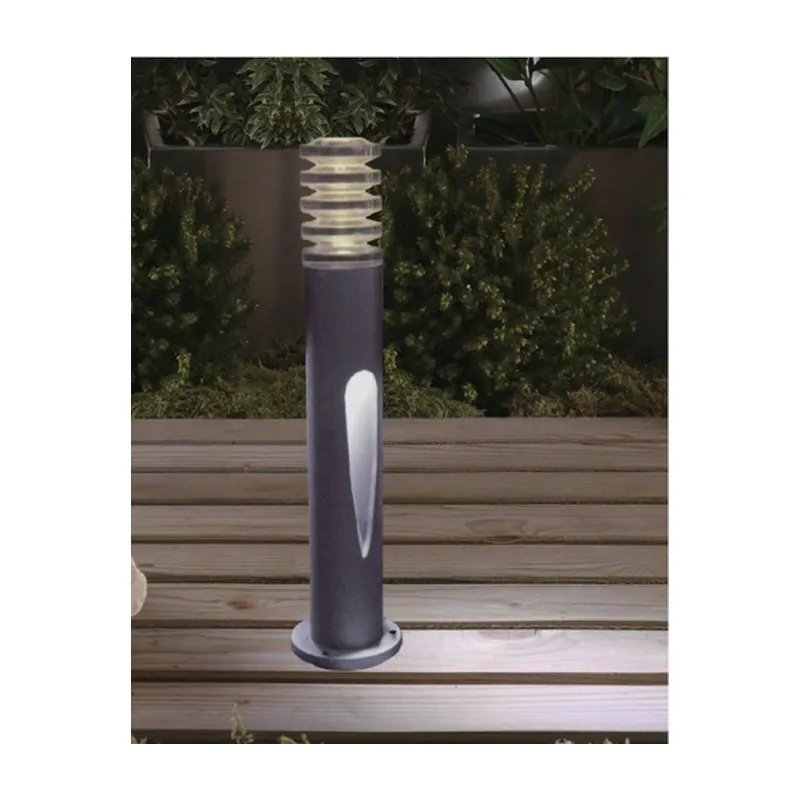
The BG-CP04509 is a mains bollard and lawn light:
| Spec | Value |
|---|---|
| Power | 3 / 6 / 9 / 18 / 20 / 24 / 30 W |
| Height | 0.6 m standard, custom on request |
| Input | AC 100–240 V, 47/63 Hz, PF > 0.9 |
| Efficacy | 90 lm/W |
| Colour temperature | 3000–6000 K |
| Protection | IP65 |
| Material | Stainless steel or aluminium |
At 9 W it gives about 810 lumens, enough for residential and campus paths; the 18–30 W versions suit wider walkways and building approaches. We do not list a 12 V version of this model; if a project needs low voltage, ask and we will tell you what we can supply.
Spacing
Spacing depends on the light distribution and height of the bollard, not the voltage. As a starting point for 0.6–1 m bollards on paths, 3–5 m apart gives overlapping pools of light; wider spacing creates dark gaps between them. Our bollard lights guide covers spacing by height and distribution.
Installation points
- 12 V: keep the transformer close to the first bollard, use landscape cable rated for burial, and make waterproof connections; our landscape lighting wiring guide shows methods.
- Mains: an electrician runs the circuit with RCD protection at the burial depth or duct the local rules require. Our bollard light installation guide covers foundations and cable entry.
- Both: set the base plate level on a firm footing, seal cable entries, and fit a photocell or timer so lights are not left on in daylight.
Glare and light spill
Bollards sit at eye level for children and close to eye level for adults when seated. Choose models with louvres or a downward distribution, use 3000 K for gardens, and avoid very high wattages on narrow paths. More light is not always better at this height.
Which to choose
- Short garden path, DIY installation: 12 V low voltage.
- Paths over about 30 m, commercial sites, public spaces: mains.
- No power at all on site: solar bollards; see solar bollard spacing.
What to send us
The path length, layout, preferred height and colour temperature, and the supply available. We will propose the wattage and spacing and check the cable sizing for your run.
Sources
Frequently asked questions
What is a low voltage bollard light?
A bollard light that runs on a safety extra-low voltage, usually 12 V AC or DC, supplied by a transformer or driver near the house. The cable can be laid shallower and there is no shock risk at the fixture.
How many low voltage bollards can I put on one transformer?
Add up the bollard wattages and choose a transformer with at least 20–25 % spare capacity. Then check voltage drop along the run; on long runs the cable, not the transformer, is usually the limit.
Are 12 V bollards less bright than mains bollards?
Not inherently. Brightness depends on the LED power and efficacy. But low voltage bollards are often sold in lower wattages, and voltage drop at the end of a long run can make the last fixtures dimmer.
Do mains bollards need an electrician?
In most countries, yes. Mains outdoor circuits need suitable cable, burial depth, RCD protection and inspection under the local wiring rules.