Bollard Lights: What They Are Used to Light, How Bright and How Far Apart
What bollard lights are, what bollard luminaires are commonly used to light, a lux table for 3–18 W bollards, and spacing for paths, entrances and driveways.
Key points
- Bollards light what is close to the ground: footpaths, park walks, building entrances, steps, plazas and the edges of driveways and car parks.
- On a 2 m path, a 6 W bollard (540 lm) every 4.5 m gives about 14 lux average in our estimate; a 9 W at the same spacing about 22 lux.
- Spacing sets the look more than the level: 6–8 m marks the path edge, 4–5 m gives an even path, 2–3 m suits steps and entrances.
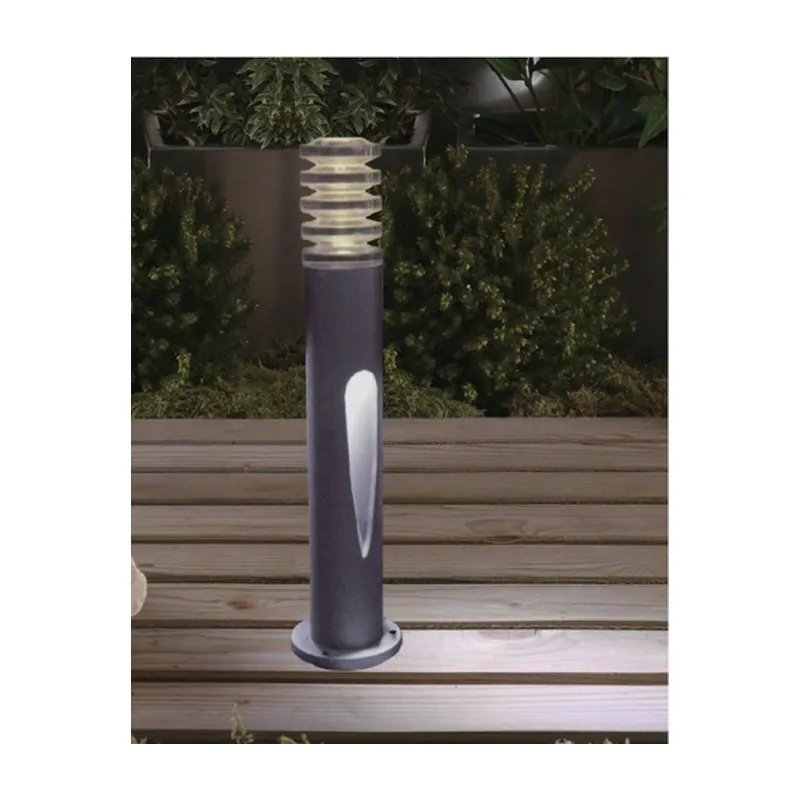
- Our BG-CP bollard is 0.6 m standard (custom heights), 3–30 W, IP65, in stainless steel or aluminium.
A bollard light is a short post, typically 0.5–1.2 m tall, with a light source at the top. It is one of the most common outdoor fittings in parks, residential estates, hotels, campuses and around commercial buildings. Because it sits at hip height, it lights the ground and the lower part of whatever is near it, without lighting the sky, windows or trees above. This guide covers what bollards are used for, how much light they actually put on a path, and how to space and specify them.
What are bollard lights?
Bollard lights are short, sturdy outdoor luminaires built as a post, with the light source and optic in the top part. Three supply types are common:
- Mains voltage (220–240 V or 120 V), fed by buried cable, for parks, estates and commercial sites.
- Low voltage (12 or 24 V) from a transformer, popular in home gardens because the cable is safer to handle and bury shallowly.
- Solar, with a small panel and battery in the head, where no cable can be run.
Heights run from about 0.5 m for garden bollards to 1.2 m for public spaces. Our bollard light installation guide covers foundations and wiring for each type.
What bollards are commonly used to light
- Footpaths and park walks. The classic use: a line of bollards along one or both sides of a path.
- Building entrances. A pair or a group of bollards frames the door and lights the approach.
- Steps and ramps. Close spacing shows each step edge.
- Plazas and courtyards. Bollards around the edge define the space without tall poles.
- Edges of driveways and car parks. They mark the kerb and the pedestrian route.
- Garden borders and lawns. Low-power bollards add gentle light to planting.
Bollards are not meant to light large open areas or roads; their light falls off quickly with distance. For those, use pole-mounted garden lights or street lights.
How much light a bollard puts on a path
We estimated the average illuminance on a 2 m wide path with the lumen method: lumens × utilisation factor × maintenance factor, divided by the area each bollard serves. We used our BG-CP bollard at 90 lm/W, an assumed utilisation factor of 0.3 (the share of the light that lands on the path from a 0.6 m bollard; the rest falls on the verges or goes upward) and a maintenance factor of 0.8:
| Bollard | Lumens | Every 3 m | Every 4.5 m | Every 7 m |
|---|---|---|---|---|
| 3 W | 270 lm | 11 lux | 7 lux | 5 lux |
| 6 W | 540 lm | 22 lux | 14 lux | 9 lux |
| 9 W | 810 lm | 32 lux | 22 lux | 14 lux |
| 18 W | 1,620 lm | 65 lux | 43 lux | 28 lux |
These are averages. The ground right beside each bollard is much brighter than the midpoint between two, so wide spacing gives a “pools of light” look even when the average is acceptable. For reference, EN 13201 P classes for pedestrian areas run from about 2 lux (P6) to 15 lux (P1) average. A 6 W bollard every 4.5 m sits near the top of that range, which suits busy park paths and estates; a 3 W bollard every 7 m suits quiet garden paths.
Spacing for the look you want
| Effect | Spacing (0.6 m bollard) | Power |
|---|---|---|
| Marking the edge of a path | 6–8 m | 3–6 W |
| Even light along a path | 4–5 m | 6–9 W |
| Entrances and steps | 2–3 m | 9–18 W |
On paths wider than about 3 m, place bollards on both sides, staggered, so the light meets in the middle. On curves, reduce the spacing on the outside of the bend so the line reads clearly.
Driveway bollard lights
On a driveway, bollards mark the edges and light the walking route from the car to the door. Using the same method and assumptions as the table above (90 lm/W, utilisation factor 0.3, maintenance factor 0.8), for a 3 m wide driveway with bollards on one side:
| Bollard | Every 5 m | Every 7 m |
|---|---|---|
| 6 W (540 lm) | ≈ 8.6 lux | ≈ 6.2 lux |
| 9 W (810 lm) | ≈ 13 lux | ≈ 9.3 lux |
So 6–9 W bollards every 5–7 m give a driveway roughly the light of a quiet residential street. Put the first pair at the entrance from the road and one beside the door, and keep bollards about 0.5 m back from the edge so wheels do not clip them. For long rural drives, low poles or solar driveway lights need fewer fittings; for a single feature light at the house, see driveway lamp posts.
Light distribution: what the head does
Bollard heads differ in how they send out light:
- 360° heads light all around the post; good for plazas and open lawns.
- Asymmetric or half-shielded heads send light only towards the path, not into gardens, windows or water; good for estates and near houses.
- Louvred heads hide the light source behind horizontal slats, reducing glare for people walking towards them.
- Downlight heads send all light down, the most sky-friendly choice for dark-sky areas.
Glare is the most common complaint with bollards, because the light source is at eye level for children and close to it for seated people. Louvres or opal diffusers help.
Materials and protection
Bollards take knocks from mowers, bicycles and vehicles. The BG-CP is available in stainless steel or aluminium, IP65, with a 0.6 m standard height and custom heights on request, and 3–30 W. Points to check on any bollard:
- Body material and wall thickness, especially near car parks.
- IP rating: IP65 at least, because the base is close to wet ground and sprinklers.
- Base fixing: anchor bolts on a concrete base, with the cable entering from below.
- Cable and joints: use outdoor cable and sealed connectors; most bollard faults start at a wet joint in the base.
Our guide to landscape lighting wiring covers cable and joints for garden circuits.
Colour temperature
Warm white (3000 K) is standard for parks, gardens, hotels and residential areas. 4000 K suits campuses and commercial sites where it matches the street lighting. Avoid mixing colour temperatures along one path.
Bollards or low poles?
On long park paths, low poles of about 3 m with garden lanterns can be spaced about 10 m apart, against 4–5 m for bollards, so they need fewer fittings and less trenching per metre. Bollards win near buildings, where poles would block views, and where a low, human-scale light is wanted. Our guides to pathway lighting and low-profile pathway lights compare the two layouts.
Common mistakes
- Spacing too wide for the power. The path becomes a row of bright spots with dark gaps.
- Placing bollards on the inside of the path edge, where they get hit.
- Unshielded heads near windows of houses and hotel rooms.
- No drainage at the base, so water stands around the cable entry.
Ordering
Send the path layout with widths, the effect you want and the supply voltage. We will propose the bollard power and spacing, with the head type, finish and height, and the quantity for each path.
Sources
Frequently asked questions
What are bollard lights commonly used to light?
Footpaths and park walks, building entrances, steps and ramps, plazas, the edges of driveways and car parks, and garden borders. They light the ground and the lower part of people and objects, not the whole space.
How far apart should bollard lights be?
For 0.6 m bollards on a path, about 4–5 m for even light, 6–8 m to mark the edge, and 2–3 m at steps and entrances. Taller bollards of about 1 m can be spaced a little further apart.
How bright should bollard lights be?
Pedestrian paths in EN 13201 P classes range from about 2 to 15 lux average. In our estimate, a 6 W bollard every 4.5 m on a 2 m path gives about 14 lux, enough for most park paths and estates.
How far apart should driveway bollard lights be?
Along a 3 m driveway with bollards on one side, about every 5 m with 6–9 W bollards. In our estimate that gives about 9–13 lux average, enough to see the edge and anyone walking up the drive.
Are bollard lights enough for a car park?
Usually not on their own. They mark edges and walkways well, but the parking area itself needs pole-mounted lights. Use bollards along pedestrian routes and at entrances.