
Solar Driveway Lights: Markers, Post Lights and Pole Lights for Every Length of Drive
How to light a driveway with solar: in-ground markers, path and post lights for short drives, pole-mounted solar lights for long rural drives, spacing, brightness, snow and placement.
Key points
- Short drives under about 30 m can be marked with solar driveway markers or path lights and lit at the entrance with post lights.
- Long rural drives and private roads need pole-mounted solar lights, spaced about 20–30 m apart on 4–6 m poles.
- Markers guide the eye; they do not light the surface. To see potholes, pedestrians and animals, you need light from above.
- Place panels in full sun, clear of trees, and choose lights that survive vehicles, snow ploughs and frost.
A driveway is one of the most useful places for solar lighting. Drives are often long, run through lawns or fields, and would need long trenches for cables. Solar lights avoid all that. But a “driveway light” can mean anything from a tiny marker to a light on a 6 m pole, and choosing the wrong type is the most common mistake. This guide matches the light to the drive.
What do you need the light to do?
Mark the edges. At night, drivers need to see where the drive goes, especially on curves and next to ditches, ponds or lawns. Markers do this well.
Light the entrance. Visitors and deliveries need to find the turn-in from the road. Lights on gate piers or posts at the entrance do this.
Light the surface. To see potholes, pedestrians, children, bikes and animals, light must fall on the drive from above. Only taller lights do this.
Most drives need the first two. Long drives, shared private roads and rural yards need all three.
Short drives: markers, path lights and post lights
For drives up to about 30 m at a typical house:
- Solar driveway markers. Small flush or low lights along the edges every 2–4 m. Some are rated to be driven over; most are not.
- Solar path lights or low bollards along the edges, set back 30–50 cm from the drive so wheels and mowers miss them. See pathway lighting for spacing.
- Post or pier lights at the entrance, and a wall light by the garage or front door. See gate post lights and driveway lamp posts.
This gives a clear route and a welcoming entrance without lighting the whole surface.
Long drives and private roads: solar pole lights
For drives longer than about 30–50 m, farm tracks, shared lanes and private estate roads, garden lights are not enough. A row of small markers shows a dotted line, but the surface between them is dark. Here, small solar street lights on 4–6 m poles work best.
- Spacing: about 20–30 m on 4–6 m poles, depending on output and width
- Output: 1,500–4,000 lumens per light is usually enough for a single-lane drive
- Profile: bright in the evening and early morning, dim in the middle of the night with motion boost when a car or person approaches
- Battery: enough for two or more nights to cover cloudy spells
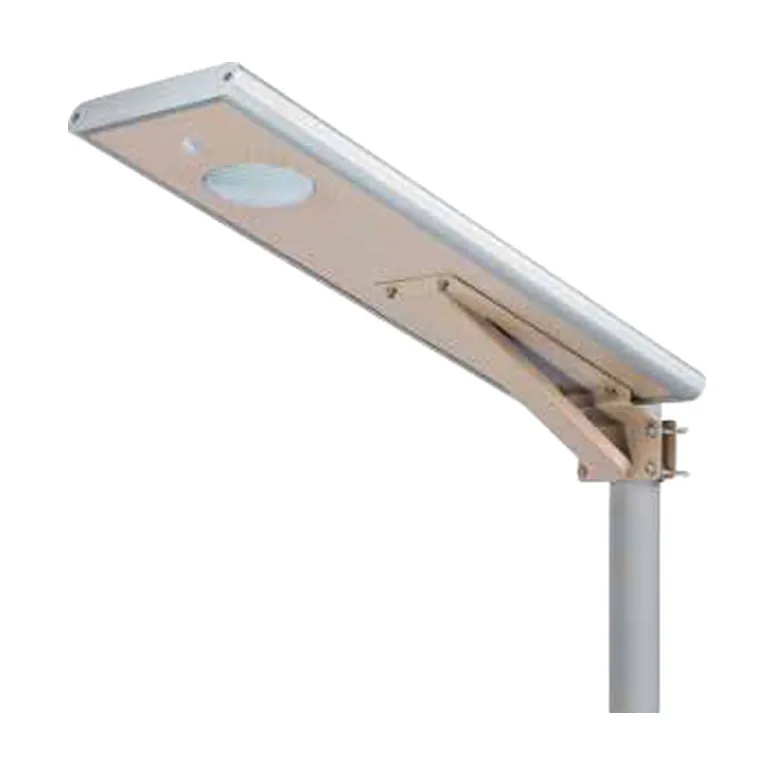
Our all-in-one solar street light is often used this way for rural homes, farms and estates. The residential solar street lights guide explains sizing, and the solar street light calculator checks a design for your location.
Placement for sun
A solar light is only as good as its panel’s sun. Drives often run under trees, which shade panels for much of the day.
- Check sun at mid-morning, noon and mid-afternoon
- In winter, the low sun is blocked more easily; check the darkest month
- Choose models with a separate panel where the light must be in shade
- Keep panels clear of tall grass, hedges and snow banks
Durability on drives
Drives are hard on lights. Look for:
- Impact resistance: markers and low lights get hit by tyres, mowers and snow ploughs
- IP65 or better: for rain, splash and snow melt
- Metal or thick UV-stable housings
- Solid foundations: concrete footings for pole lights; strong stakes or base plates for low lights
- Anti-theft fixings for pole-mounted lights at isolated drives
Brightness and colour
Warm white of 2700–3000 K suits homes and rural settings and disturbs wildlife less. Avoid very bright cool-white markers at eye level, which dazzle drivers. For pole lights, choose road optics that throw light along the drive rather than into windows or fields.
Spacing guide
| Light type | Typical spacing | Notes |
|---|---|---|
| Driveway markers | 2–4 m | Both edges or one edge on curves |
| Path lights / bollards | 3–5 m | Set back from the edge |
| Post lights | Entrance, junctions | Pairs at gates |
| Solar pole lights (4–6 m) | 20–30 m | Lights the surface |
On curves, reduce spacing so drivers can see the line of the drive ahead.
Combining types
A good scheme for a long rural drive often looks like this: a pair of lights on the gate piers to mark the entrance from the road, solar pole lights every 25 m or so along the drive, markers on sharp bends or beside water, and a wall light with a motion sensor at the house. Each type does its own job, and none has to be oversized.
Snow and winter
In snowy regions, markers are buried and ploughs damage low lights. Pole lights stay clear. Tilt panels more steeply to shed snow, and choose batteries and controllers that handle cold. Our guide to solar street lights in all weather covers this in more depth.
Installation tips
- Mark the drive edges and pole positions before buying
- Keep low lights back from the edge
- Use concrete footings for poles, sized for the local wind
- Aim pole lights along the drive, not into fields or neighbours’ windows
- Set the lighting profile so lights are bright when you usually arrive home
Maintenance
Clean panels a few times a year, more often near dusty farm tracks. Trim trees that grow over panels. Replace batteries in small markers every one to two years; lithium batteries in pole lights last much longer.
For estates, farms and resorts
We supply solar pole lights, garden lights and posts for private roads, estates, farms and resorts. Send us a plan of the drive or road with its length, width and any trees, and we will propose a layout with pole positions and light settings.
Sources
Frequently asked questions
Are solar driveway lights worth it?
Yes, for marking edges and lighting entrances without trenching. For long drives, small markers only show the route; pole-mounted solar lights are needed to light the surface.
How far apart should solar driveway lights be?
Markers and path lights are usually 2–4 m apart along the edges. Pole-mounted solar lights on long drives are usually 20–30 m apart, depending on pole height and output.
Can you drive over solar driveway lights?
Only models rated for vehicle loads. Flush in-ground solar markers rated for traffic exist, but most stake-type lights must be set back from the edge where wheels cannot reach them.