
Outdoor Solar Lights That Work in Winter: What to Look For and How to Size Them
Why many solar lights fail in winter and what makes the ones that keep working: panel size, battery chemistry and cold tolerance, sizing for the darkest month, snow, placement and dimming.
Key points
- In winter, solar lights get fewer sun hours but must run longer nights, so a light sized for summer runs short.
- Lights that work in winter have larger panels for their output, enough battery for two or more nights, and dimming.
- LiFePO4 batteries work in cold weather but cannot be charged below about 0 °C without heating or a low-temperature controller; NiMH tolerates cold charging better in small garden lights.
- Placement matters most: low winter sun is easily blocked by buildings, trees and fences.
Solar lights that shine brightly all summer often disappoint in December. They come on at dusk, fade by mid-evening and may not light at all after a few cloudy days. Some solar lights do keep working through winter. The difference is design and sizing, not luck.
Why winter is hard for solar lights
Winter combines three problems:
- Fewer sun hours. At mid-latitudes, peak sun hours in December can be a third or less of June’s.
- Lower sun angle. Panels get less energy per square metre, and low sun is easily blocked by buildings and trees.
- Longer nights. A light that runs dusk to dawn must work for 14–16 hours instead of 7–9.
So in winter a light collects less energy but needs more. A light that just balances in summer will run out in winter.
What makes a light work in winter
A panel sized for the worst month
The panel must collect enough energy on a short winter day to run the night. Good winter performers have panels that look oversized for their output. For street and area lights, designers size for the worst month using local sun data. Our solar street lights in all weather guide explains this approach.
Enough battery for long nights and cloudy spells
The battery should cover at least one long night plus reserve for cloudy days. For street lights, two to three days of autonomy is common in temperate climates; see how many rainy days a solar street light can run.
Dimming profiles
The most effective way to stretch winter energy is to dim. Many good lights run bright for the first hours after dusk, then dim to 20–50% in the quiet hours, with motion sensors bringing them back to full when someone passes. See solar street light motion sensors.
Batteries that handle the cold
- NiMH (in small garden lights) tolerates cold charging reasonably well but loses capacity in the cold
- LiFePO4 (in larger lights) has long life and good cold discharge, but should not be charged below about 0 °C unless the controller limits current or the pack is heated
- Lead-acid and gel handle cold charging but are heavy and wear out faster with deep cycling
Ask suppliers about the low-temperature charging protection in the controller. See LiFePO4 vs gel batteries.
A good charge controller
MPPT controllers harvest more energy from a panel in low light and cold than simple PWM controllers, which helps in winter. They also manage dimming and battery protection.
Placement for winter sun
In the northern hemisphere, the winter sun is low in the south; in the southern hemisphere, low in the north. Positions that are sunny in summer can be in shadow all winter.
- Check the site in winter, or use a sun-path app
- Place panels clear of buildings, evergreen trees and fences
- Tilt panels more steeply in winter-dominated climates, roughly latitude plus 10–15°; this also helps shed snow
- For garden lights in shade, choose models with a separate panel on a cable
Snow and ice
Snow on the panel stops charging completely. Steeper panels shed snow better. In snowy regions, brush panels clear after snowfall where practical, and choose lights whose panel sits above typical snow depth. Pole-mounted lights stay clear of drifts.
Garden lights vs street lights in winter
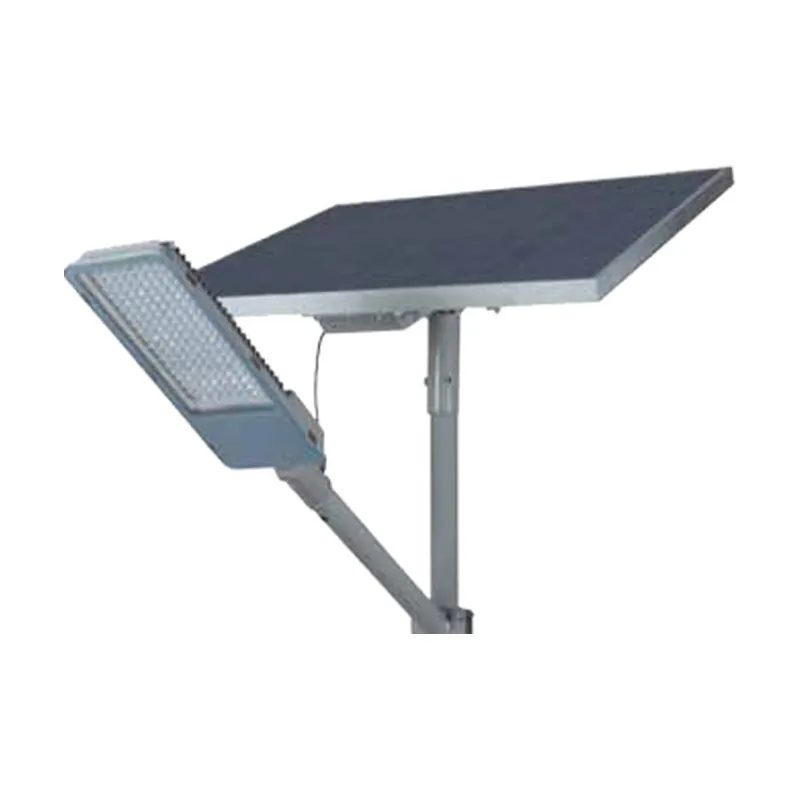
Small garden lights have tiny panels and cannot do much in winter. Expect a few hours of glow at best in December at high latitudes. Larger solar wall lights and post lights do better. For reliable light every winter night on a drive, yard or private road, a properly sized solar street light or a split system with a large separate panel is the realistic choice. Our split solar street light SL4830G is designed for climates where a larger panel is needed.
Example: sizing for a northern winter
Suppose a path light needs 20 W for 4 hours and 6 W for the rest of a 15-hour winter night: 80 + 66 = 146 Wh per night. With 1.5 peak sun hours in December and system losses of about 25%, the panel must be about 146 ÷ (1.5 × 0.75) ≈ 130 W. For two nights of autonomy, the battery needs about 300 Wh usable. In summer the same light would need far less. Our solar street light calculator does this sum for your location.
Maintenance before winter
- Clean panels in autumn; leaves and dust cut output
- Replace tired batteries in garden lights before winter
- Check that panels are not now shaded by grown trees
- Check the controller settings and dimming profile
When to choose hybrid or grid power
In the far north, or in deep shade, solar may not be practical for all-night light in midwinter. Options include hybrid systems, lights that run part-night in winter, or mains-powered lights. A good supplier will tell you honestly when solar is not the best fit.
Our approach
We size solar street and area lights for the worst month at your site, not for an average day. Send us your location, the hours of light needed and the area to be lit, and we will propose panel, battery and dimming settings that keep the lights on through winter.
Sources
Frequently asked questions
Do outdoor solar lights work in winter?
Yes, if they are sized for winter. They need larger panels relative to their output, enough battery for long nights and cloudy days, and a sunny position. Lights designed only for summer often fade early in the evening in winter.
Why do my solar lights not work in winter?
Short days, a low sun angle, shading, snow on the panel and cold batteries all cut the energy collected, while nights are longer. The battery may also be worn out after a season or two.
Do solar lights work in snow and freezing temperatures?
The LEDs work well in cold. Snow must be cleared from the panel. Batteries lose capacity in the cold, and lithium batteries need protection from charging below freezing. Lights with tilted panels shed snow more easily.