
All-in-One Solar Street Light Manufacturer: How to Choose One and What to Ask
How to choose an all-in-one solar street light manufacturer: real panel and battery ratings, LiFePO4 cells, controllers, test reports, samples, warranty terms and red flags.
Key points
- The biggest risk with all-in-one solar lights is overstated ratings: ask for real panel watts, battery watt-hours and LED power, not just marketing watts.
- Good manufacturers state cell type and grade, controller type, autonomy and lighting profile, and provide test reports for the exact model.
- Order samples, test them for several nights, and check that production matches the sample.
- Read warranty terms closely, especially for batteries, and confirm spare parts availability.
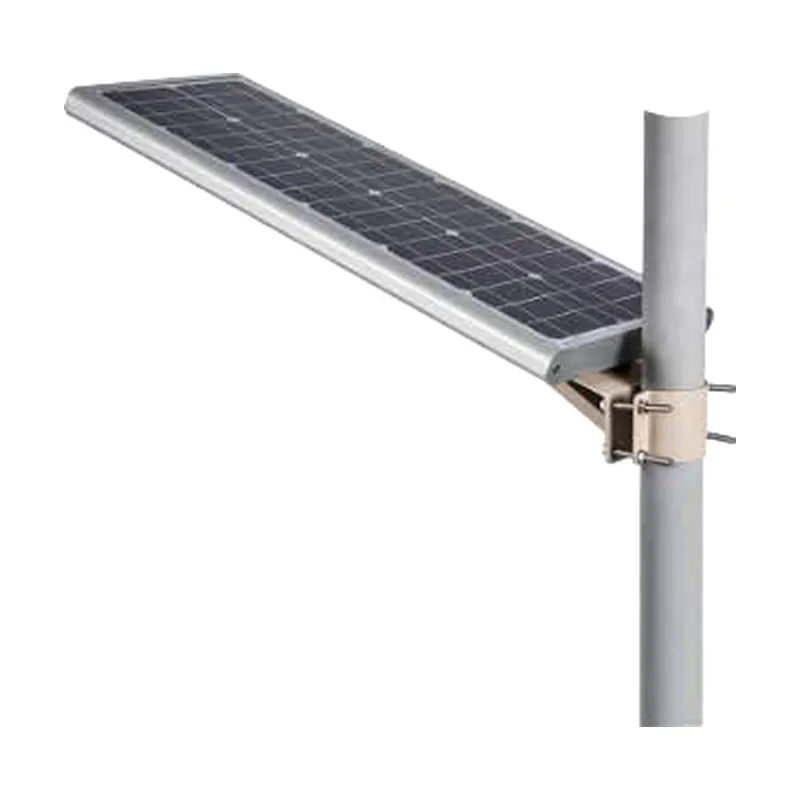
All-in-one solar street lights are sold by thousands of factories and traders. Prices for lights that look identical can differ by a factor of three or more. The difference is inside: panel size, battery capacity and quality, controller and LED drive. This guide explains how to tell a reliable manufacturer from one that relies on inflated labels.
The labelling problem
Many all-in-one lights are labelled with a “wattage” that has little to do with the actual LED power or the energy the panel and battery can supply. A light labelled “300 W” may contain a 30 W panel and a 100 Wh battery. It might run brightly for an hour, then dim for the rest of the night. Buyers who compare labels end up buying the most exaggerated product.
The fix is to ask for real numbers.
Questions to ask every manufacturer
- Panel: rated power in watts (Wp), cell type (mono PERC, TOPCon), dimensions
- Battery: chemistry (LiFePO4), capacity in Wh at nominal voltage, cell brand and grade, battery management system
- LED: real LED power at full output, LED brand, system lumens, optic type
- Controller: MPPT or PWM, lighting profile options, remote or app control, low-temperature charge protection
- Autonomy: how many nights at the stated profile without sun
- Protection: IP and IK ratings of the whole light, not just the LED module
- Testing: reports for the exact model: photometric, IP, battery, and ideally system autonomy
- Warranty: length and what it covers, especially battery capacity retention
A manufacturer that answers clearly and in writing is a good sign. One that only repeats the label wattage is not.
Checking the energy balance
You can check a light’s claims yourself:
- Daily panel energy ≈ panel Wp × local peak sun hours × about 0.75
- Nightly need ≈ LED power × hours at each level of the profile
- Battery autonomy ≈ usable battery Wh ÷ nightly need
If the light needs 200 Wh per night but the panel can only collect 100 Wh in your worst month, it will not work through the season, whatever the label says. Our solar street light calculator and battery autonomy calculator do these sums for your site.
Samples and testing
Before a larger order:
- Order two or three samples
- Weigh them; batteries and panels add weight that is hard to fake
- Measure panel dimensions and compare with rated power
- Run them on a site for several nights, including cloudy ones
- Record brightness at different times of night
- Open one sample if possible to check cells and wiring
Then check that production units match the samples.
Factory and documentation checks
- Business licence and manufacturing scope
- Quality management system certification
- In-house testing equipment for batteries, IP and photometrics
- Production records and batch traceability
- Clear product specifications and drawings
Visiting the factory, or using a third-party inspection service, is worth it for large orders. Our guide to choosing an LED street light manufacturer in China covers factory checks in more depth.
Price realism
Real panels and LiFePO4 batteries have real costs. A quotation far below the market for the stated panel watts and battery Wh almost always means the stated figures are not real. See solar street light price for what drives cost.
Warranty terms
Read the warranty carefully:
- Length for the whole light and for the battery
- Battery capacity retention guaranteed (for example, 70% after a stated period)
- Exclusions: installation errors, shading, extreme weather
- How claims are handled: replacement parts, shipping costs, time
- Availability of spare batteries and controllers
Red flags
- Only “label watts” quoted, no panel Wp or battery Wh
- Battery capacity given in mAh without voltage
- No cell type or brand
- Test reports for a different model
- Very low prices for very high “wattages”
- Pressure to order before samples are tested
Questions about after-sales support
A light that fails in year two is only a problem if you cannot get it fixed. Before ordering, ask how the manufacturer handles field failures: will they ship replacement batteries, controllers or complete lights, who pays freight, and how quickly? Ask whether batteries and controllers can be replaced on site without replacing the whole light, and whether spare parts will be available for at least the warranty period. For large projects, agree a small stock of spares, often 1–2% of the quantity, to be shipped with the order. Clear answers to these questions often say more about a manufacturer than its brochure.
Installation guidance
Good manufacturers supply installation instructions covering pole height, panel orientation and tilt, controller settings and commissioning checks. Poor installation, especially panels facing the wrong way or shaded by trees, causes many failures blamed on the product. Our installation guide covers the main steps.
When all-in-one is the right choice
All-in-one lights suit residential roads, paths, car parks and village roads in sunny climates, on poles up to about 6–8 m. For higher poles, higher output or cloudy climates, split systems with larger separate panels are often better. See all-in-one vs split solar street lights.
About our all-in-one lights
We manufacture the SL series all-in-one solar street lights Ask us for the panel watts, battery watt-hours, cell type and LED power of any model and we will state them in writing, so you can check the energy balance yourself. Send us your site location, pole height, road width and the hours of light you need, and we will propose a model with the numbers behind it.
Sources
Frequently asked questions
How do I choose an all-in-one solar street light manufacturer?
Ask for real panel watts, battery watt-hours and cell type, LED power and lumens, controller type and lighting profile, test reports for the exact model, and a written warranty. Order samples and test them before placing a larger order.
Why are some all-in-one solar street lights so cheap?
Usually because the panel and battery are much smaller than the advertised wattage suggests, cells are low grade or recycled, and the controller is basic. The light may be bright for a short time and then dim, or fail within a year or two.
What should be in a solar street light test report?
Photometric data (lumens and distribution), panel power, battery capacity and cell type, ingress protection test, and ideally a full-system autonomy test under a defined lighting profile.