
Solar Street Light Price: What You Are Actually Paying For
Why solar street light prices range from under US$50 to over US$1,000: battery, panel, LED head, controller and pole costs, how battery size drives the price, and how to compare quotations fairly.
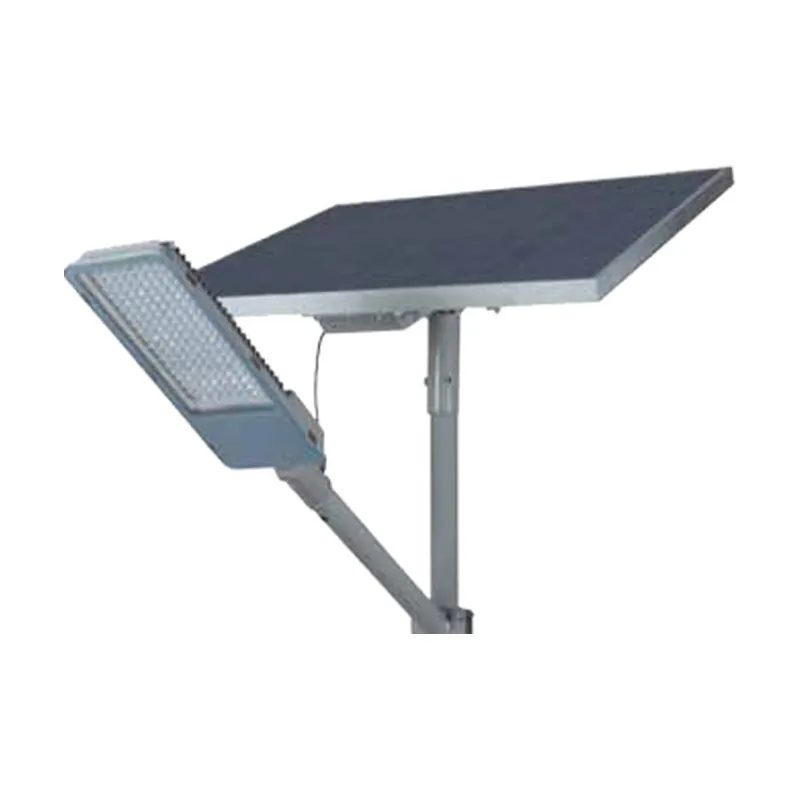
Key points
- The battery is usually the largest single cost in a solar street light, and its size depends on the night's energy and the nights of autonomy.
- At late-October 2026 market prices, the LiFePO4 cells for a 40 W light with 3 nights of autonomy cost about RMB 430; the 100 Wp panel about US$12.
- A cheap light is cheap because it has a small battery and panel, not because it is efficient. Compare watt-hours and peak watts, not the wattage on the label.
- Poles, foundations, shipping and installation can cost as much as the light itself on a project.
Ask for a solar street light price and you will get answers from US$30 to well over US$1,000. Both can be honest. The two lights simply contain very different amounts of battery and panel. This guide breaks the price into its parts, so you can see what a quotation includes and compare suppliers on the same basis.
The parts of a solar street light
| Part | What drives its cost | Share of the light’s price |
|---|---|---|
| Battery (LiFePO4) | Watt-hours of storage, cell grade, BMS | Usually the largest |
| Solar panel | Peak watts, cell type, frame and glass | Medium |
| LED head | Real wattage, LED and driver quality, optics, housing | Medium |
| Controller | MPPT or PWM, dimming profiles, remote functions | Small |
| Bracket and fixings | Material, adjustability, anti-theft parts | Small |
| Pole and foundation | Height, wall thickness, galvanising, wind design | Often as much as the light |
The first two follow directly from the design: how much energy the light uses each night, and how many nights it must last without sun.
How the battery sets the price
Take a 40 W light running at full power for 5 hours after dusk and 30% for the next 7 hours. Our solar street light calculator gives about 316 Wh a night. With 3 nights of autonomy and LiFePO4 used to 90%, the battery needs about 1,050 Wh (82 Ah at 12.8 V).
At InfoLink’s 28 October 2026 average of RMB 0.413/Wh for 100 Ah-class LFP cells, the cells for that battery cost about RMB 430. That is the raw cells only, before the BMS, case, wiring, testing and margin.
| Light | Nights of autonomy | Battery needed | Cells at RMB 0.413/Wh |
|---|---|---|---|
| 20 W | 2 | 351 Wh | about RMB 145 |
| 20 W | 3 | 526 Wh | about RMB 217 |
| 40 W | 3 | 1,052 Wh | about RMB 434 |
| 40 W | 4 | 1,402 Wh | about RMB 579 |
| 60 W | 3 | 1,578 Wh | about RMB 652 |
| 60 W | 4 | 2,104 Wh | about RMB 869 |
(Same schedule throughout: 5 hours at 100%, 7 hours at 30%, 4.5 peak sun hours.)
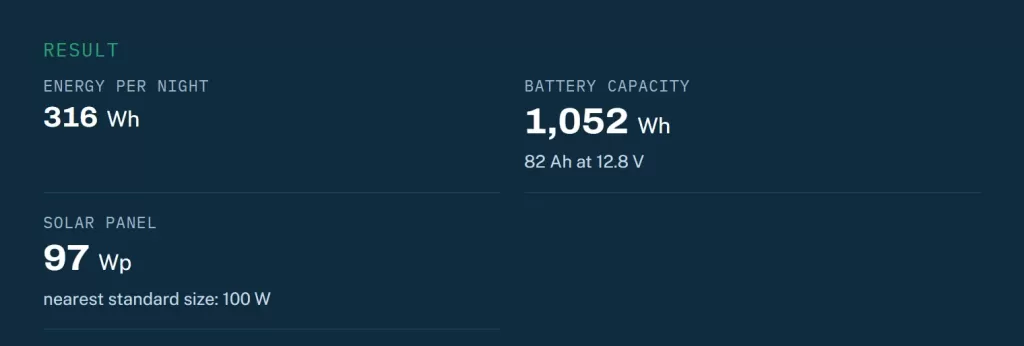
Open the example and change the wattage or nights to see the battery change.
Two things follow. The battery cost scales with the night’s energy, so a light that runs at full power all night needs twice the battery of one that dims after midnight. And every extra night of autonomy adds a third to the battery of a 3-night design. That is why the rainy-day requirement in a tender moves the price so much; see how many rainy days a solar street light should cover.
The panel is cheaper than you might think
InfoLink’s average for China-made TOPCon modules was US$0.115/W FOB in the week to 28 October 2026. At that rate, the 100 Wp panel for the 40 W example costs about US$12 as module capacity. Small street light panels cost more per watt than large utility modules, because of the frame, the cutting and the smaller volumes, but the panel is still rarely the biggest cost.
This is why cutting the panel to save money is a poor trade. An undersized panel saves a few dollars and leaves a battery that never refills in the rainy season.
Why cheap lights are cheap
Many low-cost solar street lights are sold with large wattage labels and very small energy stores. A light labelled 300 W with a 6 W panel and a 3.2 V 4,000 mAh battery holds about 13 Wh. That would run a true 300 W light for less than 3 minutes. Its real average power through the night is under 1.5 W.
Such lights can be useful for a garden path. They are not a cheaper way to light a road. Our solar street light technical specification template lists the numbers to ask for, so a datasheet can be checked in a few minutes.
What else is in a project price
The light is only part of the cost of a lit road:
- Pole: height, wall thickness and hot-dip galvanising; a 6–8 m galvanised steel pole for a split system is a major item
- Foundation: concrete, anchor bolts and labour, set by the soil and the wind speed
- Shipping: poles take far more container space than lights
- Installation: crane or lift time, wiring, commissioning
- Spares: a few heads, controllers and batteries for maintenance
When comparing quotations, check whether the price is for the light only, the light with bracket, or a complete pole set, and whether it is EXW, FOB or CIF.
How to compare quotations fairly
- Write down the battery in Wh, not just Ah: Ah × voltage. A 12.8 V 100 Ah battery holds 1,280 Wh; a 3.2 V 100 Ah battery holds 320 Wh.
- Write down the panel in Wp, and its size. A real 100 Wp panel is about 0.5 m².
- Ask for the night’s energy and autonomy the supplier designed for, at your site’s worst month. If two quotes assume different sun hours, they are not comparable.
- Check the controller and dimming profile. MPPT gives roughly 20% more usable energy than PWM, which means a smaller panel for the same light.
- Check the warranty, especially on the battery, and what counts as a failure.
- Compare on cost per lit kilometre or per year of service, not per light.
If a quotation is much cheaper than the others, the battery is the first place to look.
Getting a price for your project
Send us the site location, road width, pole height, number of lights and burning hours. We size the battery and panel for your worst month, then quote the split or all-in-one light with the pole if you need it, and state the Wh, Wp and design assumptions in the quotation so you can compare it with any other offer.
Sources
Frequently asked questions
How much does a solar street light cost?
Prices range from under US$50 for small residential lights to over US$1,000 for a complete commercial light with a large battery, pole and foundation. The difference comes mostly from the battery and panel size, the quality of the cells, and whether the pole is included.
Why are some solar street lights so cheap?
Because they have small batteries and panels. A light sold as 300 W with a 6 W panel and a 13 Wh battery can only run a few watts on average. It is a cheap light, not a cheap version of a 300 W light.
What is the most expensive part of a solar street light?
Usually the battery. For a 40 W light with 3 nights of autonomy, the LiFePO4 cells alone hold about 1,050 Wh. The pole and foundation can cost even more on a project, but they are often quoted separately.
Are solar street lights cheaper than grid street lights?
Often, once trenching, cabling, a grid connection and electricity bills are counted. Our solar vs grid cost calculator compares both for your project.