
Semi-Integrated vs All-in-One vs Split Solar Street Lights: Which Design Fits Your Road?
What a semi-integrated solar street light is, how it differs from all-in-one and split systems, what panel and battery each can carry, and which suits paths, village roads and main roads.
Key points
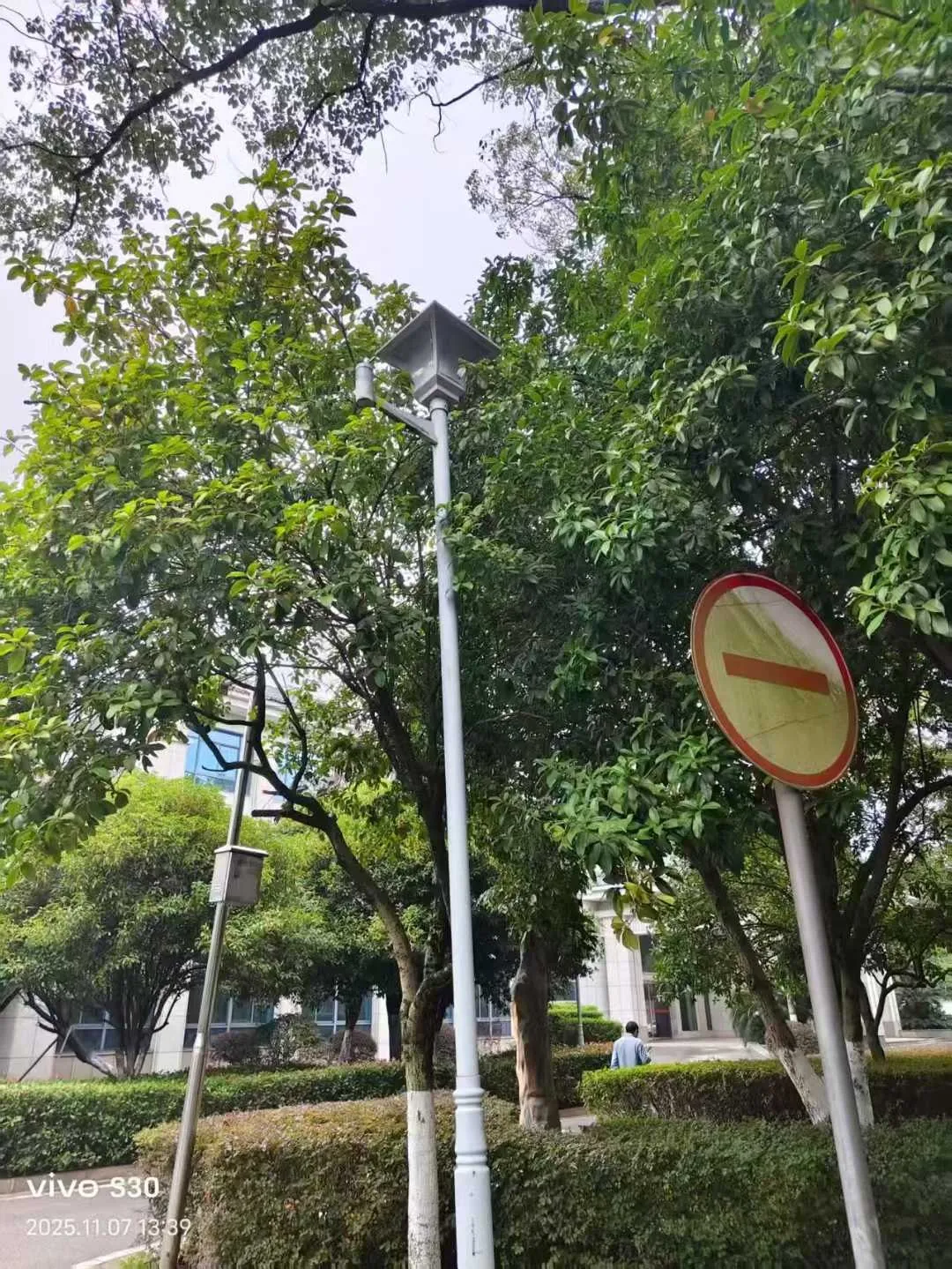
- All-in-one: panel, battery, controller and LED in one housing. Semi-integrated: battery and controller in the lamp, panel separate. Split: all three separate.
- The design decides how big the panel and battery can be, and that decides how bright the light can be all night.
- A 40 W light running 5 h at full power and 6 h at 30% needs about a 105 Wp panel and 79 Ah battery at 4 sun hours; a 60 W light needs about 157 Wp and 118 Ah.
- Check what a light can do all night, not its peak wattage: a '60 W' all-in-one with a 75 Wp panel can only run about 3 hours at full power a night.
Solar street light offers come in three physical designs, and the names vary from supplier to supplier: “all-in-one”, “integrated”, “semi-integrated”, “two-in-one”, “split”, “separate type”. Behind the names there is one simple question: where do the panel and the battery go? The answer limits how big each can be, which in turn limits how bright the light can be through the night and through a rainy week.
The three designs
| All-in-one (integrated) | Semi-integrated | Split | |
|---|---|---|---|
| Panel | On top of the lamp housing | Separate, on its own bracket on the pole | Separate, on its own bracket on the pole |
| Battery | In the lamp housing | In the lamp housing | In a box on the pole, in the pole or buried |
| Controller | In the lamp housing | In the lamp housing | With the battery or in the lamp |
| Panel size | Limited by the housing | Free | Free |
| Panel tilt | Fixed by the housing angle | Adjustable | Adjustable |
| Battery size | Limited by the housing | Limited by the housing | Free |
| Wiring on site | None | Panel cable only | Panel, battery and lamp cables |
All-in-one lights are the simplest: one box, mounted on a bracket, working the same evening. Split systems are the most flexible: each part can be sized for the site. Semi-integrated lights sit in between: the panel can be as large and as steeply tilted as the site needs, while the battery and controller stay in the lamp head, high above flood level and out of easy reach of thieves.
Why the design limits the light
A solar street light has to collect, every day, the energy it uses every night. Using our solar street light calculator with a common schedule (100% for 5 hours after dusk, then 30% for 6 hours), a LiFePO4 battery, an MPPT controller, 3 nights of autonomy and 4 worst-month sun hours:
| LED power | Energy per night | Battery (3 nights) | Panel needed | Standard panel |
|---|---|---|---|---|
| 30 W | 227 Wh | 756 Wh (59 Ah) | 79 Wp | 80 W |
| 40 W | 302 Wh | 1,007 Wh (79 Ah) | 105 Wp | 120 W |
| 60 W | 453 Wh | 1,511 Wh (118 Ah) | 157 Wp | 180 W |
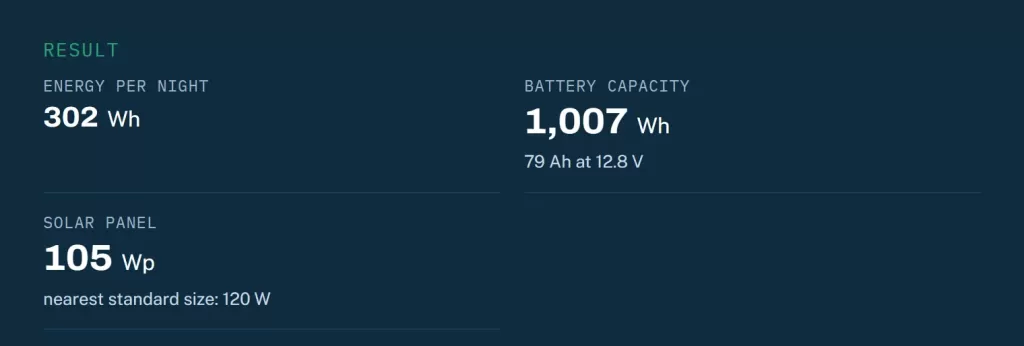
Open this example and change the wattage, schedule and sun hours for your site.
Now compare those needs with what fits in each design.
All-in-one. The panel can be no larger than the top of the housing. Our own all-in-one series, for example, carries 20–75 Wp panels and 9–33 Ah batteries for its 15–60 W models. That comfortably covers a 15–30 W light on a sensible schedule. But a 75 Wp panel at 4 sun hours collects about 216 Wh a day, enough for about 3 hours at 60 W, or a longer night at a lower level. The “60 W” is the peak power, not what the light can sustain all night. That is normal for all-in-one designs, and fine for paths and side streets with motion dimming, but it is not a 60 W road light.
Semi-integrated. The panel is free, so a 120–180 Wp panel can be fitted and tilted correctly. The battery is limited by the lamp housing, often to around 1–1.5 kWh in larger heads, which suits 30–60 W lights with dimming after midnight.
Split. Both panel and battery are free. Our split solar street light pairs 20–60 W lamps with 60–180 Wp panels and 38–100 Ah batteries; larger systems are possible with a battery box or a buried enclosure. This is the design for main roads, long dark winters, monsoon climates and anything above about 60 W.
Tilt matters more than people expect
On an all-in-one light the panel angle is set by the bracket angle of the lamp, which is chosen to aim the light at the road. Near the equator a flat panel is fine. At higher latitudes, a panel tilted towards the equator at roughly the latitude collects noticeably more in winter, and that is exactly when the light is most likely to run short. Semi-integrated and split designs let the panel face the sun while the lamp faces the road. See how to install a solar street light for tilt angles by latitude.
Heat, theft and flooding
- Heat: an all-in-one battery sits in a housing directly under the hot panel. Good designs separate them with an air gap; ask how. A semi-integrated lamp head is shaded by the panel above it.
- Theft: batteries on the ground or in low boxes are the main target. All-in-one and semi-integrated lights keep the battery at the top of the pole.
- Flooding: a buried or low battery box on a split system must be above flood level, or in the pole.
- Wind: a larger separate panel adds wind load, so the pole and foundation must be designed for it. See our street light pole guide.
Which design for which road?
| Application | Typical power | Recommended design |
|---|---|---|
| Garden paths, parks, compounds | 10–30 W | All-in-one |
| Village roads, estate streets (with dimming) | 20–40 W | All-in-one or semi-integrated |
| Rural roads in cloudy climates | 30–60 W | Semi-integrated or split |
| Main roads, junctions, car parks | 40–100 W+ | Split |
| High latitudes, long winter nights | Any | Split, with a tilted panel and large battery |
How to compare offers
Whatever the name on the datasheet, ask every supplier for the same figures:
- Panel Wp and battery Wh (not only Ah, and with the voltage)
- The schedule the light was sized for, and the energy per night
- The sun hours assumed, which should be the worst month at your site
- Rainy days covered and recovery time, from a calculation such as our battery autonomy calculator
With those numbers, an all-in-one, a semi-integrated and a split offer can be compared on what matters: how much light the road gets, all night, all year. For a deeper comparison of the two main designs, see all-in-one vs split solar street lights.
Our range covers all-in-one lights from 15 W and split systems to 60 W and above. If your tender specifies a semi-integrated design, send it to us and we will tell you what we can supply against it, with the sizing calculation.
Sources
Frequently asked questions
What is a semi-integrated solar street light?
A design in which the LED, battery and controller share one lamp housing, while the solar panel is mounted separately on top of the pole on its own adjustable bracket. The panel can be larger and better tilted than on an all-in-one light, but the battery stays inside the lamp, away from the ground.
Which is better, all-in-one or semi-integrated solar street light?
For paths and short village streets with low wattages, all-in-one lights are simpler and cheaper to install. For brighter lights, cloudy climates or higher latitudes, a semi-integrated or split design allows a larger, correctly tilted panel, which is what keeps the light on through the rainy season.
What size battery does a 40 W solar street light need?
With 5 hours at 100% and 6 hours at 30% after midnight, about 1,000 Wh for 3 nights of autonomy: roughly 79 Ah at 12.8 V with a LiFePO4 battery. A schedule that runs at full power all night needs much more.