
How to Choose the Best LED High Bay Lights: 10 Specifications That Matter
What separates a good LED high bay from a cheap one: measured efficacy, beam angle, driver quality, surge protection, thermal design and rated ambient, IP rating, glare, dimming, photometric files and warranty, with a calculator example showing what efficacy is worth.
Key points
- Compare high bays on measured lumens and efficacy of the complete fixture, not on wattage or LED chip claims.
- In a 40 × 25 m hall at 9 m, 140 lm/W fixtures need 24 instead of 30 fixtures for the same light as 100 lm/W ones: about 20% less power.
- The driver and the thermal design decide how long a high bay lasts; ask for the driver brand and the rated ambient temperature.
- Ask for an IES or LDT file so the layout can be calculated, and a written warranty that covers the driver.
Search for LED high bay lights and you will find 150 W fixtures priced from US$20 to US$200. They look similar in photos, and the datasheets all promise “150 lm/W” and “50,000 hours”. The difference shows up later: in the light that actually reaches the floor, in the electricity bill, and in how many fixtures fail in the second summer. Here are the ten specifications that separate a good high bay from a cheap one, and how to check each.
1. Measured lumens and efficacy of the complete fixture
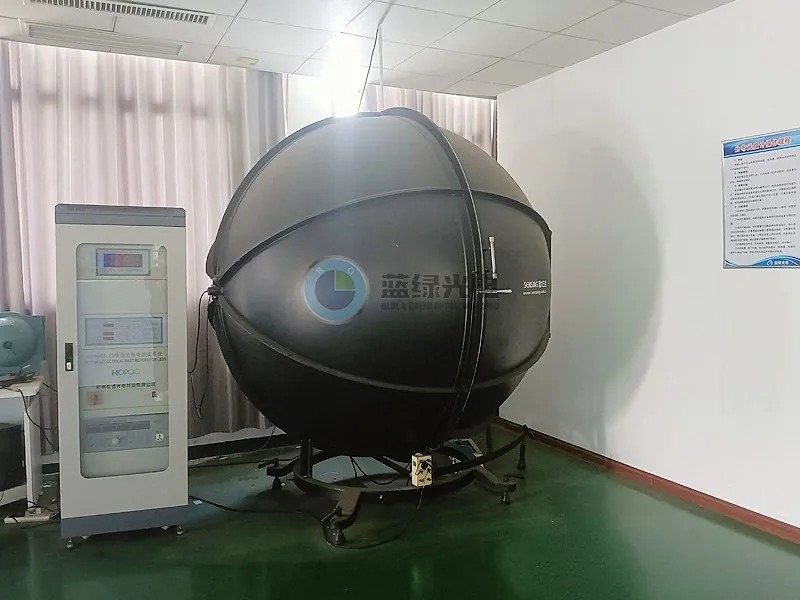
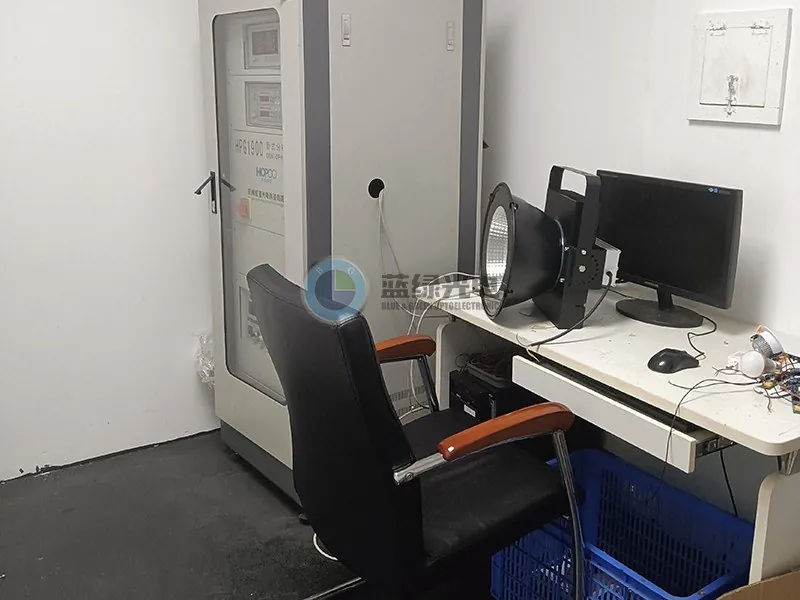
The number that matters is how many lumens the complete fixture emits, measured in an integrating sphere or goniophotometer, divided by the power it draws from the mains. LED chip ratings (often 160–200 lm/W) are higher, because they ignore losses in the driver, lens and reflector and are measured at 25 °C.
What efficacy is worth: take a 40 × 25 m hall with fixtures at 9 m and a 200 lx target, 150 W fixtures with 90° beams. In our high bay and warehouse lighting calculator:
| Fixture efficacy | Fixtures needed | Average light | Power density |
|---|---|---|---|
| 100 lm/W | 30 (6 × 5) | about 230 lx | 4.5 W/m² |
| 140 lm/W | 24 (6 × 4) | about 260 lx | 3.6 W/m² |
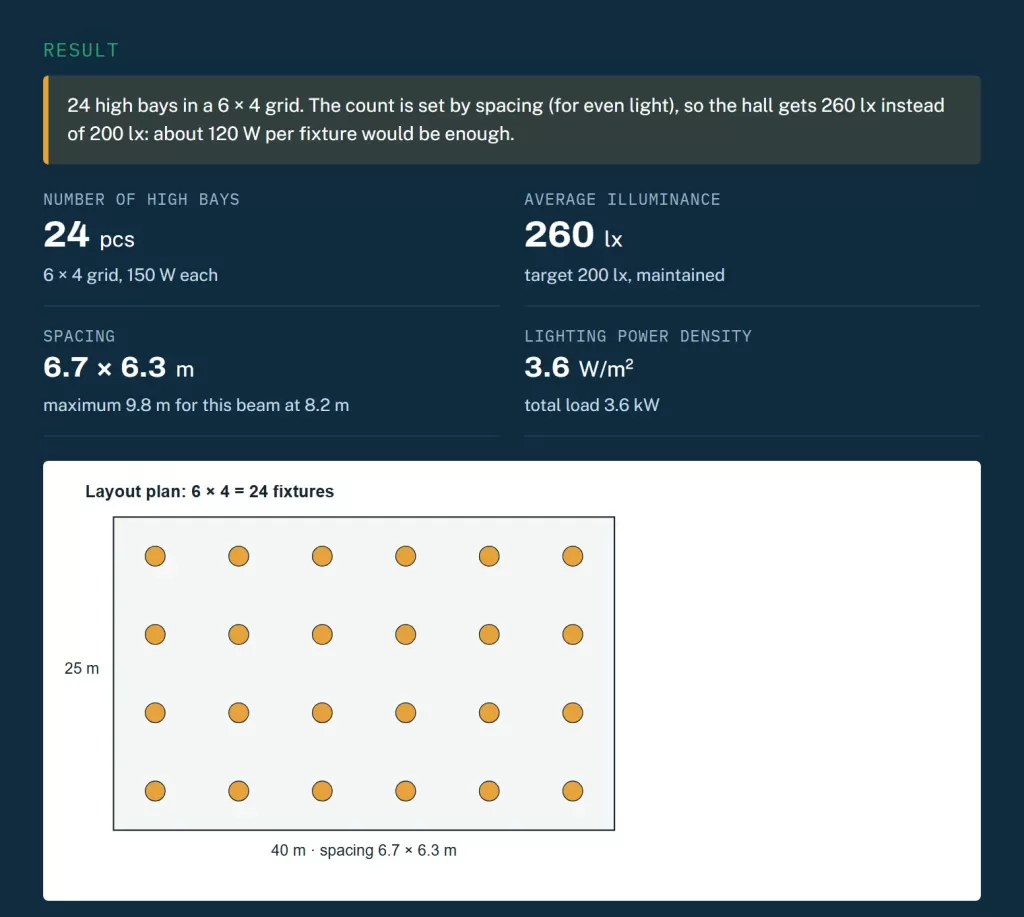
Open this example and change the efficacy to 100 lm/W to compare. Six fewer fixtures, and about 20% less power every hour the lights are on, for the life of the installation. Ask for the test report, not just the datasheet.
2. Beam angle matched to the height
| Mounting height | Typical beam |
|---|---|
| 4–7 m | 90°–120° (wide) |
| 7–12 m | 60°–90° |
| Above 12 m | 30°–60° (narrow) |
| Racking aisles | Aisle optics (long, narrow pattern) |
A wide beam from too high wastes light on the walls and the tops of racking; a narrow beam from too low leaves dark bands between fixtures. Good suppliers offer several reflector or lens options for the same fixture. See how many LED high bay lights do I need for the spacing rules by beam angle.
3. The driver
Most high bay failures are driver failures. Check:
- Brand and model of the driver, with its datasheet
- Power factor above 0.95 and THD below about 15–20%
- Low flicker, important for workers and for cameras
- Rated life at its case temperature (tc) in the fixture
- Dimming interface (1–10 V or DALI) if controls are planned
4. Surge protection
Industrial supplies carry spikes from motors, welders and lightning on long overhead lines. Look for surge protection of at least 4 kV for indoor fixtures, and 6–10 kV for fixtures near doors, in open-sided buildings or on long feeds. A separate surge protector in the fixture or the distribution board adds a second layer.
5. Thermal design and rated ambient temperature
LEDs and drivers age with heat. Two fixtures with the same LEDs can differ by years in lifetime because of their heat sinks. Check:
- Rated ambient temperature (ta): standard fixtures are often rated to 40–45 °C; hot roofs need more. See high-temperature LED high bay lights.
- Heat sink design: open fins, high-purity aluminium or copper heat pipes move heat away from the LEDs.
- Weight: a very light 200 W fixture usually means a small heat sink.
6. IP rating and materials
- IP20–IP44 is enough in dry, clean warehouses.
- IP65 for dusty, humid or washdown areas, and anywhere insects get into open fixtures.
- Tempered glass or PC cover to keep dust off the LEDs and reflector.
- Coated or stainless fixings in corrosive atmospheres.
7. Glare
Under ceilings below about 7 m, bright point sources cause glare. Check the unified glare rating (UGR) in the photometric calculation, and consider frosted covers, deeper reflectors or linear fixtures. See UFO vs linear high bay lights.
8. Photometric file
A reputable supplier provides an IES or LDT file for each model and optic. With it, the layout, uniformity and glare can be calculated before you buy. Without it, nobody can prove that the fixture lights your building as promised.
9. Mounting and weight
Hook, U-bracket, chain or surface mounting; a safety cable; and a weight the roof structure can carry. A fixture that installs quickly from a lift saves real money on large projects.
10. Warranty in writing
Three to five years is typical. Read what it covers: the driver, the LEDs, lumen maintenance, surge damage, and who pays for removal and reinstallation at height. A long warranty with exclusions for “power surges” and “high ambient” is worth less than it looks.
A quick comparison checklist
| Specification | Ask for |
|---|---|
| Lumens and efficacy | Test report for the complete fixture |
| Beam options | Reflector or lens angles available |
| Driver | Brand, model, PF, THD, flicker, dimming |
| Surge protection | kV rating |
| Thermal | Rated ambient (ta), heat-sink design, weight |
| Ingress | IP rating and cover material |
| Glare | UGR from a layout calculation |
| Photometry | IES or LDT file |
| Mounting | Options, weight, safety cable |
| Warranty | Written terms, what is covered |
Our LED high bay range runs from 30 W economy fixtures to 1500 W heat-pipe high bays, with 45°–120° reflectors and IP65–IP66 versions. Send us your floor plan and mounting height, and we will propose the fixture and layout, with the photometric file.
Sources
Frequently asked questions
What is the best LED high bay light?
The best one for your building is the fixture that delivers the needed light level evenly at your mounting height with the lowest power and the longest reliable life. In practice that means high measured efficacy (130–150 lm/W), a beam angle matched to the height, a quality driver with surge protection, a rated ambient temperature above your roof temperature, and a photometric file to prove the layout.
How many lumens should an LED high bay have?
Typically 13,000–20,000 lm for 100–150 W fixtures at 6–9 m, and 25,000–40,000 lm for 200–300 W fixtures above 10 m. The right number comes from the hall size, height and target lux; use a lumen-method calculation rather than a fixed rule.
Are UFO or linear high bays better?
UFO (round) high bays suit open halls at 6–15 m and one-for-one replacements; linear high bays suit lower ceilings, racking aisles and glare-sensitive work. See our UFO vs linear comparison for details.