
Top Rated Solar Path Lights: What the Best Ones Have in Common
What separates top rated solar path lights from cheap ones: panel size, battery type, lumens, IP rating, housing material, light spread and modes, with spacing and placement tips.
Key points
- Well-reviewed solar path lights share the same basics: a decent panel, a replaceable rechargeable battery, a sealed housing and light that spreads down onto the path.
- Look for 10–50 lumens per light for path marking, and a panel that gets five or more hours of direct sun.
- Stainless steel, aluminium or thick UV-stable plastic housings outlast thin plastic; IP65 or better keeps rain out.
- Space lights 1.5–2.5 m apart and stagger them along the path rather than pairing them.
Search for “top rated solar path lights” and you will find hundreds of models with thousands of reviews. Rather than repeat a list that will change next season, this guide explains what the well-reviewed lights have in common, so you can judge any model on the shelf or online.
What reviewers actually complain about
Read the low ratings on any popular path light and the same complaints come up:
- Dim after a few hours, or not lighting at all in winter
- Water inside the head after rain
- Dead after one season, with a battery that cannot be replaced
- Cracked or faded plastic after a summer
- Stakes that break when pushed into hard ground
- Light that glares sideways instead of lighting the path
The top-rated lights avoid these problems. Here is how.
1. A panel sized for the battery
A path light is a small solar system. Its panel must refill its battery every day. A light with a tiny panel will be bright for an hour on the first night and then dim. Look at the panel area, not the lumen claim. A panel of roughly 5 × 5 cm or larger for a 10–20 lumen light is reasonable; brighter lights need bigger panels. Monocrystalline panels work better in winter and low light than older amorphous ones.
2. A replaceable rechargeable battery
Batteries are the part that wears out. Good path lights use standard AA or AAA NiMH cells, or a small lithium (often LiFePO4) pack, and let you open the light to change them. Avoid lights with sealed-in batteries unless they come with a long warranty. Our guide to rechargeable batteries for solar lights explains capacities and which types to use.
3. Brightness that matches the job
- 5–15 lumens: marker lights that show where the path is, with a soft glow
- 15–50 lumens: enough to see the path surface in a typical garden
- 50–150 lumens: bright path lights for long drives, public paths and steps
More lumens need more energy, so very bright path lights either have large panels or run bright for fewer hours. Some top models have two modes: bright for the first hours of the evening and a low glow until dawn.
4. A sealed, durable housing
Rain gets into cheap lights through the switch, the seam between the panel and the head, and the battery cover. Top-rated lights have gaskets on every joint and are rated IP65 or better. Our IP65 vs IP66 vs IP67 guide explains what the numbers mean. Housings in stainless steel, die-cast aluminium or thick UV-stabilised plastic survive sun and frost far better than thin plastic, which yellows and cracks.
5. Light thrown down onto the path
The best path lights have a cap or reflector that throws light down and out onto the path, so you see the ground and not the bulb. Lights with clear glass or plastic globes look decorative but cause glare and light the sky. For a calm look, choose warm white of about 2700–3000 K; cool white of 5000 K and above looks harsh in gardens. See the colour temperature chart for examples.
6. Strong stakes and mounting options
Long, thick stakes, or a separate metal spike, hold up in hard soil. Some models can also be fixed to decks or walls with a base plate, which is useful where paths run along a fence or deck edge.
7. Automatic dusk-to-dawn switching
Every solar path light switches on at dusk using its panel as a light sensor. Better ones also have a switch to turn them off for storage or holidays, which protects the battery. Place lights away from porch lights and street lights, which can stop them switching on.
How to space and place path lights
- Space lights about 1.5–2.5 m apart, closer on curves and near steps
- Stagger lights on alternate sides of the path rather than lining them up in pairs
- Keep lights 15–30 cm back from the edge so they are not kicked or mowed
- Check that each panel gets direct sun; move lights out of the shade of shrubs
- Mark steps and changes of level with a light at the top and bottom
For a full layout guide, see pathway lighting.
Solar or low voltage for paths?
Solar path lights are quick to install and have no running cost, but they depend on sun and their brightness varies with the season. Low-voltage path lights run from a transformer and are steady every night, but need a cable along the path. For long or shaded paths, or where steady light matters, low-voltage landscape lighting is often the better choice. Many gardens use both.
For commercial and public paths
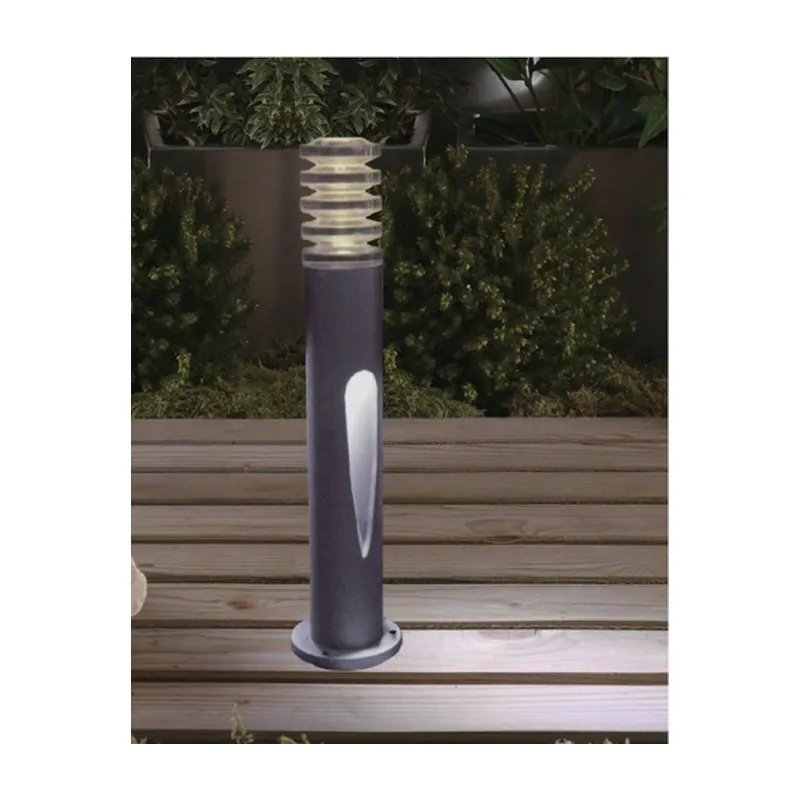
Parks, campuses, hotels and housing estates usually need more than garden path lights. Options include low bollards, lawn lights and small all-in-one solar street lights on 3–4 m poles. Our LED lawn light BG-CP is a mains-powered bollard for projects where steady output and long life matter more than avoiding cables.
Maintenance that keeps them rated highly
- Wipe the panels every few weeks; dust, pollen and bird droppings cut output
- Replace NiMH batteries every one to two years
- Check seals after the first winter
- Store cheap lights indoors in hard frost if the instructions say so
- Trim plants that grow over the panels during summer
Checklist before you buy
- Panel size reasonable for the stated brightness
- Replaceable battery of a standard type
- IP65 or better, with gaskets on joints
- Metal or thick UV-stable housing
- Downward light distribution, warm white
- On/off switch and solid stake
- Clear warranty from a seller that answers questions
Sourcing in volume
For distributors and contractors buying garden and path lights in volume, we supply lawn, bollard, garden and solar lights by project and can suggest specifications for your market. Send us the quantities, finish and power option you need, and we will reply with options.
Sources
Frequently asked questions
What are the best rated solar path lights?
The best-reviewed models are not one brand but share a pattern: a panel big enough for the battery, a replaceable NiMH or lithium battery, a sealed metal or thick plastic housing rated IP65 or better, and a head that throws light down onto the path rather than into the eyes.
How many lumens should solar path lights have?
About 10–50 lumens per light is enough to mark a path. Brighter path lights of 50–150 lumens light the path surface more clearly but need larger panels and batteries.
How long do solar path lights last?
Good ones last several years if the battery is replaced every one to two years for NiMH, or longer for lithium. Cheap ones often fail in one season because of water ingress or a battery that cannot be replaced.