
Wind or Solar Energy: Which Is Better for Off-Grid Lighting and Small Sites?
Wind vs solar energy compared for street lights, small off-grid sites and homes: resource, reliability, maintenance, cost, noise and when a wind-solar hybrid makes sense.
Key points
- For most small off-grid loads such as street lights, solar is simpler, cheaper and needs less maintenance than wind.
- Small wind turbines only pay off where average wind speeds are consistently high, typically above about 4–5 m/s at hub height.
- Wind and solar complement each other in places with windy winters and sunny summers, which is where hybrids make sense.
- Moving parts make wind turbines the higher-maintenance option; panels have none.
Wind and solar are the two most common ways to power lighting and small loads away from the grid. At large scale, both are major sources of electricity. At small scale, such as a street light, a remote sign, a farm building or a cabin, the answer to “which is better” depends on the site. This guide compares them honestly.
How they differ
Solar converts sunlight to electricity with panels. Output follows the daily and seasonal sun: predictable, but lower in winter and zero at night.
Wind converts moving air to electricity with a turbine. Output depends on wind speed, which varies a lot hour to hour and site to site, and can be strong at night and in winter.
Resource: the deciding factor
Solar resource is fairly predictable and reasonably good almost everywhere at low and mid latitudes. Sun data for any location is easy to obtain.
Wind resource varies enormously with local terrain. A turbine on an exposed coast may produce many times more than the same turbine in a sheltered valley or town. Power rises with the cube of wind speed, so a site with 6 m/s average produces roughly twice the energy of one with 4.8 m/s. Small turbines on short poles in built-up areas usually disappoint because buildings and trees slow and disturb the wind.
Comparison
| Factor | Solar | Small wind |
|---|---|---|
| Predictability | High (daily, seasonal pattern) | Low (weather-dependent) |
| Works at night | No (needs battery) | Yes, if windy |
| Winter output | Lower | Often higher |
| Moving parts | None | Rotor, bearings, yaw |
| Maintenance | Cleaning, checks | Inspections, bearings, blades |
| Noise | Silent | Some noise |
| Site assessment | Simple sun check | Needs wind data, height, exposure |
| Cost per kWh at small scale | Usually lower | Usually higher, except at very windy sites |
| Storm behaviour | Must withstand wind load | Must brake or furl in storms |
For street lights
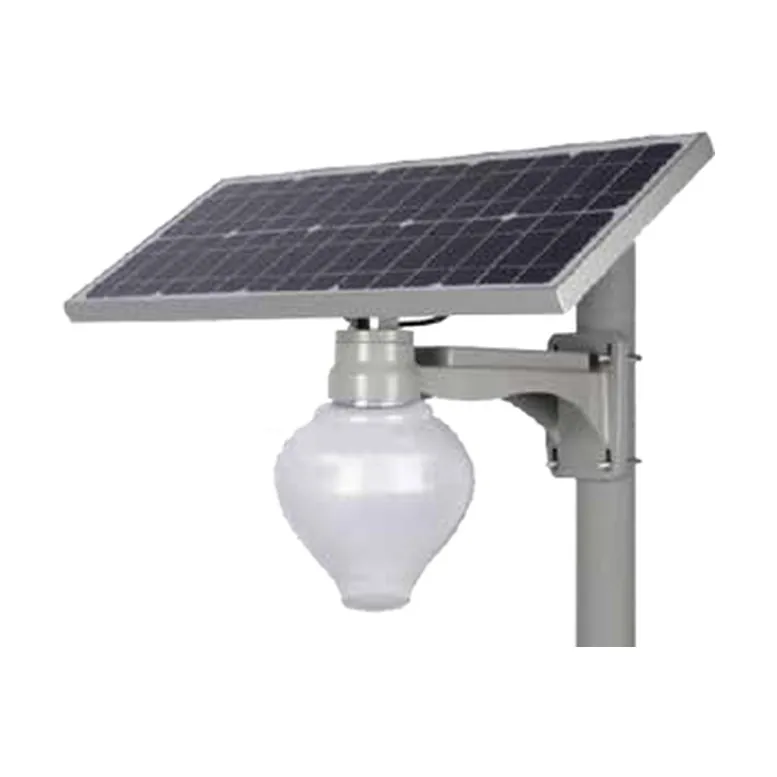
For street lights on roads, estates and villages, solar is the standard choice. Panels and LiFePO4 batteries are sized for the worst month, and the light needs no moving parts. Most of the world’s off-grid street lights are solar for this reason. See advantages and disadvantages of solar street lights.
Wind-solar hybrid street lights add a small turbine to the pole. They make sense where winter sun is weak but wind is reliable: coastal roads, islands, high-latitude sites and exposed highways. The turbine fills the gap when solar is low. Our wind-solar hybrid street lights guide explains sizing and maintenance.
For small off-grid buildings
For cabins, farm buildings and telecom sites, the same logic applies. Solar with batteries is the default; wind is added where the site is very windy, or where winter loads are high and winter sun is poor. Many remote systems use both, plus a generator for backup.
Cost and payback
At small scale, panel prices have fallen so far that solar usually gives cheaper energy per kWh than small wind, except at excellent wind sites. Wind turbines also need taller towers, which add cost and may need permits. Maintenance over 10–20 years adds to wind’s cost.
Reliability
Solar’s main risks are shading, dirt and battery ageing, all manageable. Wind’s risks include mechanical wear, storm damage and underperformance at sites without good data. For lighting where failure means dark roads, many buyers prefer the simpler technology.
Complementarity: the case for hybrids
In many climates, wind is stronger in winter and at night, while sun is stronger in summer and by day. Combining them smooths output across seasons, which can allow a smaller battery. The benefit is real only where both resources are good. A hybrid at a calm, sunny site just adds a turbine that rarely turns.
How to decide for your site
- Get solar data for the worst month at your location
- Get wind data at the intended hub height, ideally measured, or from reliable maps adjusted for terrain
- Estimate the energy each would give for your load
- Compare total costs including towers, batteries and maintenance
- Consider noise, planning rules and appearance
Our solar street light calculator sizes the solar side for your location and hours.
Common misconceptions
- “Wind works at night, so it is always better.” Only if the wind blows; calm nights are common.
- “Solar does not work in winter.” It works with less output; sizing for winter is the answer. See solar street lights in all weather.
- “Hybrids are always more reliable.” Only where both resources are good and the turbine is maintained.
Batteries tie both together
Whichever source charges it, an off-grid light depends on its battery. Wind and solar both produce energy at times other than when the light needs it, so the battery bridges the gap. Lithium iron phosphate batteries are now standard in off-grid lighting because they tolerate daily cycling and last many years. Sizing the battery for the longest expected period of low input, whether calm cloudy days for a hybrid or a run of dull winter days for solar, matters as much as choosing the source. Our battery autonomy calculator helps with that step.
Our recommendation
For most lighting projects we recommend solar, sized for the worst month. Where a site has poor winter sun and strong, steady wind, we supply wind-solar hybrid street lights through our partner factory. Send us your location and requirements, and we will tell you which suits it, with the reasons.
Sources
Frequently asked questions
Is wind or solar energy better?
For small off-grid loads like lights, solar is usually better: it is predictable, silent, has no moving parts and costs less per unit of energy at small scale. Wind can be better on very windy coasts, islands and high latitudes, often combined with solar.
When is a wind-solar hybrid worth it?
Where winter sun is poor but wind is strong and steady, such as exposed coasts, islands, mountain passes and high-latitude sites. The turbine fills the winter gap that solar leaves.
Do small wind turbines need maintenance?
Yes. Bearings, blades and yaw mechanisms wear and need inspection, and turbines may need to be stopped in storms. Solar panels only need cleaning and occasional checks.