
Solar Street Lights for Homes, Driveways and Private Roads
How to choose a solar street light for a house, driveway, farm road or small estate: pole height, real wattage, battery and panel size, spacing, neighbours and installation, with worked examples.
Key points
- For a driveway or private road, a real 15–30 W solar street light on a 4–6 m pole is usually enough; larger lights mostly add glare.
- A real 20 W light running 5 hours at full power and 7 hours at 30% needs about 526 Wh of battery for 3 nights and a 50 Wp panel.
- On a 4 m wide driveway with 6 m poles, lights about 20 m apart meet a residential lighting class.
- Shield the light from neighbours' windows, put the panel in full sun, and check the real panel watts and battery Wh before buying.
Solar street lights are not only for city roads. Many are bought for a single house, a long driveway, a farm track, a holiday home or a small gated estate, where running a cable would cost more than the light. Lighting a private road well is simple, but the residential market is full of lights whose labels promise far more than their batteries can deliver. This guide shows how to size one honestly.
How much light a private road needs
A driveway or estate road needs enough light to see the edges, people and obstacles, not the light level of a highway. In European terms, that is a pedestrian or residential class such as P4 (about 5 lux average) to P2 (about 10 lux).
Take a 4 m wide driveway with 6 m poles. Our pole height and spacing calculator shows that about 10 W of real LED output is already enough for P4 at 21 m spacing, and a 20 W light gives about 10 lux on average. So the useful range for homes is about 15–30 W of real power. Anything larger mostly adds glare and battery cost.
Sizing the battery and panel
Most households want the light bright in the evening and dimmed later: 5 hours at full power, then 30% for 7 hours. At a site with 4.5 peak sun hours in the worst month and 3 nights of autonomy, our solar street light calculator gives:
| Real LED power | Energy per night | Battery (3 nights) | Panel |
|---|---|---|---|
| 15 W | about 118 Wh | about 394 Wh (31 Ah at 12.8 V) | 40 Wp |
| 20 W | about 158 Wh | about 526 Wh (41 Ah) | 50 Wp |
| 30 W | about 237 Wh | about 789 Wh (62 Ah) | 80 Wp |
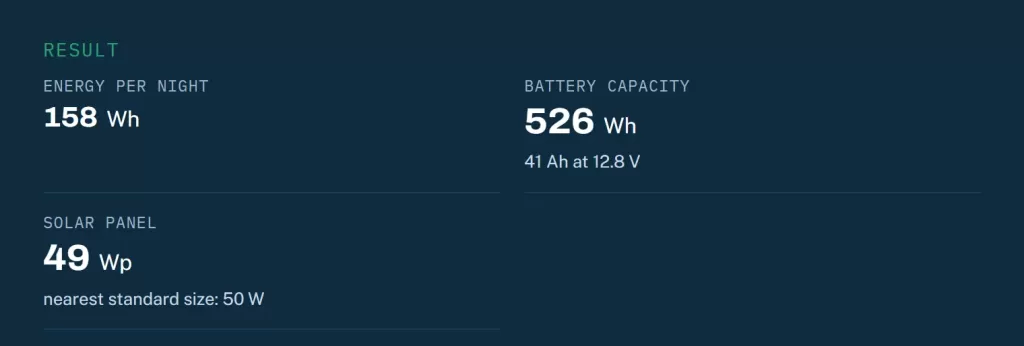
Open the example and enter your own site and schedule.
In cloudy climates or high latitudes, check your worst month first; see how many rainy days a solar street light should cover.
The label trap
Residential solar lights are often sold as “300 W” or “1000 W”. Check two numbers on the datasheet:
- Battery in Wh = voltage × Ah. A 3.2 V 10,000 mAh battery holds 32 Wh: enough for a true 3 W light all night, not 300 W.
- Panel in Wp. A real 50 Wp panel is about 0.25 m², roughly 55 × 45 cm. A “500 W” light with a panel the size of a book is not 500 W.
A light with about 500 Wh of battery and a 50 Wp panel will light a driveway reliably. A light with 30 Wh and a 6 W panel will light a garden path for a few hours. Both have their place, but they are not the same product, whatever the label says.
Example: a 200 m farm road
A farm house sits 200 m from the public road along a 3.5 m gravel track. The owner wants to see the track and the gate at night, not light it like a street.
- Poles: 6 m, on one side of the track
- Spacing: about 21 m for even light, so 10 lights; at 30 m spacing for orientation only, 7 lights
- Light: a real 20 W, 3000K, road optic, motion sensing at 20% when nobody is on the track
- Solar: about 50 Wp and 500 Wh per light at 4.5 peak sun hours
- Gate: a slightly brighter light, or a second head, where people stop to open it
Running a mains cable 200 m with a trench would often cost more than the ten solar lights.
All-in-one or split?
| All-in-one | Split | |
|---|---|---|
| Installation | One unit on the pole bracket | Panel, battery box and lamp on the pole |
| Panel angle | Fixed by the lamp’s direction | Can face the sun, whatever the road direction |
| Battery position | Inside the housing, high up | In a box on the pole or in the pole |
| Suits | Most driveways and estates | Shaded sites, high latitudes, larger lights |
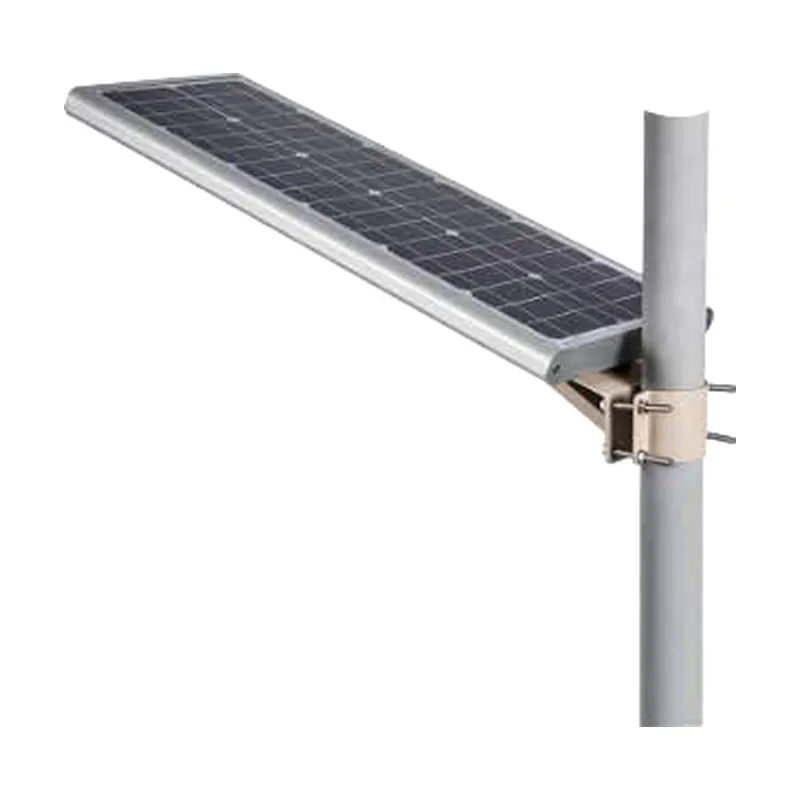
For most homes, an all-in-one light is the simpler choice. If the driveway runs so that the lamp must face away from the sun, or trees shade the top of the pole, a split light lets you put the panel where the sun is. See all-in-one vs split solar street lights.
Neighbours and night sky
- Use 3000K warm white for homes; it is more comfortable and less intrusive.
- Choose a road optic that throws light along the drive, not a round floodlight that lights the neighbour’s bedroom.
- Mount the head level, without upward tilt, and use a lower pole near houses.
- Motion sensing keeps the light dimmed most of the night and bright only when someone comes; see solar street light motion sensors.
Installation
- Choose the position: full sun on the panel from mid-morning to mid-afternoon, all year. Check for winter shade from trees and buildings.
- Foundation: for a 4–6 m pole, a concrete foundation with anchor bolts, sized for local wind and soil. Our installation guide covers the steps.
- Orientation: panel towards the equator, tilted at least 10–15° so rain cleans it.
- Commissioning: check the controller settings (schedule, dimming, motion) before lifting the light.
- Maintenance: clean the panel once or twice a year; the LiFePO4 battery typically lasts 5–8 years or more.
Our residential options
Our all-in-one solar street lights cover 15–60 W with 12.8 V lithium batteries and mount at 3–8 m; our split solar street lights come with a galvanised pole and a tiltable panel. Send us your location, the driveway or road length and the hours you need light, and we will size a light and spacing for you.
Sources
Frequently asked questions
What size solar street light do I need for a driveway?
For most driveways, a real 15–30 W light on a 4–6 m pole. A real 20 W light with about 500 Wh of battery and a 50 Wp panel runs all night with dimming and keeps a reserve for 3 cloudy nights at a site with 4.5 peak sun hours.
How far apart should solar street lights be on a private road?
About 3–3.5 times the pole height for even light: roughly 18–21 m for 6 m poles. For a long farm road where you only need to see the route, you can space them further.
Do residential solar street lights need wiring?
No mains wiring is needed. All-in-one lights have the panel, battery and controller in one housing; split lights have a short cable from the panel and battery to the lamp on the same pole. You still need a solid pole and foundation.