
Solar Fence Lights and Fence Post Lights: Sizes, Spacing and Mounting
How to choose solar fence lights and fence post caps for homes, farms and commercial perimeters: brightness, spacing, motion modes, mounting on wood, metal and walls, and what lasts outdoors.
Key points
- Small solar fence lights (0.2–1 W) mark the line of a fence; security lighting along a perimeter needs 3–10 W lights with real panels and motion modes.
- Typical spacing: every 2–3 m for decorative fence lights, 8–15 m for wall-type solar lights on a perimeter fence.
- Fence post cap lights must match the post size exactly: 4x4 in (89 mm), 5x5, 6x6, or metric 100 and 120 mm.
- The panel must face the sun; on a fence that runs east-west, lights on the shaded side will not charge.
Fence lights are one of the easiest ways to make a boundary visible at night: no cables along the fence, no trenching, and they switch on by themselves. But the term covers two very different products, and buyers often get the wrong one. Small decorative fence lights mark a line; perimeter lights let you see who is there.
Two kinds of fence light
| Decorative fence lights | Perimeter / security fence lights | |
|---|---|---|
| Real LED power | 0.2–1 W | 3–10 W |
| Panel | 0.3–1.5 Wp | 5–15 Wp |
| Light | Glow and small pool | Lights the ground and people |
| Spacing | 2–3 m | 8–15 m |
| Mode | On all night, dim | Dim plus motion, or motion only |
| Typical use | Gardens, decks, villas | Farms, warehouses, schools, construction sites |
Types by mounting
- Fence-mounted wall lights: screwed or clipped to boards, pickets or panels
- Post cap lights: replace the cap on top of a fence post
- Post-side lights: fixed to the side of a post below the cap
- Clip-on lights for metal and wire fences
- Wall lights on masonry walls and gate pillars
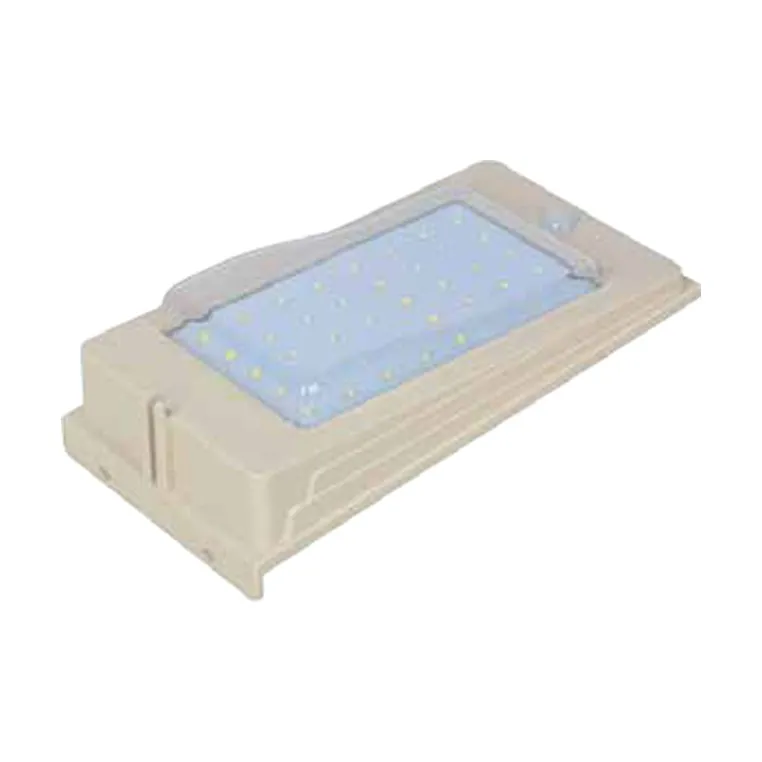
Our solar wall light (5 W LED, 6.8 Wp panel, 3.7 V 8 Ah lithium battery) is the perimeter type: mounted at 3–5 m on a wall or post, it lights the ground in front, with modes that dim until someone approaches.
Post cap lights and sizes
Post caps must match the post:
| Nominal post | Actual size | Notes |
|---|---|---|
| 4×4 in | about 89 × 89 mm | Most common timber post in North America |
| 5×5 in | about 114 × 114 mm | Heavier fences and gates |
| 6×6 in | about 140 × 140 mm | Pergolas, decks, entrances |
| 100 mm | 100 × 100 mm | Common metric timber and metal |
| 120 mm | 120 × 120 mm | Gate pillars |
Measure the real post before ordering. Many caps include adapters for two sizes, but a loose cap lets water into the top of a timber post.
How bright, how many?
For decorative lights, the effect is a line of points; more lights closer together look better than a few bright ones. For perimeter lighting, think of light on the ground:
- At 3 m height, a 5 W light (about 500 lm) gives useful light on a patch about 6–8 m across
- Spacing 8–12 m gives overlapping pools along the fence
- Gates and corners need their own light
For long perimeters, solar post-top or small solar street lights on 4–6 m poles inside the fence may be cheaper per metre than many small lights.
Charging and orientation
A fence has two sides, and usually only one gets the sun. On a fence running east-west in the northern hemisphere, lights on the north face may hardly charge. Options:
- Put lights on the sunny side and accept that they light that side
- Use post caps, whose panels face the sky
- Use lights with separate panels on a cable
- Mount on posts above the fence top
Check for shade from trees, buildings and the fence itself in winter, when the sun is low.
Modes for fences
| Mode | When to use |
|---|---|
| Constant low glow | Decorative fence lines, garden edges |
| Bright then dim | Entrances, decks used in the evening |
| Dim plus motion | Perimeters, farms, warehouses |
| Motion only | Gates, rarely used paths, saves most energy |
On a perimeter, dim plus motion gives orientation light all night and a clear signal when someone approaches. Our motion sensor guide shows how motion modes cut energy use and stretch battery life.
Battery and winter
A decorative light with a small Ni-MH cell may last only a few hours in winter. Lithium cells with more capacity last much longer. To check whether a light gets through a run of cloudy days, use the battery autonomy calculator with the panel Wp, battery capacity and LED power.
What lasts outdoors
- Housing: aluminium or UV-stabilised PC/ABS; thin plastics go yellow and brittle in two summers
- IP65 or better
- Stainless steel screws that will not stain the fence
- Lithium iron phosphate cells for heat and long life
- Replaceable battery
On farms and coastal sites, salt and fertiliser dust attack cheap metals quickly; ask about the coating.
Installation tips
- Mount lights on the post rather than on thin boards, which flex in wind
- Pre-drill timber to avoid splits
- Keep panels clear of the fence top, where snow or leaves collect
- Switch the light on and let it charge for one or two sunny days before judging runtime
Farms and livestock fences
On farms, fence lights help with night checks, deter predators around pens and mark gates for vehicles. Animals can rub against and chew low fittings, so mount lights high on posts, out of reach, and protect cables if there are any. Lights near electric fences must not touch the live wire; mount them on the posts on the opposite side from the energised wire.
Projects
For farms, schools, warehouses, solar parks and construction sites, tell us the length of fence, which sides get sun, the gates and corners, and whether you need security or just marking. We will propose solar wall lights, post lights or small solar street lights, with modes for each section.
Sources
Frequently asked questions
Are solar fence lights worth it?
For marking a fence line and adding atmosphere, yes: they need no wiring and cost nothing to run. For security on long perimeters, choose larger solar wall-type lights with motion sensing, or mains lighting, because tiny fence lights do not give enough light to see people.
How far apart should solar fence lights be?
Decorative lights about 2–3 m apart, or one on every second post. Security-type solar lights of 3–10 W about 8–15 m apart depending on mounting height and the light level wanted.
Do solar fence post cap lights fit any post?
No. Caps are made for specific post sizes, commonly 4x4, 5x5 and 6x6 inch nominal, or 100 and 120 mm metric. Measure the actual post, since a nominal 4x4 timber post is about 89 mm across, and check whether the cap fits over or into the post.