
Solar Powered Garden and Yard Lights: Types, Runtime and Buying Tips
Types of solar garden and yard lights, from stake and path lights to post-top and flood lights, what panel and battery sizes give, runtime in summer and winter, and how to compare them.
Key points
- Solar garden lights range from 0.1 W stake lights to 20–60 W post-top and street-type lights; the panel and battery decide what they can really do.
- Small stake lights mark a path; lighting a yard, drive or car park needs a light with a panel of 20 Wp or more.
- Compare panel watts (Wp), battery watt-hours (Wh) and real LED watts, not 'equivalent' or 'up to' numbers.
- Winter sun can be a third of summer sun; good lights dim automatically to stretch the battery.
“Solar garden light” covers anything from a supermarket stake light with a coin-sized panel to a 4 m post-top light that lights a whole park path. Both are useful, but for very different jobs. The mistake buyers make most often is to expect yard or security lighting from a light built to mark the edge of a flower bed.
The main types
| Type | Typical real LED power | Panel | Job |
|---|---|---|---|
| Stake / path marker | 0.05–0.5 W | 0.1–0.5 Wp | Mark edges and paths |
| Solar spotlight | 1–5 W | 2–6 Wp | Light a shrub, sign or tree |
| String and decorative | 0.5–3 W total | 1–3 Wp | Atmosphere |
| Wall light | 3–10 W | 5–15 Wp | Gates, doors, small yards |
| Bollard | 2–6 W | 3–8 Wp | Paths and lawns |
| Post-top garden light | 10–40 W | 20–60 Wp | Park paths, estates, campuses |
| Solar flood light | 3–20 W | 10–60 Wp (separate) | Yards, signs, sheds |
| Small solar street light | 15–60 W | 20–75 Wp | Drives, estate roads, car parks |
Small decorative lights are fine for homes. For hotels, parks, estates and car parks, look at the bottom half of the table.
Garden lights versus yard lights
A garden needs light on features and paths: a little light in many places. A yard, drive or farm needs enough light to see and work safely over an area: more light from fewer points, mounted higher. That is why “solar yard light” searches often end with a post-top light or a solar flood light rather than a stake light.
- Garden: stake lights, spotlights on shrubs, bollards along paths, wall lights on steps
- Yard and drive: wall lights at 3–4 m, post-top lights at 3–5 m, or a solar flood light
- Large yard or car park: small all-in-one solar street lights at 4–6 m
What the panel and battery tell you
Energy collected per day is roughly: panel Wp × peak sun hours × about 0.6 (losses from heat, dirt, charging and the battery).
- A 0.3 Wp stake light at 4 sun hours collects about 0.7 Wh: enough for a 0.1 W LED for several hours.
- Our 5 W solar wall light has a 6.8 Wp panel and a 3.7 V 8 Ah lithium battery (about 30 Wh). At 4.5 sun hours it collects about 18 Wh a day, so it runs bright after dusk and dims later.
- A 30 W all-in-one solar street light has a 45 Wp panel and a 12.8 V 18 Ah battery (about 230 Wh), enough for real area lighting with dimming.
If the panel is tiny compared with the claimed brightness, the light will either be dim or run for a short time.
Watts, lumens and the “equivalent” problem
Packaging often shows “300 W equivalent” or “10,000 lumens” on a light with a panel the size of a phone. A useful check:
- Real lumens ≈ real LED watts × 100–150 lm/W for decent LEDs
- A light cannot use more energy per night than its battery stores
- A battery in Wh = voltage × Ah (3.2 V × 10 Ah = 32 Wh)
Ask the supplier for the real LED power, the panel Wp and battery Wh. A reputable supplier answers in numbers.
Runtime in summer and winter
| Summer (5 sun hours) | Winter (2 sun hours) | |
|---|---|---|
| 6.8 Wp panel collects | about 20 Wh | about 8 Wh |
| 5 W at full power for | about 4 h | about 1.5 h |
| With bright-then-dim mode | All night | Most of the night |
Lights with automatic dimming or motion modes cope far better in winter. Our solar street light motion sensor guide shows how much energy dimming saves. For several cloudy days in a row, battery autonomy matters: see how many rainy days a solar light can last, and check your own figures with the battery autonomy calculator.
Where to put solar garden lights
- Full sun for the panel. At least 4–6 hours of direct sun, no shade from trees, eaves or walls.
- Away from other lights. Porch lights and street lights can make the sensor think it is still day.
- Height for the job. Stake lights at 0.3 m, bollards at 0.6–1 m, wall lights at 2–4 m, post-tops at 3–5 m.
- Spacing. Path lights every 2–3 m for marking; post-top lights every 12–20 m for walking light.
- Panel angle. If adjustable, tilt the panel towards the equator, steeper in winter.
Materials and protection
| Item | Better choice | Why |
|---|---|---|
| Housing | Aluminium or UV-stabilised PC | Cheap plastics go yellow and brittle |
| Ingress protection | IP65 or better | Rain and garden sprinklers |
| Battery | Lithium iron phosphate | Longer life, better in heat |
| Panel | Monocrystalline | More energy per area |
| Fixings | Stainless steel | No rust streaks on walls |
Solar post-top lights for parks and estates
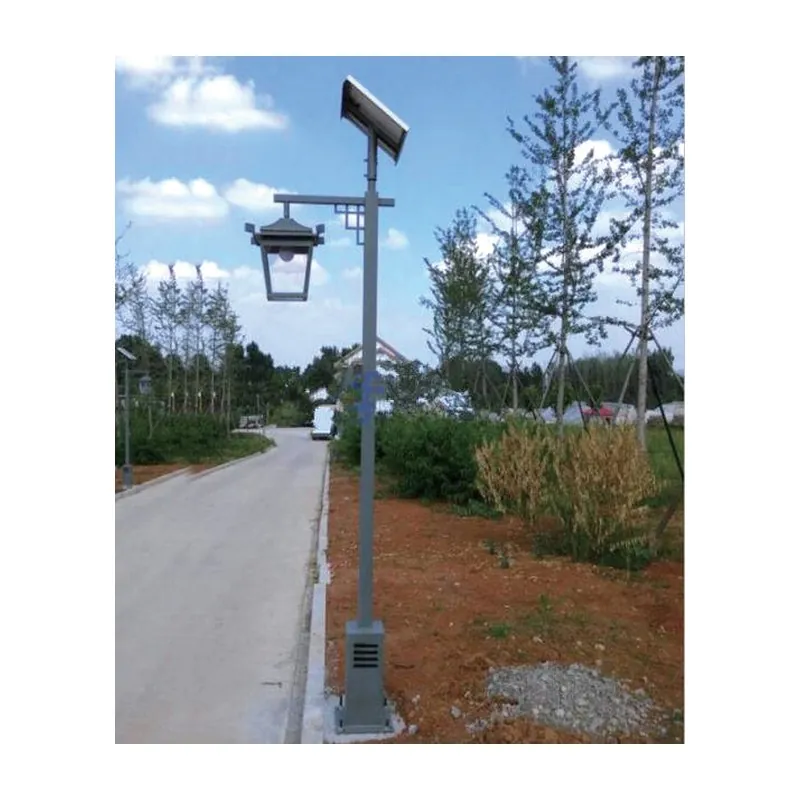
For public paths, estates, resorts and campuses, a post-top light on a 3–5 m pole looks like a normal garden light but runs from its own panel. Our BG-TYO45 garden light comes in modern, classical and European designs on 2.5–5 m poles, in mains or solar versions. For a mixed site, mains-powered lawn and bollard lights near buildings and solar post lights further out is often the cheapest combination.
Maintenance
- Wipe panels every few months; dust and pollen cut charging noticeably
- Clear leaves and snow
- Check that plants have not grown over panels or sensors
- Replace batteries when runtime drops, typically after 2–5 years depending on cells and climate
Ordering for projects
For commercial projects we need the site plan, the hours of light wanted, the location (for sun hours) and the look you prefer. We then match panel and battery to the climate and propose a mode for each area, so path lights, gate lights and car-park lights each get the right size rather than one model everywhere.
Sources
Frequently asked questions
How long do solar garden lights last at night?
Good solar garden lights run 6–10 hours after a sunny day, often dimming after the first few hours. After cloudy days or in winter, runtime falls. The battery capacity in watt-hours, compared with the LED power, tells you how long a full battery lasts.
Are solar powered yard lights bright enough?
Small stake and path lights are only for marking. For a yard or drive, choose a post-top or wall-mounted solar light of 5–30 W real LED power with a panel big enough to recharge it, or a solar flood light with a separate panel.
How long do solar garden lights last before replacement?
The LED itself can last many years. The battery usually wears first: cheap Ni-MH cells in 1–2 years, lithium-ion in 2–4 years, lithium iron phosphate in 5 years or more. Choose lights where the battery can be replaced.