
Solar Powered Outdoor Wall Lights: What They Can Really Light
How much light a solar wall light really gives: panel and battery sizes, runtime through the night, motion and dusk modes, mounting, and how to compare models.
Key points
- A solar wall light is a small all-in-one: panel, battery, controller and LED in one housing on a wall.
- Our 5 W wall light has a 6.8 Wp panel and a 3.7 V 8 Ah battery (about 30 Wh): enough for 6–8 hours a night, brightest at dusk.
- Mount the panel where it sees open sky for most of the day; on a north-facing wall in the northern hemisphere, choose a model with a separate panel.
- Compare panel watts and battery watt-hours, not the wattage on the box.
Solar wall lights are the simplest solar lights there are: one housing on a wall, no cable, no trench, no switch. They suit gates, garden walls, yards, sheds, car-park entrances and the outside walls of buildings without a power point. Their limit is the size of the panel that fits on a wall light. This guide shows what that means in practice.
What is inside
| Part | Typical in a wall light | What it decides |
|---|---|---|
| Solar panel | 2–10 Wp | Energy collected per day |
| Battery | 3.7 V lithium, 2–10 Ah | Energy stored for the night |
| LED | 1–10 W real power | Brightness |
| Controller | Light sensor, timer, motion sensor | How the energy is spent |
A worked example: our 5 W wall light
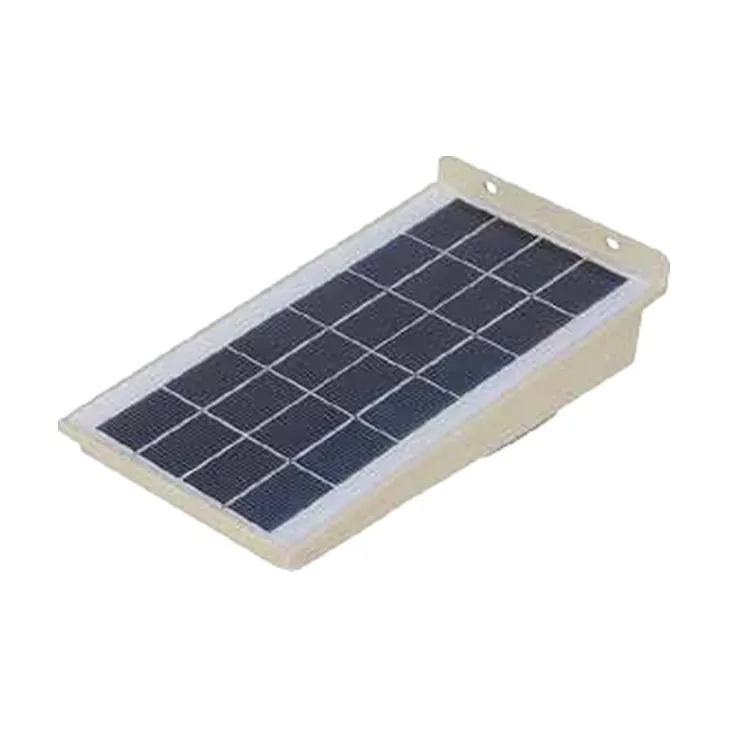
Our SL3530J005 solar wall light has a 5.5 V, 6.8 Wp panel and a 3.7 V, 8 Ah lithium battery:
- Stored energy: 3.7 V × 8 Ah ≈ 30 Wh
- On a sunny day with 4.5 peak sun hours, a 6.8 Wp panel at about 60% system efficiency collects about 18 Wh
- That supports, for example, 5 W for about 1.5 hours after dusk and then about 1 W until morning, or a motion mode at 20% with full output when someone passes
The battery holds more than one day’s charge, so one dull day does not leave it dark, but several dull days will. For the method behind these numbers, see our solar street light calculator, which works the same way for small lights.
Modes and what they cost
| Mode | Behaviour | Energy use |
|---|---|---|
| Dusk to dawn, constant | Same light all night | Highest; needs the biggest battery |
| Bright then dim | Full output for 2–4 h, then 20–30% | Moderate; the usual choice |
| Motion only | Off or dim until someone passes | Lowest; ideal for gates and paths |
| Dim + motion | 20% background, 100% on motion | Low, with constant orientation light |
For security and gates, dim + motion is usually best: the wall is always marked, and the burst of light on approach is noticed.
Where to mount it
- Panel in the sun. At least 4–6 hours of direct sun a day. In the northern hemisphere, south, east and west walls work; north walls usually do not.
- Height. 2–3 m for gates and paths; up to 4–5 m for yards, with a wider beam.
- Clear of overhangs. A roof edge can shade the panel for most of the day.
- Away from other lights. A nearby street light can trick the sensor into thinking it is daytime.
- Angle. Some models let the panel tilt; tilt it towards the sun, steeper in winter.
How to compare models
- Panel in Wp and its size; a real 7 Wp panel is about the size of a postcard plus a bit
- Battery in Wh (voltage × Ah), and the cell type; lithium iron phosphate lasts longest
- Real LED power and lumens, not “equivalent” wattage
- Ingress protection: IP65 at least
- Housing: UV-resistant ABS/PC or aluminium; cheap plastics yellow and crack in sun
- Replaceable battery, because the battery wears out first
Wall light or something bigger?
| Need | Better choice |
|---|---|
| Gate, door, small yard | Solar wall light |
| Path or garden | Solar post lights |
| Car park or estate road | Residential or commercial solar street light |
| Large yard or sign | Solar flood light with a separate panel |
Winter and cloudy climates
The same light collects far less energy in winter. At 2 peak sun hours, our 6.8 Wp panel collects about 8 Wh a day, less than a third of the battery. Practical steps:
- Switch to motion or bright-then-dim mode for the winter months
- Tilt the panel steeper if the model allows it
- Clear snow and leaves from the panel
- In places with long grey seasons, choose a model with a separate, larger panel
Near the equator, where sun hours vary little through the year, a wall light can be set once and left. Higher latitudes need a summer and a winter setting.
Projects with many lights
For estates, schools, farms and resorts, solar wall lights avoid running cable to every wall. A typical order lists the walls, their orientation and the hours of light needed. We then check the panel and battery against the local sun hours and propose a mode for each location, so lights over gates and lights over storerooms do not get the same setting.
Questions to ask a supplier
- What is the panel’s real rated power, and its size in millimetres?
- What cells are in the battery, and what is the capacity in Wh?
- What are the default modes, and can they be changed on site or by remote?
- Can the battery be replaced, and is it sold separately?
- What test data supports the runtime claim?
Maintenance
Wipe the panel every few months, more often in dusty or coastal places. Check the sensor lens, and replace the battery when runtime falls noticeably, typically after 2–5 years depending on the cells and climate.
Send us the wall orientation, the hours you need light and the number of units, and we will confirm whether a wall light is enough or suggest a larger solar light.
Sources
Frequently asked questions
How long do solar wall lights stay on?
A well-made solar wall light runs 6–8 hours or all night with dimming, if the panel gets enough sun. In winter or after cloudy days, runtime drops; motion-sensor modes stretch the battery by staying dim until someone passes.
Do solar wall lights work in winter?
Yes, with less runtime. Short days and a low sun can cut the energy collected by half or more. Mount the panel facing the sun, keep it clean, and use a motion or timer mode in winter.
Can solar wall lights be mounted on any wall?
Only where the panel gets several hours of direct sun. A wall facing away from the sun or shaded by a roof overhang will not charge it. Models with a separate panel on a cable let you put the panel in the sun and the light where you need it.