
Solar Post Lights for Paths, Parks and Estates: Sizing and Spacing
How to choose solar post lights for paths, parks and estates: post height, real wattage, battery and panel size for a 10–15 W light, spacing, and when to use a street light.
Key points
- Solar post lights stand 2.5–5 m high and light footpaths, park walks and estate roads where people walk, not drive.
- A real 15 W post light running 4 hours at full power and 8 hours at 30% needs about 360 Wh of battery for 3 nights and a 40–50 Wp panel.
- Space post lights at about 4–5 times their height for an even path; wider spacing leaves dark gaps between pools of light.
- Choose warm white (3000K) and shielded optics for parks and homes; use a solar street light where cars drive.
Solar post lights, also called solar post-top or garden lights, light the places where people walk: park paths, campus walks, estate footpaths and squares. They sit lower than street lights, use less power and are often chosen as much for their look as for their light. Sizing them properly is the same job as sizing a solar street light, only smaller. This guide shows how.
Where post lights fit
| Place | Typical post height | Real LED power | Notes |
|---|---|---|---|
| Garden and park paths | 2.5–3.5 m | 5–15 W | Warm white, shielded, low glare |
| Estate footpaths, campus walks | 3–4 m | 10–20 W | Even light along the path |
| Squares and plazas | 3.5–5 m | 15–30 W | Several heads or symmetric optics |
| Estate roads with cars | 5–8 m | 20–40 W | Use a solar street light instead |
Above about 5 m, or wherever vehicles drive, a solar street light with a road optic gives better results; see solar street light pole height and spacing.
Sizing a 15 W post light
Paths are busy in the evening and almost empty after midnight, so the usual profile is full power for 4 hours after dusk, then 30% for 8 hours. For a real 15 W light, at a site with 4 peak sun hours in the worst month and 3 nights of autonomy, our solar street light calculator gives:
| Light | Energy per night | Battery (3 nights) | Panel at 4 PSH | Panel at 3 PSH |
|---|---|---|---|---|
| 10 W | about 71 Wh | about 240 Wh (19 Ah at 12.8 V) | 30 Wp | |
| 15 W | about 107 Wh | about 360 Wh (28 Ah) | 40 Wp | 50 Wp |
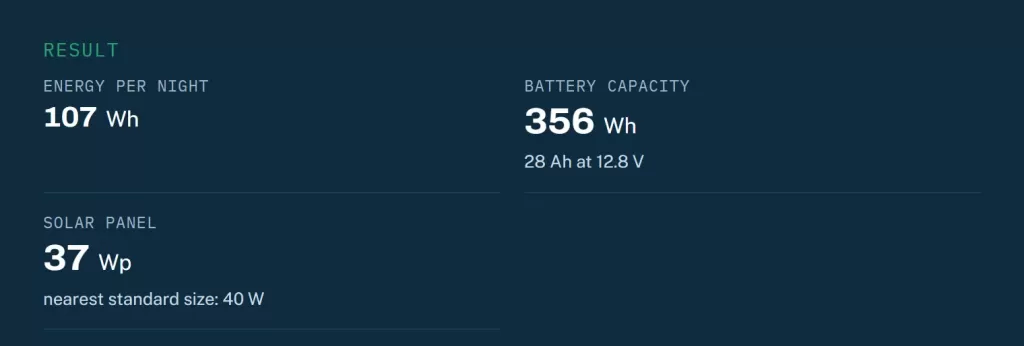
Open the example and change the wattage or sun hours for your site.
These numbers are modest, which is the attraction of post lights: a 40 Wp panel fits on top of a post-top lantern or on a small bracket. They are also a test of a supplier. A “60 W” post light with a 10 W panel cannot run 60 W for long; check the real wattage, the battery in Wh and the panel in Wp, as in our solar street light specification template.
Spacing along a path
For an even path without dark gaps, space posts at about 4–5 times their height:
| Post height | Spacing for an even path | Spacing for orientation only |
|---|---|---|
| 3 m | 12–15 m | up to 20 m |
| 4 m | 15–20 m | up to 25 m |
| 5 m | 18–22 m | up to 30 m |
“Orientation only” means pools of light that show the line of the path, common in large parks at night. Where people need to see faces and steps, for example near entrances, play areas and stairs, keep to the closer spacing. For lighting classes and lux levels on pedestrian areas, our pole height and spacing calculator covers the P classes used in Europe.
Choosing the light
- Colour temperature: 3000K is usual in parks and residential areas: comfortable, and less blue light for wildlife and neighbours. 4000K for squares and commercial areas.
- Optics: shielded or downward optics keep light on the path and off windows and the sky. Open globes look attractive but send much of the light upwards.
- Motion sensing: dimming to 20–30% when nobody is near and brightening on approach saves energy and lets a smaller battery last longer; see solar street light motion sensors.
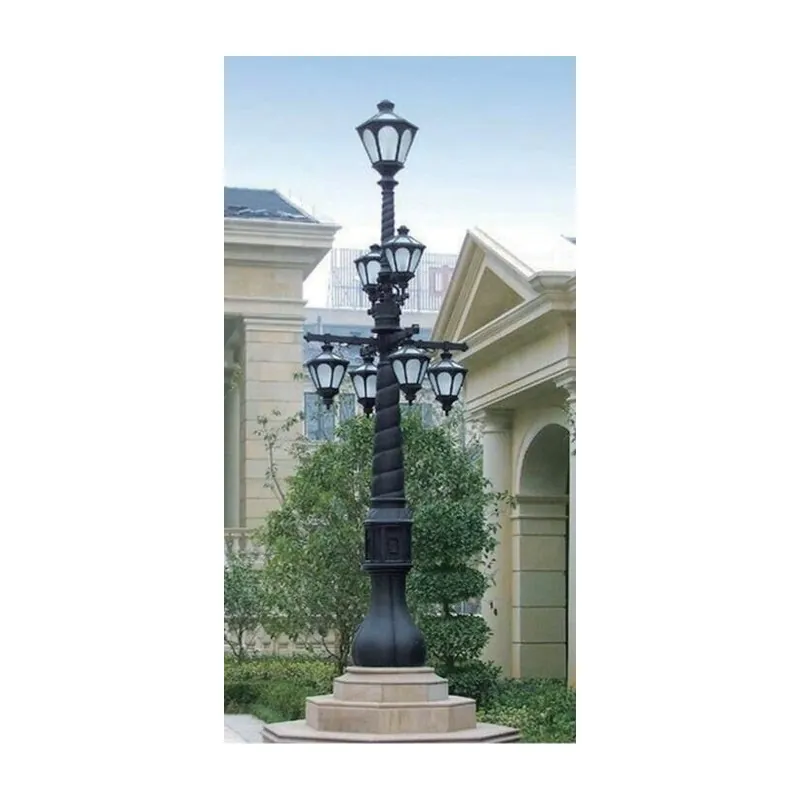
- Style: modern, classical or European lantern heads; most can carry a solar panel on top or on a side bracket.
Example: a 400 m park path
A park wants a lit 400 m walk, 2.5 m wide, with 3 m posts and an even path, not just orientation points.
- Spacing: about 14 m (4.7 × the post height), so 400 ÷ 14 ≈ 29 spaces, 30 posts including both ends
- Light: a real 10–15 W, 3000K, with a symmetric or path optic
- Solar: 40 Wp and about 360 Wh per post for 3 nights at 4 peak sun hours
- Profile: full output from dusk to 22:00, then 30%, or motion sensing at 20% when the path is empty
- Connected load: 30 × 15 W = 450 W at full power, with no cable, trench or electricity bill
On the same path, 6 m street lights at about 21 m spacing would need 20 poles, but the light would sit high above the trees and feel like a road. Lower, closer posts usually suit a park better.
Panel placement
The panel needs open sky and should face the equator. Under trees, a post-top panel can be in shade for much of the day, which is the most common reason park solar lights fail. Options:
- Prune or choose positions clear of the canopy
- Use a split design with the panel on a taller pole or a nearby building
- Use a slightly larger panel to make up for partial shade
Durability
Park and estate lights face weather, dust and vandalism:
- IP65 or better for the lamp and battery compartment
- LiFePO4 batteries, which last far longer than lead-acid or cheap lithium
- Hot-dip galvanised or aluminium posts with a durable powder coat
- Tamper-resistant screws and a battery out of easy reach
Our post lights
Our LED garden lights come in modern, classical and European designs on 2.5–5 m poles, with solar versions; for walls, gates and small paths, the 5 W solar wall light runs from its own 6.8 Wp panel. Send us a plan of the paths and the site location, and we will suggest post heights, spacing and a solar configuration for your worst month.
Sources
Frequently asked questions
How high should solar post lights be?
Usually 2.5–3.5 m for garden and park paths, and 3.5–5 m for wider walks, estate roads and squares. Lower posts give a more human scale and less glare; higher posts let you space them further apart.
How far apart should solar post lights be?
As a guide, about 4–5 times the post height: 12–15 m for 3 m posts, 15–20 m for 4 m posts. Closer spacing gives a continuous lit path; much wider spacing leaves dark gaps.
How long do solar post lights stay on?
A well-sized light runs all night, at full brightness for the first hours and dimmed afterwards, and keeps a reserve for 2–3 cloudy days. Cheap lights with tiny batteries often go dark after a few hours or after one cloudy day.