
Lamp Post Street Lights: Modern and Classic Post-Top Lights for Streets and Parks
Lamp posts vs street lights, modern and classical post-top designs, heights and spacing for paths and residential streets, wattage, light control and how to choose poles that last.
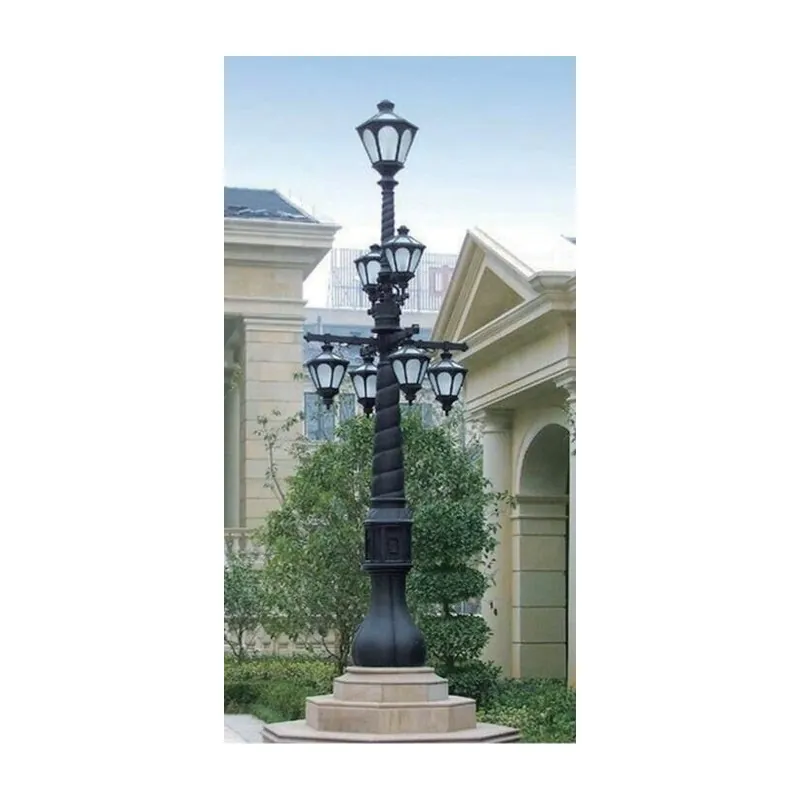
Key points
- A lamp post is usually a lower, decorative post-top light (3–5 m) for paths and residential streets; a street light sits on a taller pole with an arm (6–12 m) for traffic roads.
- Post-top lights of 20–60 W at 3–5 m, spaced about 4–5 times the height, suit parks, estates and town centres.
- Modern designs give the best light control; classical lanterns need LED optics and shielding to avoid glare and sky glow.
- Choose galvanised steel or aluminium poles with a proper base and IP65 heads so the look lasts.
Lamp posts give a street or park its character in a way that tall road lighting does not. They light people more than cars: faces, steps, benches and shop fronts. With LED, a classical lantern or a slim modern post-top can now deliver controlled, efficient light instead of the glare of old globe lamps.
Lamp post or street light?
| Lamp post (post-top) | Street light (arm-mounted) | |
|---|---|---|
| Height | 3–5 m, sometimes 6 m | 6–12 m |
| Light position | On top of the pole | On an arm over the road |
| Main users | Pedestrians, cyclists | Vehicles |
| Look | Decorative, part of the streetscape | Functional |
| Spacing | 12–25 m | 25–45 m |
| Typical power | 20–60 W | 40–200 W |
Many towns use both: tall road lights for the carriageway, lamp posts along pavements and in squares. Our guide on how many watts a street light needs covers the road side.
Design styles
| Style | Look | Best for |
|---|---|---|
| Modern | Slim columns, discs, cylinders, cubes | New estates, campuses, waterfronts |
| Classical | Lanterns, coach lamps, fluted columns | Old towns, heritage areas, villas |
| European | Clean lantern shapes, dark finishes | Town centres, resorts |
| Contemporary decorative | Sculptural heads, multiple arms | Plazas, landmark streets |
Our BG-TYO45 garden and post lights come in modern, classical and European designs, 20–80 W, on 2.5–5 m Q235 steel poles, with mains or solar versions.
Heights and spacing
| Place | Height | Spacing |
|---|---|---|
| Garden path | 2.5–3 m | 10–15 m |
| Park path | 3–4 m | 12–20 m |
| Residential street | 4–5 m | 16–25 m |
| Town square | 4–6 m | By layout |
Spacing of about 4–5 times the height keeps light even along paths. Closer spacing looks busier but suits busy pedestrian streets.
Wattage
At 100 lm/W:
- 20–30 W (2,000–3,000 lm): garden paths and quiet park walks
- 30–50 W (3,000–5,000 lm): park main paths, residential streets
- 50–80 W (5,000–8,000 lm): squares, wider streets, 5–6 m posts
For streets that also carry traffic, the light level comes from the road class; see road lighting classes. Residential streets are often in the P classes, which focus on pedestrians.
Light control: the difference between good and bad lamp posts
Old globe and lantern lamps spread light everywhere, including into the sky and people’s eyes. With LED:
- Downward-facing LED modules with optics inside the lantern put light on the ground
- Asymmetric optics throw light along a path or street instead of into gardens and windows
- Frosted or prismatic diffusers reduce glare when people look at the head
- Shielded tops cut upward light
Ask for the light distribution, not only the wattage. A lantern that looks right but glares wastes most of its value.
Colour temperature
- 2700–3000K for heritage areas, parks and residential streets: warm and comfortable
- 4000K for modern campuses and busy town centres where better colour rendering matters
- Many cities now limit outdoor lighting to 3000K or below for dark-sky reasons
Poles and finishes
| Item | Good practice |
|---|---|
| Material | Hot-dip galvanised steel or cast/extruded aluminium |
| Finish | Polyester powder coat over galvanising |
| Base | Bolted flange with decorative base cover |
| Door | Lockable access door for the driver and connections |
| Fixings | Stainless steel |
In coastal places, aluminium or extra-thick galvanising and marine-grade coating prevent rust streaks that spoil the look.
Mains or solar?
Solar post-top lights avoid trenching through paved parks and are useful for remote paths. Their panel sits on top of or beside the head, which changes the look, so choose a design where the panel is part of it. Mains lights are better where the look is critical or the trees shade the panel.
Controls
- Photocell or timer to switch at dusk and dawn
- Dimming after midnight on quiet paths
- Motion sensing for paths with little use late at night
- Central control for city-wide schemes
Common mistakes
- Choosing the lantern from a catalogue photo without checking its light distribution
- Mixing colour temperatures between old and new sections of a street
- Posts too far apart, leaving dark gaps between pools of light
- Cheap coatings that chalk and peel within a few years
- No spare heads from the same batch, so replacements never quite match
Heritage projects
In old towns, the lamp post is part of the heritage. Many cities keep the original columns and fit new LED lanterns that copy the old shape, or put LED modules inside restored lanterns. Ask for samples and test one street at night before ordering for a whole district. Night tests show glare, colour and spacing problems that drawings and daytime photos never reveal.
Maintenance
LED post-top lights need little: clean diffusers once a year, check seals and the access door, and repaint the pole when the coating wears. Choose a design where the LED module and driver can be changed without replacing the lantern, so the look survives future upgrades.
Planning a project
Send us the street or park plan, the style you have in mind (photos help), the posts you want to keep or replace, and whether there is power along the route. We will propose a design, height, spacing and wattage, in mains or solar versions.
Sources
Frequently asked questions
What is the difference between a lamp post and a street light?
A lamp post is generally a lower, often decorative pole with the light on top, used for paths, squares and residential streets. A street light usually means a taller pole with an arm holding a luminaire over the road, designed mainly for traffic. Both can use LED.
How tall is a lamp post?
Decorative lamp posts are usually 3–5 m (10–16 ft) for parks, paths and residential streets. Higher posts, 6 m or more, are used for squares and wider roads.
How far apart should lamp posts be?
About 4 to 5 times the mounting height for paths and residential streets: roughly 12–20 m for 3–4 m posts. The exact distance depends on the optic and the light level required.