How to Wire Garden Lights in Series (and Why Most Should Be Wired in Parallel)
How to wire garden lights in series or parallel: why mains and 12 V garden lights are wired in parallel, the daisy-chain method people call series, and worked voltage drop for real runs.
Key points
- True series wiring divides the supply voltage between the lights: 20 mains lights in series would each see about 11.5 V and none would work. Mains and 12 V garden lights must be connected in parallel.
- What installers call 'series' or daisy-chain is usually parallel wiring run from light to light along one cable, which is correct as long as each light connects across both conductors.
- By our calculation, 20 lawn lights of 9 W on a 230 V circuit spaced along 120 m of 1.5 mm² cable lose only about 1.3 V (0.55%); at 12 V, ten 3 W lights on 30 m of 2.5 mm² cable lose about 0.56 V (4.6%).
- Low voltage is where voltage drop bites: choose cable size, run length and transformer taps so the last light gets at least the voltage its driver needs.
“How do I wire garden lights in series?” is a common search, and the honest first answer is: for almost all garden lights, you should not. What most people mean is the tidy method of running one cable from light to light, which is in fact parallel wiring. This guide explains the difference, shows how to wire a garden circuit correctly at mains voltage and at 12 V, and works out the voltage drop for two real runs.
Series and parallel in one minute
Series: the lights form a single loop, one after the other. The same current flows through all of them, and the supply voltage is shared between them. If one fails open, all go out.
Parallel: every light is connected across the two supply conductors. Each light gets the full supply voltage (minus cable losses), and one failure does not affect the others.
Garden lights, whether mains (100–240 V) or low voltage (12 V), are designed to run at the full supply voltage. Put 20 mains lights in series on 230 V and each sees about 11.5 V: none of them will start. Put three 12 V lights in series and each sees about 4 V. That is why the answer is parallel.
The exceptions are products designed for series operation, such as some constant-current LED strings where a single driver feeds LEDs in series. Those come with their own instructions and their own driver.
The daisy chain: parallel along one cable
The practical layout installers use looks like a chain:
- A cable leaves the supply (consumer unit or transformer).
- At the first light, it enters the light’s junction box or a connector, and a second cable continues to the next light.
- At each light, the live (or positive) conductor connects to the light’s live, and the neutral (or negative) to its neutral, in addition to continuing onward.
- The last light terminates the cable.
Electrically every light is across both conductors: parallel. The only “series” element is that the cable is shared, so current for all downstream lights passes through each upstream section. That is what causes voltage drop.
Other layouts, such as a T or a loop, spread the load more evenly and reduce drop on long low-voltage runs. Our landscape lighting wiring guide compares them.
Worked example 1: mains lawn lights
Twenty of our BG-CP lawn lights at 9 W each (AC 100–240 V, power factor above 0.9), every 6 m along a 120 m path, fed with 1.5 mm² copper cable (about 12.1 mΩ per metre per conductor) at 230 V:
- Current per light: 9 W ÷ (230 V × 0.9) ≈ 0.043 A
- Total current: about 0.87 A
- Voltage drop with the load spread evenly along the run: 2 × 0.87 A × 0.0121 Ω/m × 120 m ÷ 2 ≈ 1.3 V, about 0.55%
At mains voltage, drop is rarely the problem. The limits are the protective device, residual current protection (required for outdoor circuits in most codes), cable type for burial and mechanical protection. These are installation-code matters: a qualified electrician must do mains garden wiring.
Worked example 2: 12 V garden lights
Ten 3 W low-voltage lights along 30 m of cable at 12 V:
- Total current: 30 W ÷ 12 V = 2.5 A
- With 2.5 mm² cable (about 7.4 mΩ/m per conductor), evenly spread: 2 × 2.5 × 0.0074 × 30 ÷ 2 ≈ 0.56 V, about 4.6%
- With 1.5 mm² cable: about 0.91 V, 7.6%
- If all ten lights were bunched at the far end: about 1.1 V, 9.3% with 2.5 mm²
The same power that loses half a percent at 230 V loses five to ten percent at 12 V, because the current is about twenty times higher. The fixes are the familiar ones: thicker cable, shorter runs, splitting the load into two or three runs from the transformer, using the transformer’s higher voltage taps for long runs, or a T or loop layout. Check the minimum input voltage of the lights’ drivers; many LED landscape lights accept a range, which makes them more tolerant than old halogen.
Choosing mains or low voltage for a garden
| Mains garden lights | 12 V garden lights | |
|---|---|---|
| Typical products | Post-tops, bollards, lawn lights, floodlights | Path lights, spotlights, deck lights |
| Voltage drop | Negligible on garden distances | The main design constraint |
| Installation | Qualified electrician, protected cable | Easier, but still needs proper cable and connections |
| Safety | RCD protection, burial depth, IP rating | Lower shock risk |
| Best for | Campuses, parks, long paths, higher output | Residential gardens, accent lighting |
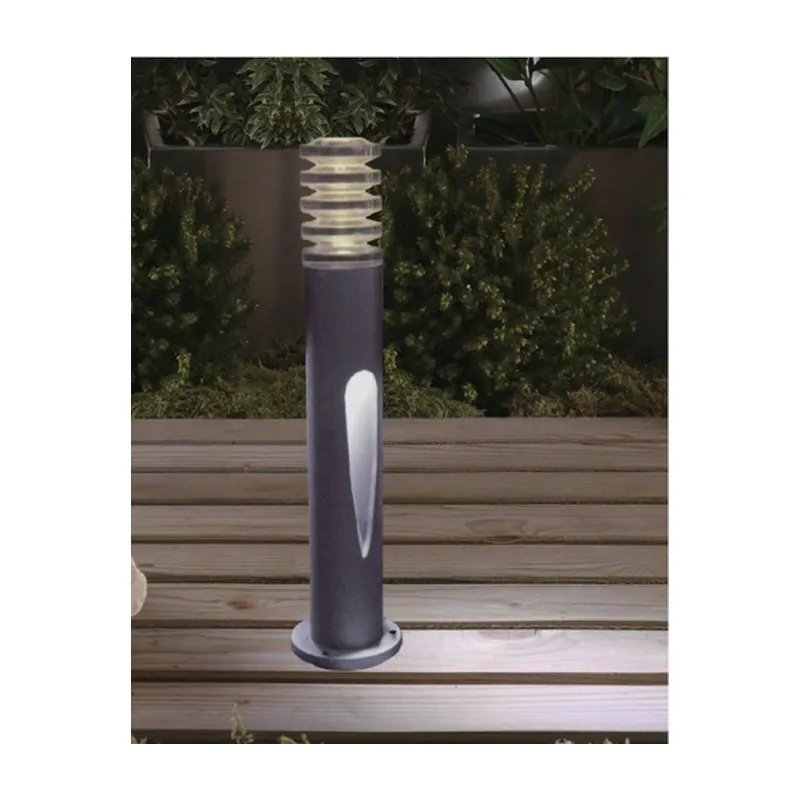
Our lawn lights (3–30 W, IP65, 0.6 m standard height) and BG-TYO45 garden post lights (20–80 W, 2.5–5 m, AC 100–240 V) are mains fittings for project use. In December 2025 we replaced the garden lights around the Xianggang steel group’s administrative centre with LED post-top fittings; the general design notes for campus paths are on the project page.
Making good connections
Most garden lighting faults are connection faults: water gets into a joint, the copper corrodes, resistance rises and lights dim or flicker. Use connectors rated for burial or wet locations, gel-filled where appropriate, and make joints inside the fitting’s junction box or a proper IP68 box. Our guide to landscape lighting wire connectors covers the types.
Step-by-step: a daisy-chain run
- Plan light positions and measure the cable route, including rises to each light.
- Calculate the total load and the voltage drop for your cable size; split long runs.
- Lay cable at the depth your code requires, with mechanical protection where needed.
- At each light, connect live to live and neutral to neutral (positive to positive, negative to negative at 12 V), with earth where the fitting requires it, and continue the cable onward.
- Seal every joint.
- Test insulation resistance and voltage at the last light before backfilling.
- Label the circuit at the supply.
Common mistakes
- True series wiring of standard lights. They will not work, or work badly.
- Thin cable on long 12 V runs. The far lights glow dim.
- Unsealed joints. The first wet season finds them.
- No RCD on mains garden circuits. Unsafe and against code in most countries.
If you are planning a garden or campus path project, send us the layout and light positions. We will propose fittings and check loads and voltage drop for the cable you plan to use.
Sources
Frequently asked questions
Can you wire garden lights in series?
Only lights specifically designed for series operation, such as some constant-current LED strings, can be wired in true series. Standard mains and 12 V garden lights must be wired in parallel so each receives the full supply voltage.
What happens if you wire 12 V garden lights in series?
The 12 V is shared between them. Two lights would get about 6 V each, three about 4 V; most will not light or will flicker. If one fails open, the whole string goes dark.
Is daisy-chaining garden lights series or parallel?
Electrically it is parallel. The cable runs from one light to the next, but each light connects across both conductors, so each sees the full voltage minus a little voltage drop along the cable.
How many garden lights can go on one circuit?
On mains, many: twenty 9 W lights draw under 1 A. The limit is usually the circuit protection and voltage drop on long runs. On 12 V, the transformer rating (with about 20% margin) and voltage drop set the limit.