Landscape Lighting Cost: What Drives a Professional Quote and What It Costs to Run
What drives the cost of professional landscape lighting in 2026: fixtures, transformer, cable, labour and design, plus running costs for a home and a facade.
Key points
- A professional quote is made of fixtures, transformer or drivers, cable, labour, design and controls; labour and cable often equal or exceed the fixture cost.
- Twenty 5 W low-voltage LED fixtures running 6 hours a night use about 250 kWh a year including transformer losses, about $38 at $0.15/kWh.
- Twelve 30 W line-voltage facade spots running 4,000 hours a year use 1,440 kWh, about $216 at $0.15/kWh.
- Size a low-voltage transformer so the connected load is no more than about 80 % of its rating, leaving room for voltage drop and future fixtures.
Landscape lighting quotes vary more than most home improvement prices. Two installers looking at the same garden can come back with very different totals. Some of that is quality, some is design choices, and some is labour. This guide breaks a quote into its parts so you can compare them, then works out what the system costs to run, which with LED is the cheap part. We do not give installation prices here; they depend on local labour rates and site conditions.
What goes into a quote
| Item | What it covers | What changes the cost |
|---|---|---|
| Design | Night survey, plan, fixture choice, aiming | Size of the property, number of features |
| Fixtures | Spotlights, path lights, well lights, wall washers | Material, IP rating, beam options, warranty |
| Power supply | Low-voltage transformer, or drivers for line voltage | Total wattage, timer and photocell options |
| Cable | Low-voltage cable or armoured mains cable | Run lengths, cable gauge, voltage drop |
| Labour | Trenching, mounting, connections, aiming | Ground conditions, hard landscaping, access |
| Controls | Timers, photocells, smart control | Number of zones and scenes |
| Warranty and service | Return visits, re-aiming, repairs | Length and terms |
Cable and labour are easy to underestimate. On a property with lights spread across a large garden, trenching and cable can match or exceed the cost of the fixtures. Our landscape lighting installation guide shows each step and why it takes time.
Fixture quality and lifetime cost
Cheap fixtures save money at purchase but fail in a few seasons: plastic housings crack in UV and frost, seals let water in, and thin wiring corrodes. A quality fixture has:
- die-cast aluminium, brass or stainless housing;
- IP65 or better, with tempered glass;
- a choice of beam angles, so each feature is lit properly;
- replaceable or long-life LED modules.
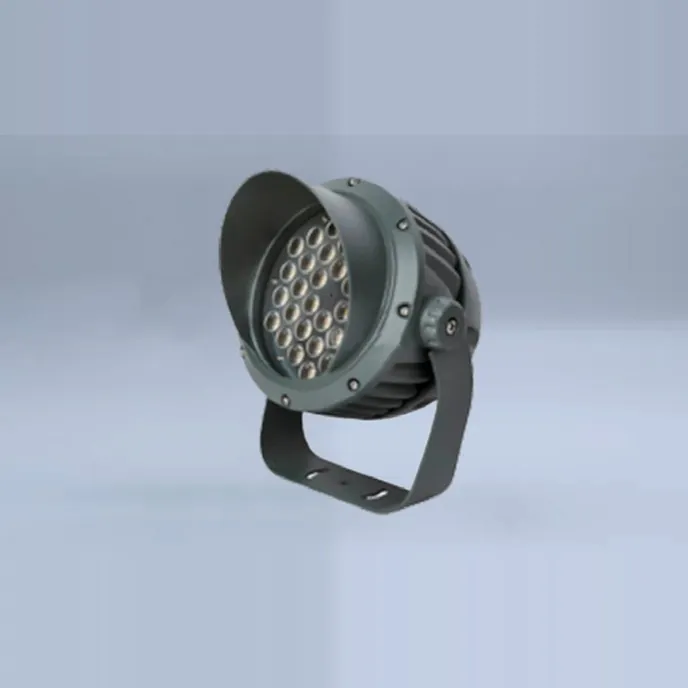
Our BG-TGJ / BG-TGF landscape spotlights and floodlights are aluminium with tempered glass, IP65, 100 lm/W, at 30, 50, 100 and 200 W, with beams from 15° to 120°. They are line-voltage fittings (AC 100–240 V) for commercial facades, trees and monuments, rather than small garden spots.
Low voltage or line voltage
| Low voltage (12 V) | Line voltage (mains) | |
|---|---|---|
| Typical use | Homes, gardens, paths | Commercial facades, large trees, public spaces |
| Fixture power | 2–15 W typical | 20–200 W |
| Cable | Shallow burial, simple connectors | Armoured or ducted, deeper, electrician work |
| Limits | Voltage drop on long runs | Higher installation cost per point |
For a home garden, low voltage is usually cheaper overall. For a hotel or office facade with 30 W to 100 W spots, line voltage is usually the only practical choice. Our guide to low-voltage landscape lighting covers transformers and cable in detail.
Sizing the transformer
A low-voltage transformer should carry no more than about 80 % of its rating. Take twenty 5 W fixtures:
- Connected load: 20 × 5 W = 100 W
- At 80 % loading: 100 ÷ 0.8 = 125 W minimum rating
- Choose the next standard size above, such as 150 W or 200 W, which also leaves room to add fixtures later
Voltage drop on long cable runs dims the fixtures at the far end. Splitting the load into several runs, using thicker cable or using a transformer with multiple voltage taps solves it. Our landscape lighting wiring guide explains layouts such as hub and loop wiring.
Running cost: a home garden
Twenty 5 W low-voltage LED fixtures, on a timer for 6 hours a night:
- Fixture load: 100 W
- Add about 15 % for transformer and cable losses: about 115 W
- Energy: 115 W × 6 h × 365 = about 252 kWh a year
- At $0.15/kWh: about $38 a year
The loss figure is an estimate; good transformers lose less. The point stands: a whole garden of LED lights costs less to run each year than many single household appliances.
Running cost: a commercial facade
A small office building lights its front facade with twelve 30 W BG-TGJ spotlights, on from dusk to about midnight, roughly 4,000 hours a year:
- 12 × 30 W × 4,000 h = 1,440 kWh a year
- At $0.15/kWh: about $216 a year
Switching off at midnight with a timer, rather than running dusk to dawn, cuts the hours from about 4,380 to 4,000 in this example, and much more in winter at high latitudes. Our guide to landscape lighting control systems covers timers, photocells and scenes.
The $0.15/kWh tariff in both examples is an illustrative value; use your own.
Ways to control the cost
- Light fewer things, better. A few well-chosen features look better than lights everywhere.
- Plan cable routes before landscaping. Lay ducts under new paths and patios while the ground is open.
- Choose quality fixtures where access is hard. Replacing a cheap fixture in a tree or a wall costs more than the fixture.
- Use timers. Most landscape lighting is not needed after midnight.
- Phase the work. Install the transformer and cable for the whole plan, then add fixtures over time.
Our landscape lighting plan guide helps decide what to light first.
Comparing quotes
Ask each installer for:
- an itemised list of fixtures with model, wattage, beam and material;
- transformer size and number of cable runs;
- labour, design and controls priced separately;
- warranty terms for fixtures and workmanship;
- a night demonstration or mock-up of key features.
With itemised quotes, the differences become clear, and you can choose where quality matters most.
For contractors
Landscape contractors and developers ordering fixtures in quantity can choose beam angles, colour temperatures and finishes per project. Send us the lighting plan and fixture schedule, and we will propose fittings and confirm the specification of each.
Sources
Frequently asked questions
How much does professional landscape lighting cost?
It varies with the number of fixtures, cable lengths, ground conditions, design work and local labour rates, so we do not quote a single figure. Ask installers to itemise fixtures, transformer, cable, labour and design so quotes can be compared.
What does landscape lighting cost to run?
Very little with LED. Twenty 5 W fixtures on for 6 hours a night cost about $38 a year at $0.15/kWh, including transformer losses. Your own tariff and hours change the figure.
Is low-voltage or line-voltage landscape lighting cheaper?
Low voltage (12 V) is usually cheaper to install for homes, because cable can be buried shallow and connections are simpler. Line voltage suits larger commercial schemes with high-power facade and tree lights, where long low-voltage runs would lose too much voltage.
Why do two landscape lighting quotes differ so much?
Differences in fixture quality (brass, aluminium or plastic), the number of fixtures, cable gauge and length, design time, warranty and whether controls are included. Compare itemised quotes, not totals.