Color-Changing Solar Lights: How Long They Run, Which Modes Drain the Battery, and What to Buy
How colour-changing solar lights, lanterns and pathway lights work, why RGB modes look dimmer, and PVGIS-based run times for real panel and battery sizes in Manila and Lagos.
Key points
- Colour-changing solar lights use red, green and blue LEDs (sometimes plus white) and a small controller that fades or cycles between them.
- Coloured light looks dimmer than white at the same power, especially deep blue and red, because the eye is less sensitive to them.
- In our battery calculator, a light averaging 2 W for 12 hours needs about 27 Wh a night; a 10 W panel cannot refill that in Manila's December (3.7 sun hours by PVGIS), while a 20 W panel with a 48 Wh battery can.
- Static single colours use less energy than fast cycling with all channels lit; a timer or dusk-to-midnight mode doubles the run time on small units.
Colour-changing solar lights are popular for gardens, pools, patios, fences and events: lanterns that fade through the rainbow, path lights that glow blue or red, and small floods that wash a tree in changing colour. They are easy to install because they need no wiring. They also disappoint more buyers than most solar lights, usually because they go dim early in the night. This guide explains how they work, why colour costs light, and how to size the panel and battery so they last, using real sun data.
How they work
A colour-changing solar light has four parts:
- Panel, usually monocrystalline, from under 1 W on small stakes to 20–30 W on floods.
- Battery, commonly 1.2 V NiMH on small garden lights or 3.2 V lithium iron phosphate on larger units.
- Controller, which switches on at dusk and drives the LEDs.
- RGB LEDs, red, green and blue chips, sometimes with a white chip (RGBW). Mixing them at different levels makes other colours.
Modes typically include slow fade, fast cycling, fixed colour, and on some models white only. A remote or button selects the mode. Our solar powered garden lights article covers the white-light versions of the same hardware.
Why colour looks dimmer
The human eye is far more sensitive to green-yellow light than to deep blue or red. The same electrical power in red or blue LEDs produces much less perceived brightness than in white or green. In practice:
- Green and white modes look brightest.
- Blue and red modes look noticeably dimmer, even at the same power.
- Mixed colours like purple use two channels and look moderate.
This is physics, not a fault. If brightness matters, choose an RGBW light with a white channel and use white or green for the main hours.
Run time: what the battery and panel allow
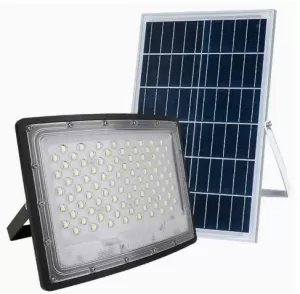
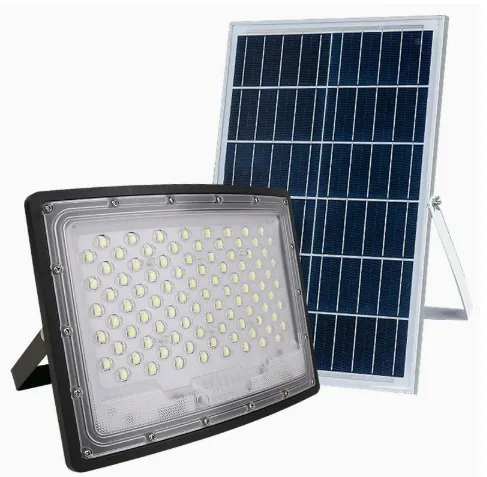
We modelled two real panel-and-battery sizes from our solar flood light range in our battery autonomy calculator. Profile: an average of 2 W for 12 hours, typical of a decorative colour-changing flood running a slow fade. That uses about 27 Wh a night after driver losses. We used PVGIS monthly sun for a horizontal panel, a PWM controller and a 15 % yield on cloudy days:
| Panel | Battery | Site and month | Sun hours | Energy per sunny day | Nights from a full battery | Keeps up day to day? |
|---|---|---|---|---|---|---|
| 10 W | 10,000 mAh (32 Wh) | Manila, December | 3.7 | 22 Wh | about 1.2 | No |
| 10 W | 10,000 mAh | Lagos, June | 4.03 | 24 Wh | about 1.3 | No |
| 10 W | 10,000 mAh | Manila, April | 6.31 | 38 Wh | about 1.4 | Yes |
| 20 W | 15,000 mAh (48 Wh) | Manila, December | 3.7 | 44 Wh | about 2.2 | Yes |
| 20 W | 15,000 mAh | Lagos, June | 4.03 | 48 Wh | about 2.2 | Yes |
(open the 10 W Manila example · open the 20 W example)
The 10 W unit is fine in the sunny months but falls behind in Manila’s December and Lagos’s rainy June: each night uses more than the day puts back, so the light gets shorter night by night. Doubling the panel fixes it. The same logic applies to small colour-changing stakes and lanterns, just at a smaller scale.
Getting more hours from the same light
- Use a fixed colour rather than fast cycling with all channels.
- Use a timer mode, such as 4–6 hours from dusk, instead of all night.
- Put the panel in full sun. Units with the panel on top of the lamp often sit in shade; a separate panel on a cable can go in the sun. Our solar floods come with a 5 m cable for this.
- Clean the panel every few weeks in dusty or coastal areas.
- Replace tired batteries. NiMH cells in small lights lose capacity after one or two seasons; see our how to change the battery in a solar garden light guide.
Lanterns, path lights and floods compared
| Type | Typical panel | Typical use | What to check |
|---|---|---|---|
| Hanging lanterns | Under 1 W | Patios, trees, events | Battery type and replaceability |
| Path and stake lights | Under 1 W | Borders, paths | Lumens in white mode, IP rating |
| Fence and post-cap lights | 1–2 W | Fences, decks | Fixing to the post size |
| Spot and flood lights | 3–30 W | Trees, walls, pools | Panel Wp and battery Wh |
For lights that must also be practical, such as path lighting at a hotel, use white lights for the path and colour for features. Our top-rated solar path lights guide covers what to look for.
For retailers and projects
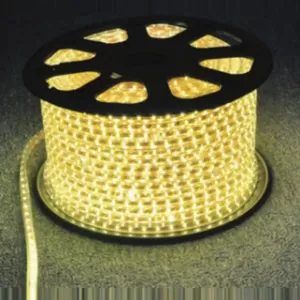
If you sell colour-changing solar lights, quote panel watts and battery Wh on the listing, not only “RGB 100 W”, so buyers can judge the run time before they buy. For landscape projects with mains power, our 12 V LED strip light BG-LB12, offered in red, green, blue and yellow as well as white, gives steady colour without battery limits.
What to send us
The number of lights, the colours or modes you want, the hours they must run, and the location so we can check PVGIS sun data. We will suggest the panel and battery size and give the real run time in the darkest month.
Sources
Frequently asked questions
How do colour-changing solar lights work?
A solar panel charges a battery by day. At dusk a light sensor switches on a controller that drives red, green and blue LEDs, mixing them into different colours or cycling through them. Some have a button or remote to pick a fixed colour.
Why do colour-changing solar lights go dim or stop early?
Usually because the panel cannot refill the battery in short or cloudy days. Coloured modes also look dimmer than white. Choose a larger panel, a fixed colour or a timer mode.
Can colour-changing solar lights stay one colour?
Many can. A fixed-colour or 'lock' mode is common, selected by a button or remote. Fixed colours usually use less power than cycling modes.
Are colour-changing solar lights bright enough for paths?
For marking a path, yes. For lighting it so people can see the ground clearly, a white solar path light or a mains light does better. Use colour for decoration and white for safety.