Solar Gazebo Lights: How Much Light a Gazebo Needs and the Panel and Battery to Run It
How to light a gazebo or pergola with solar: how many lumens a 3 × 4 m gazebo needs for ambience or dining, and the panel and battery sizes from our calculators and PVGIS sun data.
Key points
- A gazebo needs about 30 lux for relaxing and about 75 lux for eating and reading; for a 3 × 4 m gazebo that is roughly 1,100 and 2,700 lumens on the floor plan by the lumen method.
- Most solar string lights and lanterns give tens to a few hundred lumens: fine for mood, too little for a dinner table.
- In our solar calculator, a 10 W lamp running 4 hours a night uses about 44 Wh; with a flat panel it needs about 18 W of panel in a Johannesburg or Lagos June and about 31 W in a Cape Town June.
- Doubling to 20 W for dining light doubles the panel to about 37 W (Johannesburg) or 62 W (Cape Town).
- A split solar light, with the panel on the gazebo roof or a sunny spot nearby and the lamp inside, is the practical way to get useful light under a roof.
A gazebo or pergola is where people sit after dark: drinks, dinner, a book. Solar lighting is attractive because running a cable across a garden is a job, and gazebos often stand at the far end. The difficulty is that a gazebo has a roof, and the roof shades exactly the panels that solar lights depend on. This guide works out how much light a gazebo needs and what panel and battery it takes, so you can tell a real solution from a decorative one.
How much light a gazebo needs
Two uses set two targets:
| Use | Target on the floor | Feel |
|---|---|---|
| Relaxing, conversation, drinks | about 30 lux | Soft, like a lamp-lit room |
| Eating, games, reading | about 75 lux | Clear enough to see food and print |
We used the lumen method in our indoor lighting calculator for a typical 3 × 4 m gazebo with lights 2.4 m up. With open sides, there are no walls to reflect light, so we chose dark surroundings; the calculator gives a utilisation factor of about 0.42. With a maintenance factor of 0.8:
- 30 lux: 30 × 12 m² ÷ (0.42 × 0.8) = about 1,100 lumens
- 75 lux: 75 × 12 m² ÷ (0.42 × 0.8) = about 2,700 lumens
At 100 lm/W, that is about 11 W of LED for relaxing and 27 W for dining. Spreading the dining light over two to four points avoids harsh shadows on the table.
Why many solar gazebo lights disappoint
Most products sold as gazebo lights are strings, fairy lights or lanterns with a small built-in panel. A few hundred lumens in total is common, and many give far less. They make an attractive glow, which is the point, but they will not light a dinner table. And when the panel is built into a lantern hanging under the roof, it hardly charges at all.
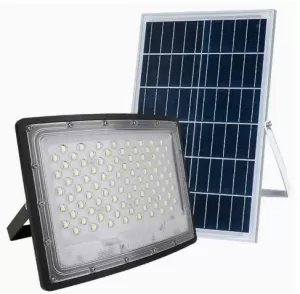
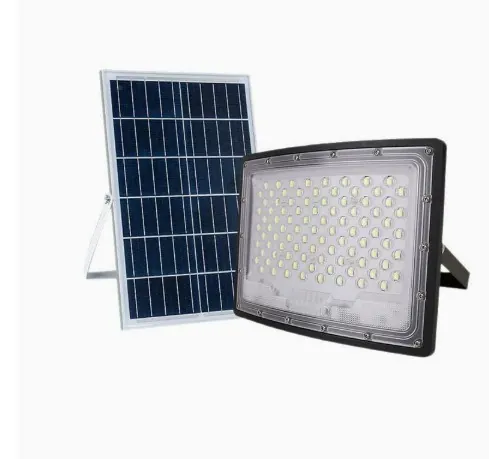
If the goal is useful light, look for a split solar light: the panel goes in the sun, the lamp goes under the roof, and a cable joins them. Our solar flood lights use a 5 m cable and come with 3–30 W panels and 3.2 V batteries of 9.6–80 Wh, so the panel can sit on the gazebo roof or a fence while the lamp hangs inside.
Panel and battery, worked out
We used our solar street light calculator, which works for any solar lighting load, with:
- A lamp running 4 hours a night at full power, 90% driver efficiency
- Sun hours from PVGIS for a flat panel in the weakest month
- A simple PWM charge controller, as in most small solar lights (60% system efficiency)
| Place and month | Sun hours | 10 W lamp: panel | 20 W lamp: panel |
|---|---|---|---|
| Lagos, June | 4.03 | about 18 W | about 37 W |
| Johannesburg, June | 4.06 | about 18 W | about 37 W |
| Nairobi, July | 4.16 | about 18 W | about 36 W |
| Cape Town, June | 2.40 | about 31 W | about 62 W |
Energy per night is about 44 Wh for the 10 W lamp and 89 Wh for 20 W. For one night of storage with lithium iron phosphate at 90% depth, the 10 W lamp needs about 49 Wh of battery, within the 48–80 Wh range of our larger solar flood light batteries. Two nights of storage, which rides through a cloudy day, needs about 99 Wh.
So a relaxing light of about 1,000 lumens is realistic with a 20 W panel in most sunny climates. Dining-level light of 2,000–2,700 lumens for 4 hours needs a panel of 40 W or more and a bigger battery: possible, but the panel then needs a proper mount on the roof or a post.
Where to put the panel
- On the gazebo roof, facing the equator (north in the southern hemisphere, south in the northern), clear of overhanging trees.
- On a nearby post or fence in full sun, with the cable run along the frame.
- Away from house shadows in winter, when the sun is lower and shadows longer. Our guide to solar street lights in shade shows how much even partial shade costs.
Making the light go further
- Use a remote or timer. Light the gazebo only when someone is there; most of our solar flood lights come with a timer remote.
- Dim for conversation. Half brightness is plenty when not eating, and doubles the hours.
- Warm white. 3000 K feels cosier and suits a garden; it costs a little efficacy, which the panel sizing should allow.
- Mix sources. One split solar lamp for useful light plus solar strings for mood is a good combination.
Gazebos, pergolas and shelters at scale
The same method applies to larger shelters: park pavilions, restaurant terraces, bus shelters and campsite cooking areas. Above a few hundred watt-hours a night, a small solar street light system with a separate panel and battery is more economical than many consumer products. See solar shed lights for a similar sizing indoors, and outdoor solar lighting ideas for the rest of the garden.
For retailers and installers
When you sell gazebo lighting, separate decorative products from functional ones, and quote the panel watts and battery watt-hours of the functional lights. For projects or private-label retail, send us the shelter size, the use and the location; we will size the panel and battery against PVGIS data and propose garden and landscape lights or split solar flood lights to match.
Sources
Frequently asked questions
How do you light a gazebo with solar?
Use a split solar light with the panel on the gazebo roof or in a nearby sunny spot and the lamp hung inside, joined by a cable. Add solar string lights or lanterns for mood if you like.
How many lumens do I need for a gazebo?
For a 3 × 4 m gazebo, about 1,100 lumens for relaxing (around 30 lux) and about 2,700 lumens for dining or reading (around 75 lux), by the lumen method with dark surroundings.
Do solar gazebo lights work under a roof?
Only if the panel is outside the roof's shade. Lights with built-in panels hung under a gazebo roof charge poorly; a split design with the panel in the sun solves it.
How long will a solar gazebo light stay on?
As long as its battery and the day's sun allow. A 10 W lamp with a 20 W panel and a 50 Wh battery runs about 4 hours a night through a sunny winter month, by our calculation.