Solar Shed Light With Remote Control: Panel, Battery and Hours Worked Out for Winter
How to choose a solar shed light with a remote: split panel or all-in-one, how many hours a night it can run in winter, and battery sizes worked through our battery calculator with PVGIS sun.
Key points
- For lighting inside a shed, choose a split light: the panel goes outside in the sun, the lamp goes inside, joined by a cable (our solar flood lights use a 5 m cable).
- In our battery calculator, a 10 W lamp with a 10 W panel and a 3.2 V 10 Ah (32 Wh) battery runs 1 hour a night through a January at 33° N (3.05 peak sun hours, PVGIS) and still covers about 3.4 cloudy days.
- Run the same light 2 hours a night and the battery slowly drains in that winter month: the panel puts back about 18 Wh a day against 22 Wh used.
- The remote control is the best energy saver in a shed: switch on when you go in, off when you leave, or set the timer.
- Check the real panel watts and battery Wh, not the lamp's headline wattage: they decide how long the light runs.
A garden shed, workshop or storage hut is often too far from the house for mains wiring, and running a cable means digging a trench. A solar shed light avoids that, and most now come with a remote control. The question is whether it will give enough light on a winter evening, when you are most likely to need it. This guide explains the types and works out how many hours a night they can run, using real winter sun figures.
Two types of solar shed light
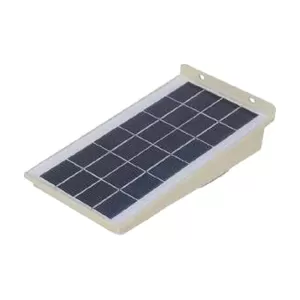
All-in-one lights have the panel on top of the lamp. They work on the outside of the shed, above the door or along a path, where the panel sees the sky. Our solar wall light SL3530J005 is this type: 5 W, a 6.8 Wp panel and a 3.7 V 8 Ah lithium battery, mounted at 3–5 m.
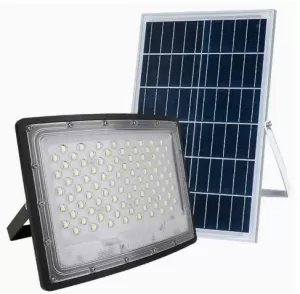
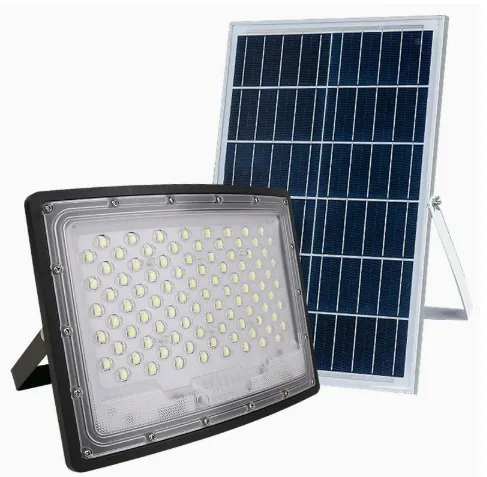
Split lights have a separate panel connected by a cable. The panel goes outside, on the roof or a sunny wall; the lamp goes inside, over the workbench or door. Our solar flood lights are this type, with 6 V panels from 3 to 30 W, 3.2 V batteries from 3,000 to 25,000 mAh (9.6 to 80 Wh) and a 5 m waterproof cable. Control is by light sensor, timer and remote, depending on the housing.
For light inside a shed, the split type is the only one that works properly. A panel behind a shed window or under a translucent roof sheet receives only a fraction of the sun.
Hanging solar bulbs with a remote panel are a small version of the split type. They suit a garden room or tool store where you need a little light for a few minutes.
Headline watts versus real watts
Many solar flood lights are sold as “100 W” or “200 W” when the LED board draws a fraction of that. What decides how long a light runs is:
- The real panel watts (Wp), which set how much energy comes in each day.
- The battery in Wh (volts × Ah), which sets how much it can store.
- What the lamp really draws in watts.
Below we use a lamp that really draws 10 W, which gives plenty of light for a shed of a few square metres.
Worked example: a 10 W split light in winter
We used our battery autonomy calculator with:
- Lamp 10 W, panel 10 Wp, battery 3.2 V 10 Ah LiFePO4 (32 Wh), simple PWM charging.
- Winter sun: 3.05 peak sun hours, the January figure for Islamabad (about 33° N) from PVGIS. It stands for a sunny but clearly seasonal climate; the darkest European winters are far lower.
| Use per night | Energy used | Panel brings in | Cloudy days covered | Result |
|---|---|---|---|---|
| 1 hour at full power | 11.1 Wh | 18.3 Wh | about 3.4 | Battery stays full |
| 2 hours at full power | 22.2 Wh | 18.3 Wh | about 1.5 | Battery slowly drains |
At one hour a night the light comfortably covers winter. At two hours it uses more each day than the panel can put back, so the battery runs down over a week or two of winter weather. Open the example and enter your own lamp, panel, battery and sun.
For 2 hours a night at that sun level, choose a panel of about 15–20 W and a battery of 20,000 mAh or more, or a lamp set to half brightness.
Worked example: an all-in-one light over the shed door
The SL3530J005 wall light draws 5 W, with a 6.8 Wp panel and a 3.7 V 8 Ah battery (about 29.6 Wh). Used 1 hour a night in the same January sun, our calculator gives:
- Energy used: 5.6 Wh a night.
- Panel brings in: about 12.4 Wh a day.
- Cloudy days covered: about 6.4.
So an all-in-one light over the door handles winter easily for short use, and with a motion sensor it only comes on when someone approaches.
Mounting the panel
- Face the equator. South in the northern hemisphere, north in the southern.
- Tilt it. A tilt close to your latitude helps in winter, when the sun is low. Our article on solar panel tilt angle explains the effect.
- Avoid shade. A tree branch across part of the panel can cut its output sharply. Check the shade in winter, not summer.
- Run the cable neatly. Drill a small hole through the shed wall above the lamp, slope it down to the outside, and seal it so water does not follow the cable in.
Our solar flood light installation guide covers brackets, cable and first charge.
Using the remote control well
A shed light is used for minutes at a time, so control matters more than size:
- Switch off when you leave. A light left on all night empties the battery and may take days to recover in winter.
- Use the timer. Many remotes set 1, 3 or 5 hours, so the light switches off even if you forget.
- Use lower brightness for finding tools; full brightness for working at the bench.
- Keep the remote in the shed, on a hook by the door.
Charging and winter care
- Before first use, leave the light switched off for a day or two of sun to fill the battery.
- In a long dark spell, a light used daily can run flat. Our article on how to charge solar lights without sun covers the options.
- Lithium batteries do not like charging below freezing. A battery inside the lamp in an unheated shed is protected from the worst cold, but it still gets cold; check the charging temperature in the data sheet.
- Wipe the panel each month in winter; dirt and leaves cut output.
Solar lights for other outbuildings
The same sizing works for garages without power, stables, chicken coops and greenhouses. Our guide to solar lights for indoor use covers rooms where the panel and lamp are farther apart.
For retailers and installers
We supply solar flood lights with separate panels, remote controls and battery options, and all-in-one solar wall lights, for garden centres, hardware chains and installers. Tell us the market, the price range and the packaging you need; we will confirm the panel watts, battery Wh and certificates for each housing with the quotation.
Sources
Frequently asked questions
Can a solar light work inside a shed?
Yes, if the panel is outside. Use a split solar light with the panel on the roof or a south-facing wall (north-facing in the southern hemisphere) and the lamp inside, connected by a cable through the wall.
How long will a solar shed light stay on?
As long as the battery holds and the panel can recharge each day. In our winter example, a 10 W lamp with a 10 W panel and 32 Wh battery manages about 1 hour a night; for 2 hours a night in winter, choose a larger panel and battery.
What does the remote control on a solar shed light do?
It switches the lamp on and off, and on many models sets brightness and a timer (for example 3 or 5 hours). Switching off when you leave the shed is what keeps the battery full.
Should a solar shed light have a motion sensor?
For a shed door or path, yes: the light only comes on when someone approaches. Inside a shed a remote or pull switch is often more practical, because a motion sensor may switch off while you stand still at a workbench.