How to Charge Solar Lights Without Sun: What Works, What Doesn’t, and the Numbers
Can solar lights charge on cloudy days, behind a window or under a lamp? The real charging numbers for a small solar light, and what to do for garden lights and solar street lights.
Key points
- Solar panels charge from light, not heat. Outdoor daylight on a cloudy day still gives far more energy than any indoor lamp.
- Under a typical indoor LED lamp, a 6.8 Wp solar wall light panel receives roughly 0.1–0.2% of full sun; filling its 29.6 Wh battery would take months.
- For small garden lights, the practical fix is to charge or swap the batteries with a proper charger, not to put the panel under a lamp.
- For solar street lights, there is nothing to do on site: autonomy must be designed in, with a bigger battery and panel or a dimming profile.
Every winter we get the same question from distributors and homeowners: the weather has been grey for a week, the solar lights are dim or dead, how do I charge them without sun? The honest answer depends on what kind of solar light you have. A small garden or wall light can be helped by hand. A solar street light needs to be designed for the weather, because nobody can charge it on a pole. Below we put real numbers on the common ideas, using our own products and calculator.
Solar panels charge from light, not from heat
A solar panel turns light into electricity. A hot, hazy day charges well; a cold, clear day charges very well. What matters is irradiance: how many watts of light fall on each square metre of panel. Panels are rated at 1,000 W/m², roughly full midday sun with a clear sky.
Typical values look like this:
| Condition | Approximate irradiance | Share of rated output |
|---|---|---|
| Clear sky, midday | 900–1,000 W/m² | 90–100% |
| Thin cloud or haze | 400–700 W/m² | 40–70% |
| Heavy overcast | 100–250 W/m² | 10–25% |
| Bright room, under an LED ceiling light (about 500 lux) | about 1.5–2 W/m² | about 0.15–0.2% |
The last line surprises people. A room that feels bright to the eye is a few hundred lux; outdoor sun is about 100,000 lux. Our eyes adapt; solar cells do not.
Example: charging a 5 W solar wall light indoors
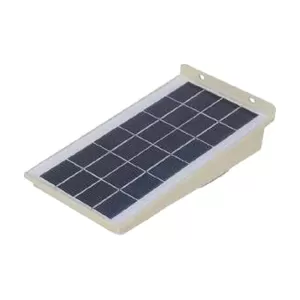
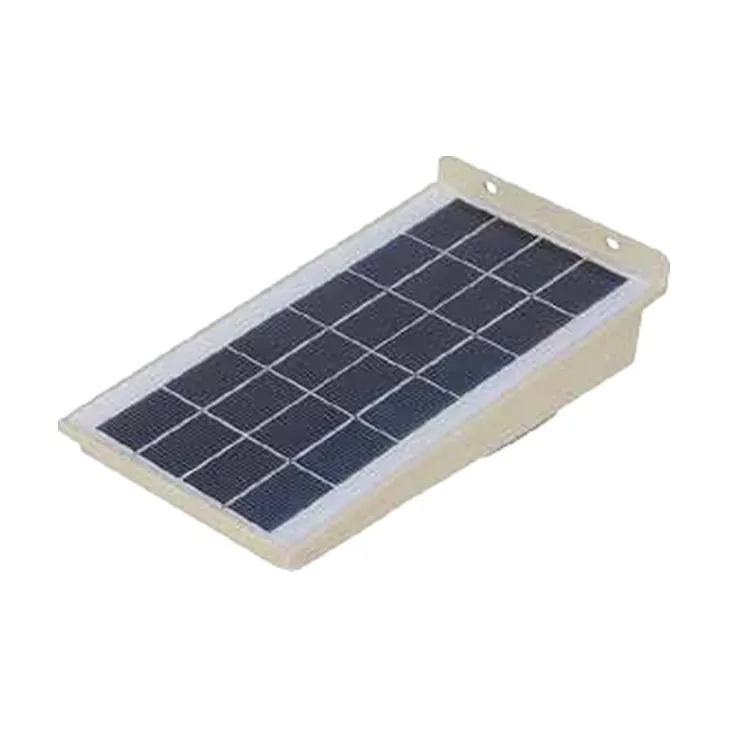
Take our SL3530J005 solar wall light: a 6.8 Wp panel and a 3.7 V, 8 Ah lithium battery, which stores about 29.6 Wh.
- Outdoors, clear day: about 4.5 peak sun hours × 6.8 W × about 72% system efficiency ≈ 22 Wh. The battery fills from empty in about a day and a half.
- Outdoors, heavy overcast: at 15% of clear-sky output, about 3.3 Wh a day. It needs about nine such days to fill, but each evening it still gets a few hours of light.
- Indoors under a room light, 24 hours a day: at 0.15% of rated output, the panel gives about 0.01 W, or roughly 0.2 Wh a day before low-light losses. Filling the battery would take well over 100 days. In practice small panels work even worse than this in very dim light, so the result is close to zero.
So the most common internet tip, “put it under a lamp”, does not work in any useful way. Leaving the light outside on a grey day still gives more than ten times as much as a full day under a room light.
What actually works for small solar lights
1. Move it into whatever daylight there is. Clean the panel, clear leaves and snow, and turn the panel towards the brightest part of the sky (south in the northern hemisphere, north in the southern). A panel in open overcast beats one in shade on a sunny day.
2. A sunny window, if it gets direct sun. Clear glass passes most sunlight. Coated or tinted glass passes less, sometimes much less. A south-facing sill in direct sun is a reasonable back-up during a storm; a north window in the shade is not.
3. Charge the battery directly. Most small solar garden lights use AA or AAA NiMH cells, or a single 18650 lithium cell. Take them out and charge them in a charger made for that chemistry, then put them back. This is the fastest real way to “charge without sun”. Never put alkaline cells into a solar light, and never charge lithium cells in a NiMH charger.
4. A USB port, if the light has one. Some consumer models have a USB socket for charging. Use it if yours has one. Our solar street and wall lights are designed to charge from their own panel, so check the datasheet before assuming a socket is there.
5. Switch off for a couple of days. If the light has an on/off switch, turning it off for two or three days lets the panel fill the battery instead of the light emptying it every night.
6. Very bright lamp, very close. A halogen work lamp a short distance from the panel does deliver real power, but it also heats the plastic housing and lens, and it uses far more electricity than it puts into the battery. We do not recommend it.
Solar street lights: you cannot charge them by hand
A solar street light on a 6 m pole is not going to be taken down and plugged in. Its “charging without sun” plan has to be in the design: battery size, panel size and the night-time power profile. That is what our battery autonomy calculator is for.
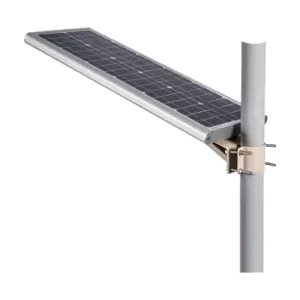
Here is our all-in-one SL5730C030 (30 W, 45 Wp panel, 12.8 V 18 Ah lithium battery) with a typical motion-sensing profile: full power for 2 hours, then 20% for 10 hours. In the calculator at 4.5 peak sun hours:
| Item | Value |
|---|---|
| Usable battery energy (90% depth of discharge) | 207 Wh |
| Energy used per night | 133 Wh |
| Energy harvested on a clear day | 146 Wh |
| Nights with no sun at all | about 1.6 |
| Nights on dull days giving 15% of normal harvest | about 1.9 |
| Clear days to refill after a three-day dull spell | about 17 |
This tells you two things. First, a dull week will run the battery down; the light protects itself by dimming further before it switches off. Second, with only 12.5 Wh of surplus on a clear day, recovery is slow. On a site with long rainy spells we would choose a bigger battery and panel, a lower night profile, or a split design. Our rainy days guide covers how to size for that, and solar lights that work in winter covers short days and cold batteries.
Why solar lights go dim before they go dark
Good solar controllers protect the battery. When the battery voltage falls, the controller first cuts the light output, then shortens the lighting time, and only switches off below a set voltage. A light that is dim after three grey days is not faulty; it is doing its job. A light that stays dim after a week of sunshine probably has a dirty or shaded panel, a battery near the end of its life, or a profile set too high for the panel.
Checklist after a long dull spell
- Clean the panel with water and a soft cloth.
- Check for new shade: grown trees, a new building, snow on the panel.
- Give it two or three clear days before judging it.
- For small lights, recharge or replace the batteries with the correct type.
- For street lights, check the controller’s battery voltage reading if it has an app or remote.
- If the same lights fail every winter, the system is undersized for the site. Re-run the numbers before buying replacements.
Summary
Solar lights charge from light, and nothing indoors comes close to daylight, even grey daylight. For small lights, the practical ways to “charge without sun” are to keep them outside in open light, use a sunny window, or charge the batteries directly. For solar street lights, the answer is design: enough battery and panel for the local weather, and a sensible night-time profile, so they ride through dull days on their own.
Sources
Frequently asked questions
Can solar lights charge on a cloudy day?
Yes, but more slowly. Thin cloud may still let through half of clear-sky sunlight; heavy overcast often only 10–25%. A light that is correctly sized for its site recovers over the next sunny days.
Can I charge a solar light with a lamp indoors?
Only in theory. An indoor room light gives roughly a thousandth of the energy of direct sun. A very bright lamp held close does more but can overheat the plastic and is still slow. Charging the battery with a charger is faster and safer.
Do solar lights charge through a window?
Yes, if direct sun falls on the panel. Clear glass passes most of the light, coated or tinted glass less. A panel in the shade behind a window charges very little.
Should I switch solar lights off to let them charge?
If the light has a switch, turning it off for two or three sunny days lets a run-down battery fill completely. This helps after a long dull spell or when a new light arrives with a partly charged battery.