Charging Solar Lights the First Time: How Long It Takes and How to Do It Right
How to charge solar lights for the first time: switch position, sun exposure, and how many days a garden light and our 30 W solar street light need to fill their batteries, by calculation.
Key points
- Before first use, charge solar lights in full sun with the switch off, or the light will drain the battery each night before it ever fills.
- Our 30 W all-in-one street light has a 230 Wh battery and a 45 Wp panel; at 4.5 peak sun hours it collects about 146 Wh a day, so an empty battery needs about 1.6 sunny days and a 30 % charged one about 1.1.
- A small solar flood light with a 3.2 V 10 Ah battery and a 10 W panel fills in about 1.2 sunny days, or about 2 days in weak winter sun.
- Charging behind a window, in shade or with the protective film still on the panel can stretch the first charge to a week or more.
New solar lights often disappoint on the first night: they glow dimly for an hour and go out. In almost every case nothing is wrong with the light. The battery simply never got a full charge. Charging solar lights the first time properly takes a day or two of sun, and the steps are the same for a small garden light and a solar street light. This guide explains them and calculates how long the first charge takes for two of our lights.
Why the first charge matters
A solar light is a small energy system: the panel fills the battery during the day, the light empties it at night. When the battery starts low and the light is switched on from day one, the light uses each day’s charge the same night. The battery never reaches full, the light runs short every night, and a lithium battery held at low charge ages faster.
Giving it one uninterrupted charge to full breaks that cycle. After that, the daily charge only has to replace the night’s use.
Step by step
- Unpack and remove all film. Many panels ship with a clear protective film. Left on, it cuts the charge noticeably.
- Switch the light off. On most designs the switch disconnects the lamp but leaves charging working. Our guide to the solar light on/off switch explains what the switch actually controls.
- Place it in full, direct sun. Outdoors, with the panel facing the midday sun and no shade from walls, trees or roof edges between about 9 am and 3 pm.
- Leave it for one to three sunny days. See the calculation below for how long your size needs.
- Switch on and install. From then on, the light should run its full programme.
If the weather is poor for a week after installation, the light may still run short at first. That is a weather problem, not a first-charge problem; see how to charge solar lights without sun for options.
How long it takes: two worked examples
The time depends on the battery’s energy, the panel’s power and the sun. We used the same formulas as our battery autonomy calculator: daily charge = panel watts × peak sun hours × charging efficiency (0.72 for an MPPT controller, 0.6 for PWM).
A small solar flood light
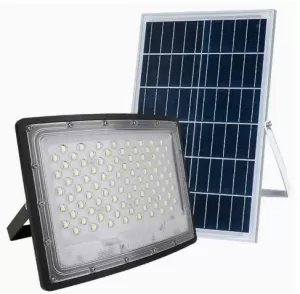
The size sold as “100 W” in our solar flood light range has a real 10 W panel and a 3.2 V, 10 Ah lithium battery (32 Wh), with a PWM controller.
| Sun | Daily charge | Empty to full | From 30 % |
|---|---|---|---|
| 4.5 peak sun hours (summer, or sunny climate) | 27 Wh | about 1.2 days | about 0.8 days |
| 2.5 peak sun hours (winter, cloudy climate) | 15 Wh | about 2.1 days | about 1.5 days |
Our 30 W all-in-one solar street light
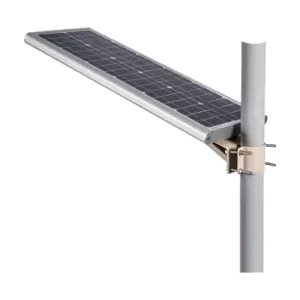
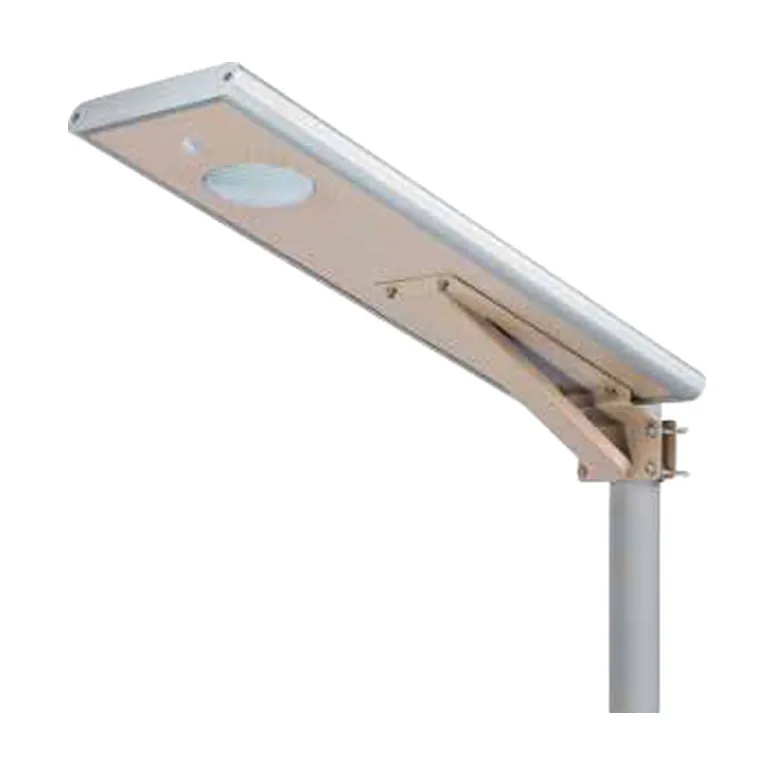
The SL5730C030 has a 12.8 V, 18 Ah lithium battery (230 Wh) and a 45 Wp panel with an MPPT controller.
| Sun | Daily charge | Empty to full | From 30 % |
|---|---|---|---|
| 4.5 peak sun hours | about 146 Wh | about 1.6 days | about 1.1 days |
| 2.5 peak sun hours | 81 Wh | about 2.8 days | about 2.0 days |
The 15 W model (9 Ah, 20 Wp) takes slightly longer: about 1.8 days from empty at 4.5 peak sun hours, because its panel is smaller relative to its battery.
Peak sun hours for your site can be read from the free PVGIS tool from the European Commission’s Joint Research Centre. Use the value for the month you are installing in, not the yearly average.
Do new lights arrive charged?
Partly. Lithium batteries are shipped at a partial state of charge, and for air freight of batteries shipped on their own the rules cap it at 30 %. Batteries also self-discharge slowly in storage. A light that spent three months in transit and in a warehouse should be treated as nearly empty, which is why the “from 30 %” column above is a best case.
For large projects we recommend charging on site for a day before mounting, or mounting and leaving the lights switched off for the first day. With solar street lights, the switch or remote setting can do this; see our guide to solar street light remote control.
Common first-charge mistakes
- Charging behind glass. Window glass, especially double glazing with coatings, cuts the charge sharply. Always charge outdoors.
- Shade for part of the day. Even a narrow shadow across one row of cells reduces the output of the whole panel.
- Panel facing the wrong way. In the northern hemisphere, face south; in the southern hemisphere, north. Near the equator, keep the panel almost flat but tilted enough to shed rain.
- Leaving the light on. It turns on at dusk and uses what it collected.
- Expecting full brightness from rechargeable AA cells after years in a drawer. Old NiMH cells lose capacity; our guide to rechargeable batteries for solar lights covers replacements.
After the first charge
A well-sized solar light should refill its battery on an ordinary sunny day and run through the night. If it still runs short after a proper first charge, check in this order:
- Panel clean and unshaded?
- Light programme (full power hours, dimming) set as intended?
- Battery old or damaged by deep discharge?
- Is the system simply too small for the site’s winter sun?
The last point is a sizing issue. Our solar street light calculator shows the panel and battery a given light needs in a given place.
For distributors and installers
If you sell or install solar lights, add a first-charge line to the instructions you give customers: “Charge in full sun with the switch off for two days before first use.” It prevents many “faulty light” complaints in the first week, and it costs one sentence.
Sources
Frequently asked questions
How long should I charge solar lights before first use?
One to three full sunny days with the light switched off, depending on battery size, panel size and the season. Our calculation gives about 1.2 days for a small solar flood light and about 1.6 days for our 30 W solar street light from empty, at 4.5 peak sun hours.
Should solar lights be on or off when charging the first time?
Off, if the light has a switch. The panel still charges the battery when the switch is off on most designs, and the light cannot use the energy at night until the battery is full.
Do new solar lights come charged?
Usually partly. Lithium batteries leave the factory at a partial charge for safety and storage, and they slowly self-discharge in the warehouse, so plan a full charge before installation.
Can I charge solar lights indoors under a lamp?
Only very slowly. Indoor lamps deliver a tiny fraction of the energy of direct sunlight on the panel. Charge outside in direct sun, or use a model with a USB or mains charging port if you must charge indoors.