How to Compare Solar Lights for Brightness and Durability
A spec-sheet checklist for comparing solar lights: lumens, panel Wp, battery Wh, night profile, IP rating and battery chemistry, with a worked check of a 30 W all-in-one in our calculator.
Key points
- Compare brightness on lumens and the night profile, not on the 'W' printed on the box; many solar lights are labelled with a lamp rating far above what the panel can support.
- The two numbers that decide how bright a solar light can be all night are panel watts-peak and battery watt-hours.
- Our 30 W SL5730C030 (45 Wp, 12.8 V 18 Ah) runs about 1.7 nights from full with motion dimming in our calculator for Nairobi's June sun; a fixed 30 W profile would need about a 100 Wp panel.
- For durability, check the battery chemistry (LiFePO4 lasts longest), the IP rating, the housing material and the stated design life.
Solar lights are hard to compare in a shop or an online listing. Boxes show large wattages and bright photos, and two lights with the same label can perform very differently. This guide gives a checklist for comparing brightness and durability from the spec sheet, then works through a real check on one of our own lights to show how the numbers fit together.
Brightness: the four numbers
1. Lumens
Lumens measure light output. Compare lumens, not watts. If only watts are given, ask for the efficacy (lumens per watt): good LED solar lights reach 100 lm/W or more.
2. Night profile
Almost every solar light dims during the night. A typical profile is full power for the first hours, then 20–50 %, sometimes with a motion boost. Ask for the profile. Without it, a lumen figure says nothing about how bright the light is at 2 a.m.
3. Panel watts-peak (Wp)
The panel decides how much energy the light collects each day. Collected energy is roughly panel Wp × peak sun hours × system efficiency (about 0.72 with MPPT, 0.6 with PWM).
4. Battery watt-hours (Wh)
Battery Wh = voltage × amp-hours. This decides how many hours or nights the light can run before it needs sun again.
The check: the energy used per night (from power and profile) must be less than what the panel collects on a worst-month day, and the battery should cover at least two nights.
Worked check: our SL5730C030
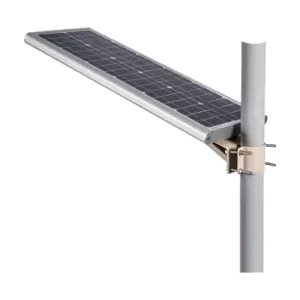
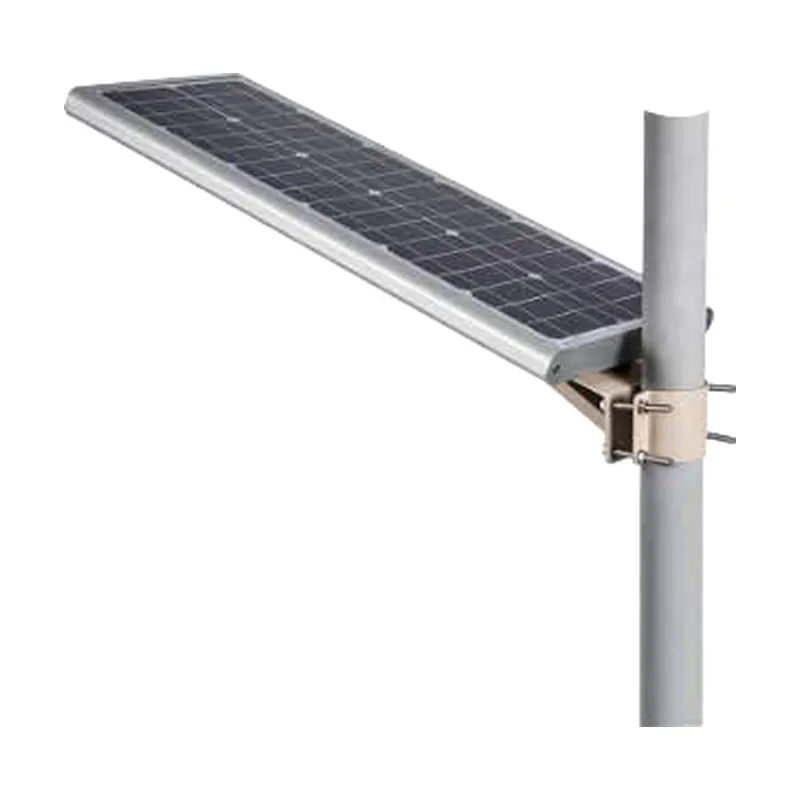
The SL5730C030 is a 30 W all-in-one solar street light with a 45 Wp panel and a 12.8 V 18 Ah lithium battery (230 Wh). It uses light control and a motion sensor.
Fixed profile, 30 W for five hours then 30 % for seven hours. Our solar street light calculator for Nairobi in June (4.05 peak sun hours) says this profile needs 237 Wh a night, a 789 Wh battery for three nights and about a 100 Wp panel (open the example). The SL5730C030’s 45 Wp panel cannot sustain that profile, and we would not sell it for that use.
Motion profile, the equivalent of one hour at full power and eleven hours at 30 %. Our battery autonomy calculator gives (open the example):
- energy per night: 143 Wh;
- energy collected on a clear June day: 131 Wh;
- from full: about 1.7 nights.
Close to balance, but slightly short in the worst month. At 20 % background the light uses 107 Wh a night, comes out ahead on clear days and runs about 2.4 nights from full. This is the honest way to use a compact all-in-one: on paths and estate roads where traffic is light and the motion boost does the work.
The lesson for any comparison: a “30 W” label tells you the LED rating, not what the light can sustain. Panel Wp and battery Wh tell you that. Our high lumen solar lights guide covers the same point for very bright models.
Durability: what to check
| Item | What to look for |
|---|---|
| Battery chemistry | LiFePO4 for long cycle life; avoid unknown “lithium” without a chemistry |
| Battery capacity margin | At least two nights at the worst-month profile |
| Controller | MPPT collects more than PWM, especially in cool weather |
| IP rating | IP65 minimum; IP66/67 for heavy rain or coast |
| Housing | Die-cast or extruded aluminium; UV-stabilised plastics for small lights |
| Panel | Monocrystalline, with a stated Wp |
| Design life | Stated for the system and the battery |
| Replaceable parts | Can the battery be changed without replacing the light? |
Our solar light replacement parts guide explains which parts wear first.
Shop and online listings
- Treat “dusk to dawn” without a profile as marketing.
- Be wary of listings with very high wattage and a small panel in the photo.
- Look for the battery Ah and voltage; if they are missing, ask.
- Check reviews from winter months; summer reviews flatter every solar light.
Bench and field tests
If you buy in volume, test samples:
- Charge fully, then measure run time at each mode indoors.
- Mount outdoors through a winter week and record when each light dims or fails.
- Measure lux at the ground at fixed points at 9 p.m. and 3 a.m.
- Open one unit to check battery labels and sealing.
Comparing our models
| Model | Power | Panel | Battery | Best for |
|---|---|---|---|---|
| SL3530C015 | 15 W | 20 Wp | 12.8 V / 9 Ah | Paths, motion mode |
| SL5730C030 | 30 W | 45 Wp | 12.8 V / 18 Ah | Estate roads, motion mode |
| SL6830C060 | 60 W | 75 Wp | 12.8 V / 33 Ah | Wider roads, motion mode |
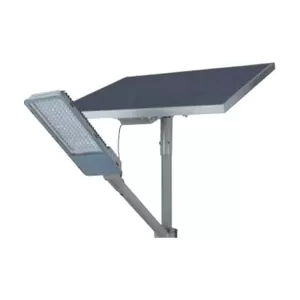
| SL4830G split | 20–60 W | 60–180 Wp | 12 V / 38–100 Ah | Fixed all-night profiles |
For fixed all-night lighting, the split system with its larger panel is the right comparison. For retailers comparing smaller garden lights, see our guide to top-rated solar lights.
What to send us
Your location, the hours and brightness you need, and the mounting height. We will check our models against your worst-month sun and tell you which one meets the profile.
Sources
Frequently asked questions
How do I know how bright a solar light is?
Look for lumens and the night profile. A light that gives 3,000 lumens for one hour and 600 lumens for the rest of the night is very different from one that gives 3,000 lumens all night. Then check that the panel and battery can support that profile.
Why do two '100 W' solar lights look so different?
The wattage on many solar lights is a nominal rating, not the power the panel can sustain. Compare the panel Wp and battery Wh: those set the real light output over a night.
Which battery is best in a solar light?
Lithium iron phosphate (LiFePO4) usually gives the longest cycle life and handles heat better than other lithium chemistries. Lead-acid is cheaper but heavier and wears faster when deeply discharged.
What IP rating should an outdoor solar light have?
IP65 is the practical minimum for outdoor use, meaning dust-tight and protected against water jets. IP66 or IP67 helps in heavy rain or coastal areas.