High Lumen Solar Lights: How Many Lumens a Solar Light Can Really Keep Up All Night
Which high lumen solar lights can actually stay bright: lumens vs panel watts and battery Wh, PVGIS worst-month sun hours for five cities, and what our all-in-one lights sustain over a night.
Key points
- Lumens on a solar light are limited by the panel, not the LED. Each 100 lumens kept on for 12 hours needs about 13 Wh a day, so roughly 4 Wp of panel in a 4.5-sun-hour month.
- PVGIS worst months: Lagos 4.03, Nairobi 4.05, Johannesburg 4.06, Manila 3.70 and Lahore 3.28 peak sun hours a day. Size for these, not the annual average.
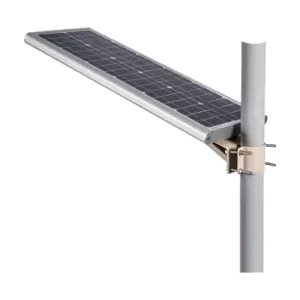
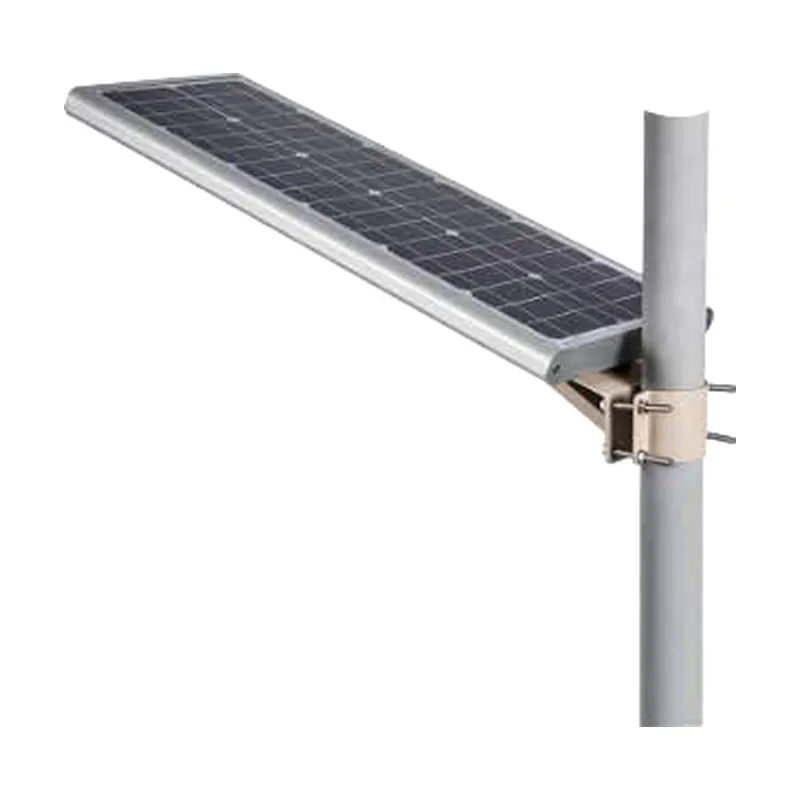
- Our 30 W all-in-one light (3,000 lm at full power) with a 45 Wp panel can sustain an average of about 1,100 lm over 12 hours at 4.5 sun hours; it uses motion sensing to give full light when someone is there.
- For a true 6,000 lm road light running a normal dimming schedule, our calculator asks for about 150–200 Wp of panel and 1.6 kWh of battery.
“High lumen” is the most common claim on solar lights, and the least useful. A solar light can show any number of lumens for a few minutes; what it can keep up all night is set by the panel and the battery. This guide puts numbers on that, using satellite sun data and our own all-in-one lights, so you can tell a bright light from a bright label.
Lumens need watt-hours
Light output comes from electrical power: a good LED street light gives 100–140 lumens per watt. A light that holds 3,000 lm for 12 hours uses about 30 W × 12 h = 360 Wh, plus driver losses. Every one of those watt-hours has to be collected by the panel the day before.
A simple rule of thumb at 100 lm/W:
- 100 lm for 12 hours ≈ 13 Wh a day (1 W × 12 h ÷ 0.9 driver efficiency)
- 13 Wh a day ≈ 4 Wp of panel in a month with 4.5 peak sun hours, with an MPPT controller (about 72% overall system efficiency)
So 1,000 lm all night needs about 40 Wp; 5,000 lm all night about 200 Wp. If a light claims 10,000 lm and has a 30 W panel, it can give that brightness for a short time only.
Sun hours: the number that decides everything
Peak sun hours (PSH) change by city and by month. We use the European Commission’s PVGIS satellite database. These are average daily values on a horizontal surface:
| City | Annual average PSH | Worst month PSH |
|---|---|---|
| Johannesburg | 5.66 | 4.06 |
| Nairobi | 5.46 | 4.05 |
| Lahore | 5.12 | 3.28 |
| Lagos | 5.06 | 4.03 |
| Manila | 4.86 | 3.70 |
Design for the worst month. A light sized on Lahore’s annual average of 5.12 would be about 36% short in its worst month (3.28), which is exactly when people complain that the lights go dark early.
What it takes to keep high lumens all night
We ran four light sizes through our solar street light calculator on a typical road schedule: 5 hours at full power after dusk, then 7 hours at 30%, LiFePO4 battery, MPPT controller, 3 days of autonomy. Full-power lumens assume 100 lm/W.
| LED power | Lumens at full power | Energy per night | Panel at 4.5 PSH | Panel at 3.5 PSH | Battery for 3 days |
|---|---|---|---|---|---|
| 15 W | 1,500 lm | 118 Wh | 40 Wp | 50 Wp | 394 Wh (31 Ah at 12.8 V) |
| 30 W | 3,000 lm | 237 Wh | 80 Wp | 100 Wp | 789 Wh (62 Ah) |
| 60 W | 6,000 lm | 473 Wh | 150 Wp | 200 Wp | 1,578 Wh (123 Ah) |
| 100 W | 10,000 lm | 789 Wh | 250 Wp | 360 Wp | 2,630 Wh (205 Ah) |
Open the 60 W example and enter your own city’s worst month. Notice how quickly the panel grows: a genuine 10,000 lm light needs a panel about the size of a door, not a laptop.
Our all-in-one lights, measured against the same method
Here is the same arithmetic applied to our own all-in-one solar street lights. Full-power lumens use the rated efficacy of over 100 lm/W; the sustainable average is what the panel collects in one day, spread over 12 hours.
| Model | LED power (lumens at full) | Panel | Battery | Hours at full power from a full battery | Average lumens over 12 h at 4.5 PSH | At 3.3 PSH |
|---|---|---|---|---|---|---|
| SL3530C015 | 15 W (1,500 lm) | 20 Wp | 12.8 V / 9 Ah (115 Wh) | about 6 h | about 490 lm | about 360 lm |
| SL5730C030 | 30 W (3,000 lm) | 45 Wp | 12.8 V / 18 Ah (230 Wh) | about 6 h | about 1,100 lm | about 800 lm |
| SL6830C045 | 45 W (4,500 lm) | 75 Wp | 12.8 V / 22 Ah (282 Wh) | about 5 h | about 1,800 lm | about 1,340 lm |
| SL6830C060 | 60 W (6,000 lm) | 75 Wp | 12.8 V / 33 Ah (422 Wh) | about 6 h | about 1,800 lm | about 1,340 lm |
This is why these lights use light control plus motion sensing: full output when someone walks or drives past, a low level in between. On a path or a village lane that suits the way the light is used. It is not the same as 3,000 or 6,000 lm continuously for 12 hours, and we would rather show that than let a label suggest otherwise.
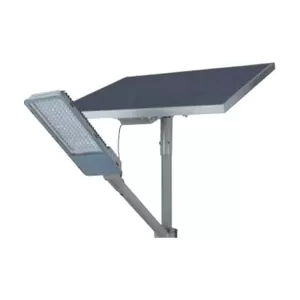
When a site does need high light levels all night, the answer is a bigger panel and battery, which means a split solar street light with a separate 60–180 Wp panel angled for the site.
How to read a high lumen claim
- Find the battery Wh. Voltage × amp-hours. A 3.2 V 30 Ah pack is 96 Wh; a 12.8 V 33 Ah pack is 422 Wh.
- Find the panel Wp. Check it against the panel’s physical size: modern mono panels give about 200 W per square metre.
- Divide. Panel Wp × worst-month PSH × 0.72 gives the daily energy. Divide by 12 hours for the average watts; multiply by about 100 for average lumens.
- Compare with the label. If the label is ten times the average, the light will be bright for an hour and dim for the rest of the night.
- Ask for the tested lumens of the luminaire, not the LED chips. Optical and thermal losses take 10–20% off chip lumens.
Our article on commercial vs cheap solar street lights walks through a “300 W” label in detail, and what is a lumen explains the unit itself.
Getting more lumens from the same panel
- Higher efficacy. At 140 lm/W instead of 100, the same energy gives 40% more light.
- MPPT controller. It collects roughly 20% more energy than PWM from the same panel; see MPPT vs PWM controllers.
- Tilt the panel. A panel tilted toward the equator collects more in the worst month than one lying flat; see our panel tilt angle guide.
- Dim late at night. Most roads are empty after midnight; 30% output then saves energy for the busy evening hours.
- Use the right optic. A road optic puts the lumens on the road instead of the hedges, so fewer lumens do the job.
Which lumen level for which use
| Use | Mounting height | Lumens at full power |
|---|---|---|
| Garden path, steps | 0.5–3 m | 100–500 lm |
| Driveway, yard, gate | 3–5 m | 1,000–2,000 lm |
| Village lane, footpath | 5–7 m | 2,000–4,000 lm |
| Estate or rural road | 7–9 m | 4,000–7,000 lm |
| Main road | 9 m and above | Usually grid-powered or a large split system |
If you need a light to stay on all night at a useful level, size it from the table above for your city’s worst month. Send us the location, mounting height and hours, and we will size the panel and battery and tell you honestly what lumen level it can hold.
Sources
Frequently asked questions
What is a good lumen rating for a solar light?
Paths and gardens: 100–500 lm. Driveways and yards: 1,000–2,000 lm. Village roads at 5–7 m: 2,000–4,000 lm. Roads at 8 m and above: 5,000 lm or more. What matters is how many of those lumens the light can keep up all night, which the panel and battery decide.
Why does my high lumen solar light get dim after a few hours?
Because its battery cannot run the full output all night. Most solar lights start bright and then dim or switch to motion mode to save energy. Compare the battery's watt-hours with the LED power × the hours you need.
How do I calculate the panel size for a solar light?
Daily energy = LED watts × hours (at each level) ÷ driver efficiency. Panel watts = daily energy ÷ (worst-month sun hours × about 0.72 for an MPPT system). Our solar street light calculator does this for you.
Are 20,000 lumen solar lights real?
A real 20,000 lm output needs about 150–200 W of LED power. Kept on for a night, that needs a panel of several hundred watts and a battery of several kilowatt-hours. If the light has a laptop-sized panel, the figure is a peak or an exaggeration.