Do Solar Street Lights Work During a Blackout? What Keeps Them On
Why standalone solar street lights keep working in a grid blackout or load shedding, what actually makes them go dark, and a battery calculation showing how many cloudy nights a 40 W light covers.
Key points
- A standalone solar street light has no connection to the grid, so a blackout or load shedding does not affect it at all.
- What can make it go dark is weather: several cloudy days in a row that empty the battery faster than the panel refills it.
- In our battery calculator example, a 40 W split light with a 65 Ah lead-acid battery and 120 Wp panel covers about 2 cloudy nights and recovers in about 3 sunny days.
- Hybrid (AC/DC) lights that run grid-first, and grid lights with a solar add-on, can still be affected by outages; check how the controller behaves.
- For routes that must stay lit through outages, size the battery for the longest cloudy spell at your site, not for the average day.
When the grid goes down, the street goes dark. Unless the street is lit by solar. Buyers in countries with regular load shedding, hurricane seasons or weak rural grids often ask whether solar street lights really keep working when the power fails, and what could still make them go out. The answers are simple, but the second one matters more than most people expect.
Short answer: a blackout does not touch a standalone solar light
A standalone solar street light is a closed system:
- Its panel charges its battery during the day.
- Its controller switches the lamp on at dusk and runs a dimming profile.
- There is no cable to the grid.
So when the grid fails, nothing changes for the light. It switches on at dusk as usual and runs its normal profile. This is why solar is popular for key routes in places with load shedding: grid lights go dark with every shedding stage, solar lights do not.
What can make a solar light go dark
If the grid is not the risk, what is? Three things:
| Cause | How it happens | How to prevent it |
|---|---|---|
| Weather | Several cloudy days drain the battery faster than the panel refills it | Size the battery and panel for the site’s worst season |
| Battery ageing | Capacity falls with years and heat | Plan replacement; use LiFePO4 where heat is high |
| Faults | Dirty panel, shading, loose connectors, failed controller | Inspection and cleaning schedule |
Weather is the one that confuses people during a blackout, because storms often cause both: the grid fails and the sky stays grey for days. When the solar lights then dim or go off after the third night, it looks as if the blackout caused it. It did not. The clouds did.
Worked example: how many cloudy nights a 40 W light covers
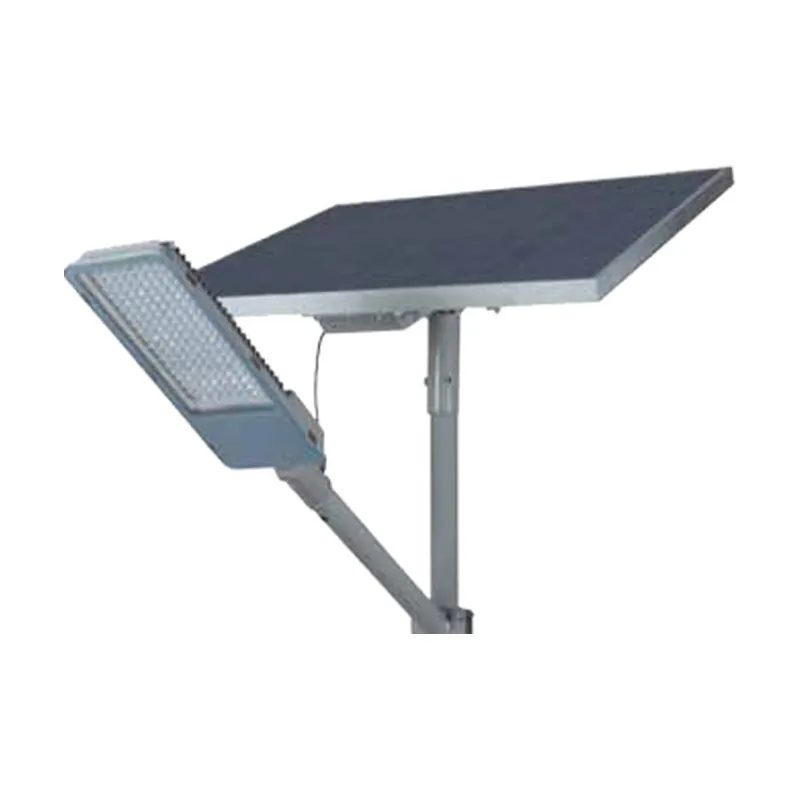
Take our SL4830G split solar street light, 40 W version, with a 120 Wp panel and a 65 Ah, 12 V lead-acid battery. Program it for 3 hours at full power after dusk and 9 hours at 30 % for the rest of the night.
Our battery autonomy calculator with 4.5 peak sun hours on a normal day, 15 % of that on a cloudy day and an MPPT controller gives:
- Usable battery energy: 390 Wh (50 % depth of discharge for lead-acid)
- Nightly consumption: about 253 Wh
- On a cloudy day the panel still brings in about 58 Wh, so the battery loses about 195 Wh per cloudy day and night
- Autonomy: about 2.0 cloudy nights before the battery is empty
- On sunny days the panel produces about 389 Wh, a surplus of about 135 Wh, so a full recovery takes about 2.9 sunny days
Open the example and enter your own battery, profile and sun hours.
What this tells you: the light rides through a grid blackout of any length, as long as the weather is fair. Through a storm with three grey days in a row, this configuration would dim or go off on the third night. If the route has to stay lit through such storms, you have three levers:
- Bigger battery, or a LiFePO4 battery with 90 % usable capacity instead of 50 %
- Gentler dimming profile, for example 2 hours at full power and 30 % or less for the rest of the night
- Bigger panel, to recover faster between storms
Many controllers also have a low-battery mode that dims further when the battery is low, so the light stays on at reduced level instead of going dark.
How to size for the worst week, not the average day
Average sun hours tell you how a light does on an ordinary day. Outages and storms happen on bad days. For a resilient design:
- Use the lowest monthly solar irradiation for the site from PVGIS, not the annual average.
- Look at local weather records for the longest run of overcast days in that season.
- Size the battery for that run, with the dimming profile you will actually use.
Our guide on how many rainy days a solar street light can handle shows this step by step.
Hybrid and grid lights behave differently
| Light type | During a grid blackout |
|---|---|
| Standalone solar | Unaffected |
| AC/DC hybrid, solar-first | Runs from battery; loses only its grid backup |
| AC/DC hybrid, grid-first | May go dark, or switch to battery if designed to |
| Grid LED light | Dark |
| Grid light with emergency battery | On for its emergency duration only |
If you are buying a hybrid, ask exactly what the controller does when the mains fails. Our AC/DC hybrid solar street light guide lists the questions.
Where solar lights help most during outages
- Junctions and crossings on routes with regular load shedding
- Hospital, clinic and police station access roads
- Evacuation routes in storm and flood-prone areas
- Rural roads and villages at the end of weak grids
- Industrial estates where security lighting must stay on
Our country guides for South Africa and Nigeria look at how load shedding and grid gaps shape solar lighting projects there.
Keep them ready
- Clean panels before the storm season; dust can cut output noticeably.
- Check that trees have not grown to shade panels.
- Replace batteries before they reach the end of their life, not after the first dark night.
- Log which lights dim first after bad weather; they point to shading or a weak battery.
Our solar street light not working guide covers the common faults.
What to send us
Send the site location, the route, the hours of light needed and how long the longest cloudy spells last. We will size the battery and panel so the lights stay on through the outages and the weather you actually get.
Sources
Frequently asked questions
Do solar street lights work during a power outage?
Yes, standalone solar street lights do. They charge from their own panel and run from their own battery, with no connection to the grid. A blackout makes no difference to them.
Why did my solar street light go off during a blackout?
The blackout itself is not the cause. Check whether the light is a hybrid model that depends on the grid, whether the battery was already low after cloudy weather, or whether the light has a fault. Our troubleshooting guide covers the usual faults.
How long can a solar street light run without sun?
It depends on the battery size and the dimming profile. Typical designs cover 2 to 5 nights. In our example, a 40 W light with a 65 Ah lead-acid battery covers about 2 nights with very little sun.
Are solar street lights good for areas with load shedding?
Yes. Load shedding switches off grid street lights when the grid is shed, while standalone solar lights stay on. That is one of the main reasons municipalities in such areas choose solar for key routes.
Can solar street lights power other things during a blackout?
They are not designed to. The battery is sized for the lamp only, and drawing extra power from it would shorten the lighting time and the battery's life.