Double Arm Solar Street Lights: Sizing the Panel and Battery for Two Heads on One Pole
Two 40 W heads on one solar pole need about 630 Wh a night, a 250 Wp panel and 2.1 kWh of lithium battery in our calculator. PVGIS checks for Nairobi and Lahore, and when two single poles are better.
Key points
- A double arm solar street light doubles the night load, so it needs about twice the panel and battery of a single head; all-in-one lights with the panel in the head cannot simply be doubled up.
- In our calculator, two 40 W heads (5 h full, 7 h at 30 %) use about 631 Wh a night and need a 250 Wp panel and 2,104 Wh of LFP battery (164 Ah at 12.8 V) for 3 days' autonomy at 4 peak sun hours.
- With PVGIS worst-month sun, the panel is 250 Wp in Nairobi (June, 4.05 h) but 300 Wp in Lahore (January, 3.28 h).
- A 40 W road head plus a 20 W footpath head needs 473 Wh a night, 180 Wp and 123 Ah at 4 peak sun hours, a cheaper way to light a road and its sidewalk.
Double arm poles are common on grid-powered roads: one pole, two heads, both sides of the carriageway lit. When buyers ask for the same on solar, the panel and battery have to be sized for two heads, and that changes the pole, the battery box and sometimes the choice between one double pole and two single ones. This guide works through the sizing with our calculators and PVGIS sun data.
What changes with two heads
| Item | Single 40 W head | Double arm, 2 × 40 W |
|---|---|---|
| Night energy | about 316 Wh | about 631 Wh |
| Panel at 4 peak sun hours | 120 Wp | 250 Wp |
| LFP battery, 3 days | 1,052 Wh (82 Ah at 12.8 V) | 2,104 Wh (164 Ah at 12.8 V) |
| Controller | 10–15 A | 20 A or more |
| Wind load on pole top | One head plus a small panel | Two heads plus a panel about twice the area |
The numbers come from our solar street light calculator with a dimming profile of 5 hours at full power and 7 hours at 30 %, a 90 % efficient driver, an MPPT controller and 3 days’ autonomy (open the double arm example). Everything doubles, which is obvious, but the consequences are not: a 250 Wp panel is about 1.2 m², heavy enough to need a stronger pole top and bracket than a 120 Wp panel.
Split system, not all-in-one
In an all-in-one light, the panel sits on top of the head and faces the same way as the arm. On a double arm pole across an east–west road, one head would face north and one south; in the northern hemisphere, the north-facing panel gets much less sun. Using two all-in-one heads therefore means sizing each for the worse direction, or accepting that one side goes dark first.
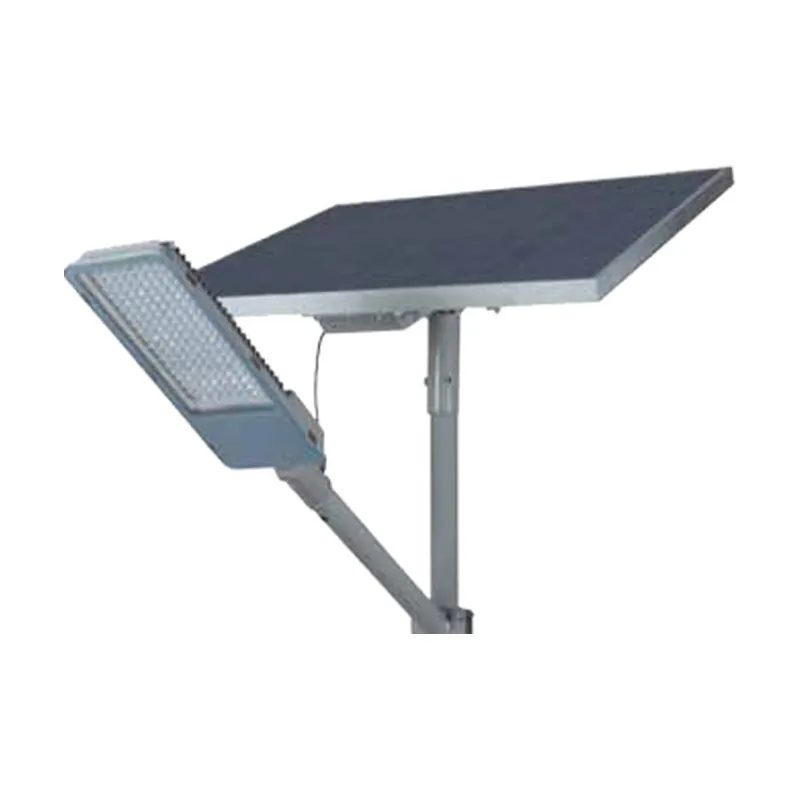
A split system avoids this: one panel (or two side by side) on a bracket at the pole top, tilted towards the equator, a shared battery in a box or buried enclosure, and two heads fed from one controller. Our SL4830G split solar street light uses this layout for a single head, with 20–60 W heads and 60–180 Wp panels; for a double arm, we size the panel and battery for the combined load.
Sizing with real sun data
The calculator needs peak sun hours (PSH) for the worst month. We used PVGIS data for two cities where we often quote:
| City | Worst month | PSH | Panel for 2 × 40 W | Panel for 40 W + 20 W |
|---|---|---|---|---|
| Nairobi | June | 4.05 | 250 Wp (open) | 180 Wp |
| Lahore | January | 3.28 | 300 Wp (open) | 250 Wp |
Lahore’s winter sun is weaker, so the same two heads need a panel one standard size larger. The battery stays the same (it depends on the night load and autonomy, not on the sun), but the panel must refill it. Our solar street lights in Kenya and solar street lights in Pakistan articles give monthly data for more cities.
Checking the battery through a cloudy spell
Sizing is one thing; checking how the system behaves through bad weather is another. We entered a 170 Ah, 12.8 V LFP battery, two 40 W heads, a 250 Wp panel, Nairobi’s June sun and 15 % of normal harvest on cloudy days into our battery autonomy calculator (open the example):
| Result | Value |
|---|---|
| Usable energy | 1,958 Wh |
| Night use | 631 Wh |
| Net drain on a cloudy day | 522 Wh |
| Nights covered | 3.75 |
| Daily surplus on a sunny day | 98 Wh |
| Days to recover after a 3-day spell | about 16 |
The system passes a 3-day spell, but recovery is slow: the panel only produces about 98 Wh more than the lights use on a sunny day. With Lahore’s January sun and a 300 Wp panel, the result is similar (3.73 nights, about 20 days to recover). If your site has frequent consecutive cloudy days, a larger panel shortens recovery more cheaply than a larger battery. Our how many rainy days article explains the trade-off.
A cheaper option: road head plus footpath head
Many double arm poles light a road on one side and a footpath on the other. The footpath needs far less light. Pairing a 40 W road head with a 20 W footpath head:
| 2 × 40 W | 40 W + 20 W | |
|---|---|---|
| Night energy | 631 Wh | 473 Wh |
| Panel at 4 PSH | 250 Wp | 180 Wp |
| LFP battery, 3 days | 164 Ah | 123 Ah |
That is a quarter less energy, a smaller panel and a smaller battery, with no loss of light where it matters. Both heads can follow the same dimming profile from one controller.
Voltage: 12 V or 24 V
At 80 W and above, a 12.8 V system carries more than 6 A at full power and the panel current rises too. Moving to 25.6 V halves the current, allows thinner cable to the heads and smaller controller losses. The battery energy is the same, about 2.1 kWh: 82 Ah at 25.6 V instead of 164 Ah at 12.8 V. Our DC street lights article covers the low-voltage side in more detail, and MPPT vs PWM controllers explains why MPPT matters more as the panel grows.
Pole and foundation
- Wind area. A 250–300 Wp panel adds about 1.2–1.5 m² at the pole top. Ask for a pole calculated for your design wind speed with the panel included, not just the heads.
- Panel bracket. Tilt the panel towards the equator at roughly the site latitude, plus about 10°, to favour the winter sun; our solar panel tilt angle guide gives the angles.
- Battery location. A 2 kWh LFP battery weighs around 20 kg or more with its case. Pole-mid boxes need a stronger bracket; buried enclosures need drainage.
- Arm length and height. Keep both heads at the same height and arm length on a symmetric road; on a road plus footpath, a shorter arm and lower head on the footpath side are common.
One double pole or two single poles?
| One double arm pole | Two single poles, staggered |
|---|---|
| One foundation, one battery, one panel bracket | Two foundations and two systems |
| Lower civil cost per head | Better uniformity on wide roads |
| Larger panel, higher wind load | Smaller panels, simpler poles |
| One fault can darken both sides | Faults affect one side only |
For roads up to about 10–12 m wide with both sides lit, a double arm pole is usually the economical choice. On wider roads, staggered single poles often light more evenly. Our solar lights that stay on all night article covers the dimming settings that keep both heads lit until dawn.
What to send us
Send the road and footpath widths, pole height and spacing, location (we check PVGIS for it), the hours of light you need and how many cloudy days in a row the system must survive. We will size the panel, battery and heads with our calculators and send the results with the quotation.
Sources
Frequently asked questions
What is a double arm solar street light?
One pole with two lamp heads on two arms, usually lighting both sides of a road or a road and its footpath, powered by a shared solar panel and battery on the pole.
How big a solar panel does a double arm street light need?
About twice that of a single head. In our calculator, two 40 W heads need about 250 Wp at 4 peak sun hours, and 300 Wp where the worst month has only about 3.3 peak sun hours.
What battery does a double arm solar street light need?
For two 40 W heads with dimming and 3 days' autonomy, about 2.1 kWh of lithium iron phosphate: 164 Ah at 12.8 V or 82 Ah at 25.6 V. Lead-acid needs roughly 1.8 times the rated capacity because it can only be discharged to about 50 %.
Can I use two all-in-one solar lights on a double arm pole?
Yes, as two independent lights, but each panel must face the sun and is tied to its arm's direction. On an east-west road one head faces away from the sun. A split system with one panel above the pole avoids that.
Is a double arm pole cheaper than two single poles?
Usually, because one pole, foundation and battery box serve two heads. But a double arm pole carries more wind load from the larger panel, and on wide roads two staggered single poles may light more evenly.