MPPT vs PWM Solar Street Light Controllers: What the Difference Means at Night
How MPPT and PWM charge controllers work in solar street lights, how much more energy MPPT harvests, a worked panel and recovery example, and when PWM still makes sense.
Key points
- A PWM controller connects the panel almost directly to the battery, so the panel works at battery voltage, not at its best voltage. An MPPT controller converts the panel's voltage down and keeps it at its maximum power point.
- In practice MPPT harvests roughly 15–30% more energy, most of it in cold, cloudy and low-sun conditions.
- In our example, a 40 W light needs a 100 Wp panel with MPPT and 120 Wp with PWM; after four rainy days the MPPT system refills its battery in about 6 days, the PWM system in about 11.
- PWM is still reasonable for small, cheap lights where the panel voltage is close to the battery voltage; for 12.8 V lithium systems from about 60 Wp upwards, choose MPPT.
Every solar street light has a charge controller between the panel and the battery. It decides how much of the panel’s energy actually reaches the battery, when the lamp turns on and off, and how it dims through the night. Specifications usually just say “MPPT” or “PWM”. The difference is real, and it shows up in panel size and in how fast the light recovers after rain.
How a PWM controller charges
A PWM (pulse-width modulation) controller is essentially a fast electronic switch. While the battery needs charge, it connects the panel straight to the battery; near full charge it switches on and off rapidly to hold the voltage.
Because the panel is connected directly, the panel runs at the battery’s voltage. A typical 36-cell panel has its maximum power at about 17–18 V when cool, but a 12.8 V lithium battery charging sits at about 13–14.4 V. At that voltage, the panel delivers roughly the same current as at 18 V, but at a lower voltage, so less power. The difference is simply lost.
How an MPPT controller charges
An MPPT (maximum power point tracking) controller is a DC-DC converter. It keeps searching for the voltage at which the panel produces most power, holds the panel there, and converts that power down to the battery voltage at a higher current. Power in (minus converter losses of a few percent) equals power out.
| PWM | MPPT | |
|---|---|---|
| How it works | Switch; panel tied to battery voltage | Converter; panel held at maximum power point |
| Usable energy (our tools) | baseline | about 20% more |
| Best case for gain | small difference | cold panels, low sun, panel voltage well above battery |
| Panel choice | must match battery voltage | wider range of panel voltages |
| Cost | lower | higher, but falling |
| Heat and complexity | simple | more electronics, needs good design |
The gain is not fixed. It is largest when the panel voltage is much higher than the battery voltage (cold mornings, a 60-cell or higher-voltage panel) and in weak, diffuse light, and smallest on hot afternoons when the panel’s voltage drops close to the battery’s.
What the difference means in practice
Our calculators treat the whole chain (panel to battery to lamp) as about 72% efficient with MPPT and 60% with PWM. That is a conservative way of expressing MPPT’s advantage of about 20%.
Panel size
Take a 40 W light running at full power for 5 hours, then 30% for 7 hours, at a site with 4.5 peak sun hours in the worst month and 3 nights of battery autonomy. The solar street light calculator gives:
- MPPT: about 97 Wp needed → a 100 Wp panel
- PWM: about 117 Wp needed → a 120 Wp panel
So PWM needs a bigger panel for the same light. The battery (about 82 Ah at 12.8 V for 3 nights) does not change, because it depends on the night’s load.
Recovery after rain
Panel size is only half of it. What matters most in cloudy seasons is how fast the battery refills after a run of bad days. We modelled the same 40 W light with a 100 Ah lithium battery and a 150 Wp panel, at 4.5 peak sun hours, through four rainy days:
| MPPT | PWM | |
|---|---|---|
| Energy into the battery on a sunny day | about 486 Wh | about 405 Wh |
| Surplus after the night’s load | about 170 Wh | about 89 Wh |
| Nights of autonomy from full | about 4.7 | about 4.5 |
| Days to refill after 4 rainy days | about 6 | about 11 |
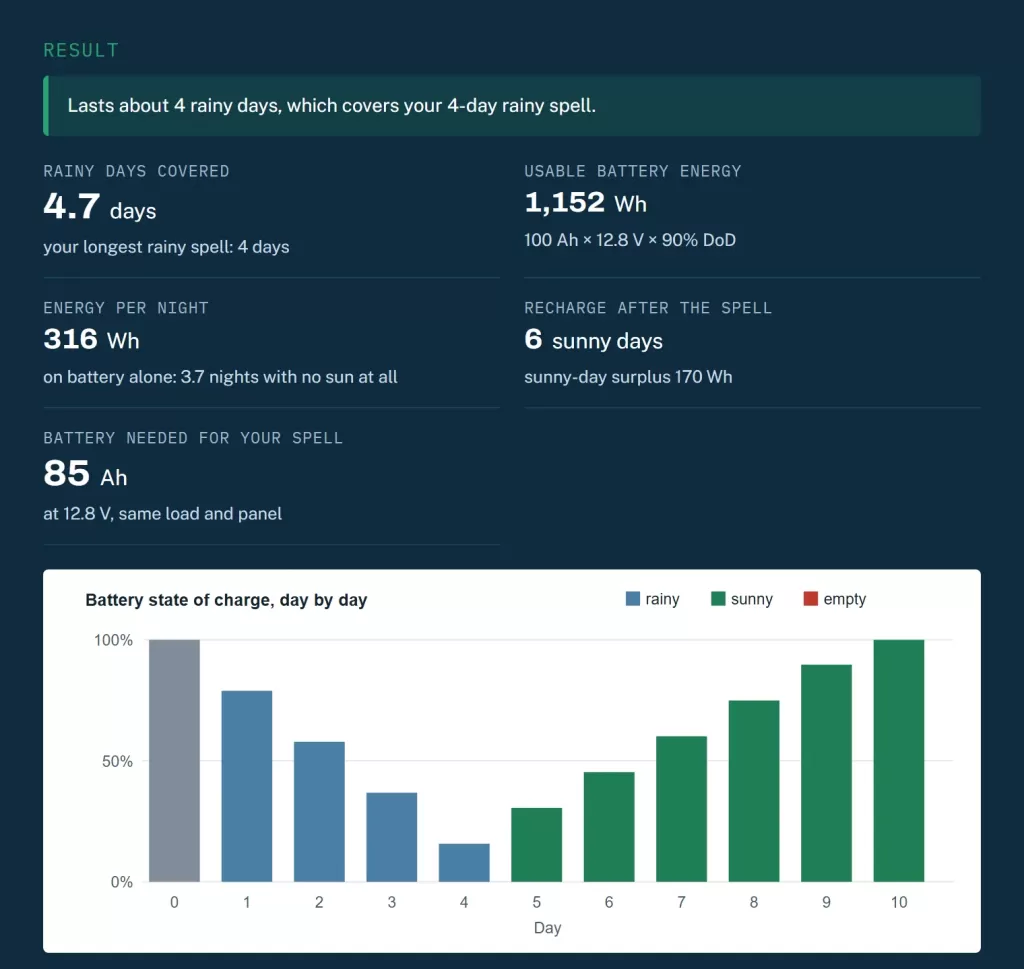
Open the MPPT example and switch the controller to PWM to see the change.
The two systems survive the rainy spell almost equally well, because both start with a full battery. The difference is the week after: with PWM, the surplus each sunny day is about half, so the battery takes nearly twice as long to get back to full. If another cloudy spell arrives within that week, the PWM light starts it with a part-empty battery and is more likely to go dark. This is why recovery, not just autonomy, belongs in a rainy-day design.
When PWM is still a sensible choice
- Small lights (roughly under 30–40 Wp of panel), where the extra cost of MPPT is a large share of the price and the absolute energy gain is a few watt-hours
- Panels matched to the battery, for example a 36-cell panel on a 12.8 V battery in a hot climate, where the panel’s working voltage is already close to the battery’s
- Very sunny sites with spare panel area, where a slightly bigger panel is cheaper than a better controller
Even then, the controller must have the right charge profile. A PWM controller set up for lead-acid will not charge a LiFePO4 battery properly, and vice versa.
When to insist on MPPT
- 12.8 V or 25.6 V lithium systems with panels from about 60 Wp upwards
- Sites with a low worst month: high latitudes in winter, monsoon and fog seasons
- Higher-voltage panels, because PWM wastes the extra voltage entirely
- Projects where the panel size is limited by the pole, the wind load or an all-in-one housing
What else to check in a controller
The charging method is only one line of the specification. Also ask about:
- Charge profile for the battery chemistry, with temperature compensation or low-temperature charge protection for lithium
- Lighting profile: how many time segments, dimming levels and motion-sensor settings it supports
- Low-voltage disconnect and how the light dims as the battery runs low, rather than simply switching off
- Standby consumption, which matters for small systems
- Protection: reverse polarity, short circuit, overcharge and lightning surge on the panel input
- Ingress protection, at least IP65 for a controller in the battery box or lamp head, IP67 if it can be exposed to water
- Remote access, such as infrared or Bluetooth for settings and an IoT module for monitoring
Our split solar street lights and all-in-one solar street lights are configured with the controller that suits the panel, battery and lighting profile for your project. Tell us the site, the burning hours and the rainy-day requirement, and we will state the controller type and settings in the quotation.
Sources
Frequently asked questions
Is MPPT better than PWM for solar street lights?
Usually, yes. An MPPT controller lets the panel run at its maximum power point and converts the extra voltage into charging current, so it typically harvests 15–30% more energy than PWM. The difference is largest in winter, in cloudy weather and when the panel voltage is well above the battery voltage.
How much more energy does an MPPT controller give?
Real gains are typically 15–30% compared with PWM, depending on the panel voltage, temperature and weather. Claims of 30–40% usually assume a cold panel with a much higher voltage than the battery. Our calculators use about 20% more usable energy for MPPT.
Can I use a PWM controller with a lithium battery?
Yes, if the controller has a charge profile for the battery chemistry (LiFePO4 at 12.8 V or 25.6 V) and the panel voltage suits it. PWM works best when the panel's maximum power voltage is only a little above the battery voltage, for example a 36-cell panel on a 12.8 V battery.