NEMA vs Zhaga Sockets on Street Lights: Which Receptacle to Specify
NEMA 3-, 5- and 7-pin vs Zhaga Book 18 receptacles on urban street luminaires: what each carries, where each fits, and the energy a dimming node saves on one kilometre of road.
Key points
- A NEMA (ANSI C136.41) receptacle sits on top of the luminaire and takes a photocell or a large control node; 3 pins switch power, 5 and 7 pins add dimming and auxiliary signals.
- A Zhaga Book 18 receptacle is smaller, has 4 pins and runs at low voltage; it is designed for sensors and nodes, often with one socket on top and one underneath.
- One kilometre of 7 m road with 60 W heads on 8 m poles needs 36 lights in our calculator; dimming to 50 % for half the night saves about 2.4 MWh a year.
- Choose the socket that matches the control system the city already runs, and ask the supplier to confirm the receptacle and driver interface for the exact model.
A street light that will be connected to a control system needs a socket on its housing for the control node. Two families dominate: the long-established NEMA twist-lock receptacle and the newer Zhaga Book 18 interface. The choice affects which nodes fit, how the driver is specified and how the light looks. This guide compares the two and shows the energy at stake on a typical road.
NEMA receptacles (ANSI C136.41)
The NEMA receptacle is the round twist-lock socket on top of many street lights. It started as a 3-pin socket for photocells and grew to carry dimming signals:
| Version | Pins | Carries | Typical device |
|---|---|---|---|
| 3-pin | Line, neutral, load | On/off switching | Photocell |
| 5-pin | + 2 dimming | 0–10 V or DALI dimming | Dimming node |
| 7-pin | + 2 auxiliary | Extra signals defined by the system | Smart node with extra inputs |
Strengths: universal in North America and common worldwide, a large range of photocells and nodes, and easy retrofitting. A 7-pin socket accepts a 3-pin photocell, so the light can start with simple dusk-to-dawn control and be upgraded later. Our photocell guide covers the simple case.
Weaknesses: a NEMA node is large and sits on top of the light, which some cities consider unsightly, and only one device fits.
Zhaga Book 18 receptacles
Zhaga Book 18 defines a compact 4-pin receptacle for outdoor luminaires:
- two pins for low-voltage power (supplied by the driver, typically 24 V DC);
- two pins for the DALI digital bus.
Because power comes from the driver, the node is small and cheap to make. The light may carry two sockets: one facing up for a communication node and one facing down for a motion or environmental sensor. Most installations pair Book 18 with a DALI-2 D4i driver, which also reports energy use and operating data to the node.
Strengths: small, tidy, supports two devices, standard data from the driver. Weaknesses: fewer legacy products, and the driver must be specified correctly at the factory.
Side-by-side
| NEMA (ANSI C136.41) | Zhaga Book 18 | |
|---|---|---|
| Size | Large, on top | Small, top and/or bottom |
| Power to node | Mains | Low voltage from driver |
| Control signal | 0–10 V or DALI on pins 4–5 | DALI (D4i) |
| Devices per light | One | Up to two |
| Retrofit market | Very large | Growing |
| Typical region | North America, many export markets | Europe, new smart-city projects |
Neither is better in general. The rule is to match what the city already runs. A city with a NEMA-based central management system should stay with NEMA; a new smart-city tender written around D4i should get Zhaga. Our smart street light control system guide explains the systems behind the sockets, and smart pole systems covers poles that carry cameras and other devices.
What a dimming node is worth on one kilometre
To see the value of a socket, run a typical road through our pole height and spacing calculator: a 7 m road, 8 m poles, 60 W heads at 110 lm/W, class M4 (open the example):
- single-sided poles at 28 m, the 3.5 × height limit;
- about 12.9 lux average against the 11 lux of M4;
- 36 lights per kilometre, 2.16 kW.
At 12 hours a night all year that is 9.46 MWh per kilometre. If a node dims the lights to 50 % for six of those hours, the saving is 36 × 60 W × 0.5 × 6 h × 365 = 2.37 MWh per kilometre per year, a quarter of the energy. At USD 0.15 per kWh that is about USD 355 per kilometre per year, before any maintenance benefit from fault reporting. Our LED street light dimming guide covers dimming profiles.
Our street lights and sockets
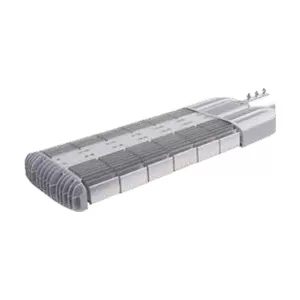
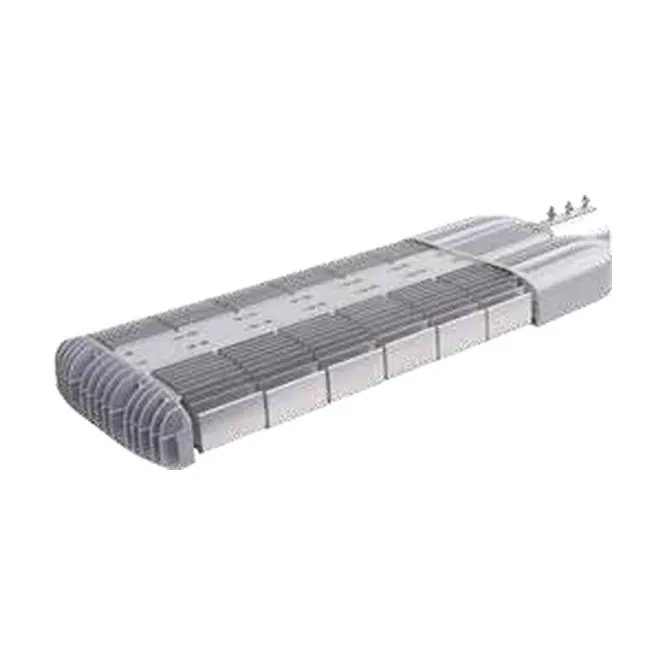
Our LDM30C modular street light (30–350 W, at least 110 lm/W, IP67) and other models are quoted with the control interface the project needs. Tell us at the inquiry stage:
- receptacle type: NEMA 3-, 5- or 7-pin, or Zhaga Book 18 (top, bottom or both);
- driver interface: 0–10 V, DALI-2 or D4i;
- the node supplier, so the interface can be checked.
We confirm the receptacle and driver for the exact model and wattage on the quotation rather than assuming every option is available on every housing.
Common mistakes
- Ordering a socket without a dimmable driver. The socket alone does nothing for dimming.
- Mixing 0–10 V nodes with DALI drivers. Interfaces must match.
- Forgetting the shorting cap. An empty NEMA socket needs a shorting cap, or the light stays off.
- Leaving the socket facing the wrong way on a tilted arm; check the node’s orientation limits.
What to send us
The road width, pole height, lighting class, control system and socket type. We will return the spacing and wattage from our calculator and a quotation with the receptacle and driver confirmed.
Sources
Frequently asked questions
What is the difference between a NEMA and a Zhaga socket?
A NEMA (ANSI C136.41) socket is a twist-lock receptacle on top of the light, rated for mains voltage on the power pins, used for photocells and control nodes. A Zhaga Book 18 socket is a smaller 4-pin low-voltage interface for sensors and nodes that the driver powers.
What do the 7 pins on a NEMA socket do?
Three carry line, neutral and switched load. Two carry the dimming signal (0–10 V or DALI). The last two are spare for other signals, defined by the control system.
Can a luminaire have both sockets?
Yes. A common arrangement is a NEMA socket on top for the control node and a Zhaga socket underneath for a sensor, or two Zhaga sockets, one on top and one below.
Do I need a D4i driver for Zhaga?
Most Zhaga Book 18 installations use a DALI-2 D4i driver, which supplies power to the node and reports energy and diagnostic data. Confirm with the control system supplier.