Smart Pole System: Modules, Power and Data, Spacing and How to Specify One
Smart pole systems explained: the modules a smart cell pole can carry, how power and data are shared, how many poles a road needs, and a checklist for specifying smart light poles.
Key points
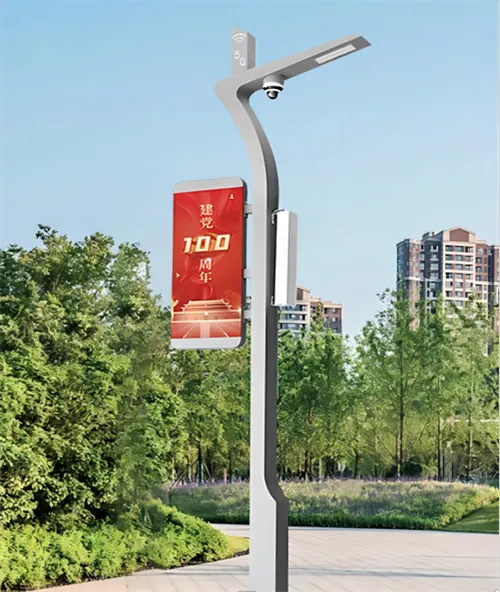
- A smart pole is a street light pole that also carries cameras, small cells, Wi-Fi, displays, sensors, speakers, emergency call points or an EV charger, sharing one foundation, one feeder and one data link.
- The lighting still sets the spacing: on a 12 m boulevard with 10 m poles in a staggered layout, our calculator gives 35 m spacing, about 58 poles per km, and shows about 90 W per head is enough for class M3.
- Not every pole needs every module: cities usually fit cameras and small cells every second to fourth pole and keep the rest as lighting poles on the same platform.
- Size the feeder for the sum of all modules plus the luminaire, give EV chargers their own circuit, and check the pole's wind area rating with every module fitted.
Searches for “smart pole”, “smart cell pole” and “smart light pole” have grown with every 5G roll-out and smart-city tender. Behind the term is a simple idea: put the equipment that cities and operators would otherwise mount on separate posts, masts and cabinets onto the street light pole, which already has a foundation, power and a position every few dozen metres. This guide explains what goes into a smart pole system, how power and data are handled, how many poles a road needs, and how to specify one.
What a smart pole carries
| Module | Purpose | Usual position |
|---|---|---|
| LED luminaire with controller | Street lighting, dimming, fault reporting | Arm or top |
| CCTV camera | Traffic and public safety | Mid-height bracket |
| 4G/5G small cell | Mobile coverage and capacity | Top section or shroud |
| Public Wi-Fi access point | Internet access in public spaces | Upper section |
| LED information display | Messages, wayfinding, advertising | Mid-height |
| Environmental sensor | Air quality, noise, weather | Upper section |
| Speaker | Public address, emergency messages | Mid-height |
| Emergency call button | Help point with video and voice | 1.2–1.5 m |
| EV charger | Kerbside vehicle charging | Base |
Our smart poles are configured around the module list for each project, with cabin layouts and cable routes designed for the modules chosen.
The pole is still a lighting pole first
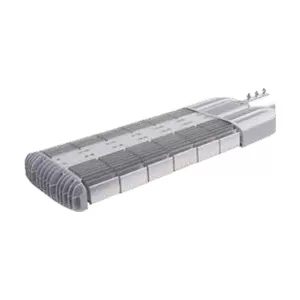
The luminaire and its controller follow the same rules as any street light: correct light level, spacing, surge protection and a reliable controller. A common pairing is our LDM30C modular LED street light (30–350 W, more than 110 lm/W, IP67, power factor above 0.97) with a dimming controller for the central platform. The BGLDM30C 60–300 W series holds a CQC product certificate (CQC19010221751).
Because the lighting sets the pole positions, we start every smart pole layout with the lighting calculation. For a 12 m boulevard with 10 m poles, our pole height and spacing calculator at 110 lm/W:
| Road | Pole height | Layout | Class | Head | Spacing | Average | Poles per km |
|---|---|---|---|---|---|---|---|
| 12 m | 10 m | Staggered | M3 | 150 W | 35 m | about 24.9 lux | 58 |
| 12 m | 10 m | Staggered | M4 | 120 W | 35 m | about 19.9 lux | 58 |
| 14 m | 12 m | Opposite | M3 | 200 W | 42 m | about 23.4 lux | 48 |
(Open the 12 m boulevard example.)
In the first row the calculator notes that about 90 W per head would be enough for M3 at that spacing, so a 100 W head with dimming headroom is the efficient choice. That leaves more of the feeder capacity for the other modules.
Which poles get which modules
A smart pole system rarely puts every module on every pole. A typical pattern on a 1 km boulevard with 58 poles:
- All poles: LED head with controller (58)
- Every second to fourth pole: CCTV, Wi-Fi or small cell, depending on coverage design
- At junctions and crossings: cameras, displays and emergency call points
- At parking bays: EV chargers, where the grid connection allows
This keeps cost and power under control while giving full coverage. All poles, smart or plain, report to the same central platform. Our guide to smart street light control systems explains the platform and networks.
Power: size for the sum
Each pole’s feeder and protection must handle the luminaire plus every module on that pole, running together. A practical approach:
- List each module and its maximum input power from the datasheet.
- Add the luminaire’s input power (a 100 W LDM30C draws a little over 100 W at power factor above 0.97).
- Add a margin for future modules.
- Size the cable for voltage drop over the whole feeder, not one pole.
- Put EV chargers on their own circuit. Their load is far larger than everything else on the pole combined.
Lighting and some modules switch off by day; cameras, small cells and Wi-Fi run 24 hours. The feeder therefore needs a permanent supply, not a photocell-switched circuit, with the lighting controlled by its own controller.
Data: fibre, wireless or both
- Fibre to each pole, or to cluster poles, carries camera video and small-cell backhaul. It is the norm for 5G small cells.
- Wireless (NB-IoT, LoRa, 4G) handles lighting control and sensor data, which are low bandwidth.
- Ethernet switches inside the pole cabin share the link between modules.
Plan the ducts for fibre at the civil works stage. Pulling fibre into existing poles later is far more expensive.
Structure: wind area and cabin space
Every module adds wind area and weight. A camera, a small-cell shroud and a display can together exceed the luminaire’s wind area several times. The pole and foundation must be designed for the full module set, including future ones. Our guides to light pole EPA and street light foundation design cover the checks.
Inside, separate compartments for power, data and radio equipment, with ventilation for small cells and lockable doors for each owner, avoid disputes between the city, the operator and the maintenance contractor.
Ownership and maintenance
Smart poles are shared infrastructure. Agree early:
- Who owns the pole, and who owns each module
- Who pays for energy, and how it is metered (separate meters per owner are common)
- Who can open which compartment
- Response times for faults
Specification checklist
- Road widths, pole positions and lighting class
- Module list per pole type, with datasheet power and weight
- Pole height, shape, material and finish
- Cabin layout and compartment access
- Feeder design, metering and EV circuits
- Data network: fibre route, switches, wireless protocols
- Platform interoperability (open protocols, for example TALQ)
- Design wind speed and foundation requirements
For an overview of what cities gain and what to budget, see our smart streetlights guide. Send us your module list, pole height, road layout and quantity, and we will propose a pole design and the lighting calculation.
Sources
Frequently asked questions
What is a smart pole system?
A network of multi-function street poles plus the software that manages them. Each pole provides lighting and can carry modules such as CCTV, Wi-Fi, 4G/5G small cells, displays, environmental sensors, speakers, emergency call buttons and EV chargers, all connected to a central platform.
What is a smart cell pole?
A smart pole that houses a mobile network small cell (4G or 5G) inside or on top of the pole, often with a separate compartment and cooling for the radio equipment. It lets operators densify coverage on streets without separate masts.
How far apart are smart poles?
The lighting design sets the spacing, typically 30–45 m on urban roads with 8–12 m poles. In our calculation for a 12 m wide road with 10 m poles, staggered, the spacing is 35 m. Modules are then placed on selected poles.
What power does a smart pole need?
The luminaire plus every module on that pole. Lighting, cameras, Wi-Fi and displays usually share one feeder; EV chargers normally need a dedicated supply. Get the input power of each module from its datasheet and size cable, protection and the cabinet for the total.