What Does Light Pole EPA Mean? Effective Projected Area Explained with Real Fixture Numbers
Light pole EPA (effective projected area) explained: how fixture and pole EPA are worked out, how to add them up against the pole rating, and worked numbers for real LED heads.
Key points
- EPA (effective projected area) is the area a fixture presents to the wind multiplied by a drag coefficient; it is the number a pole maker uses to check wind load.
- A pole is rated for a maximum total EPA at a stated design wind speed; the EPA of every head, bracket, camera and sign on it must add up to less.
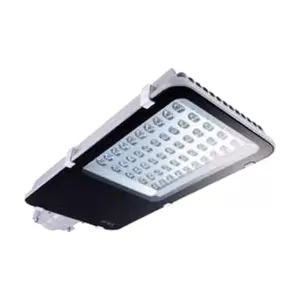
- Our 120–150 W LDM30C street light has a side area of about 0.061 m²; with a drag coefficient of 1.2 that is about 0.073 m² (0.79 ft²) EPA. A 500 W stadium floodlight face is about three times larger.
- At a wind speed of 40 m/s the dynamic pressure is about 980 Pa, so 0.073 m² of EPA pushes on the pole top with about 72 N.
Pole catalogues list heights, wall thicknesses and base plates, and then one figure that confuses many buyers: EPA, often written as “max EPA 6.2 ft² at 90 mph”. This guide explains what effective projected area is, how to work out the EPA of a fixture from its dimensions, how to add everything up against a pole rating, and what the numbers look like for real LED heads.
What EPA is
Wind pushes on everything mounted at the top of a pole. The force depends on two things: how strong the wind is, and how much area it pushes against. EPA captures the second part:
EPA = projected area × drag coefficient (Cd)
- Projected area is the silhouette the object presents to the wind, in m² or ft².
- Drag coefficient adjusts for shape. A flat plate catches more wind than a cylinder of the same silhouette. Box-shaped luminaires are commonly given a Cd of about 1.2; rounded housings less.
A pole manufacturer designs the pole for a maximum total EPA at its top, at a design wind speed, with safety factors from a standard such as AASHTO LTS in North America or EN 40 in Europe. As long as everything you mount adds up to less than that EPA, the pole is within its design.
Worked fixture EPAs
We worked out EPA from the published dimensions of our own heads. For a street light on an arm, the largest area facing the wind is the side profile (length × height) when the wind blows across the arm:
| Fixture | Size (mm) | Side area | EPA at Cd 1.2 |
|---|---|---|---|
| LDZ30J 50 W compact street light | 590 × 255 × 65 | 0.038 m² | 0.046 m² (0.50 ft²) |
| LDM30C 60–100 W | 497 × 280 × 105 | 0.052 m² | 0.063 m² (0.67 ft²) |
| LDM30C 120–150 W | 581 × 280 × 105 | 0.061 m² | 0.073 m² (0.79 ft²) |
| LDM30C 250 W | 749 × 280 × 105 | 0.079 m² | 0.094 m² (1.02 ft²) |
| Heat-pipe stadium floodlight 500 W, face 520 × 370 | face on to wind | 0.192 m² | 0.231 m² (2.49 ft²) |
Two things follow. First, modern slim LED street heads have small EPAs; even the 250 W size stays near 1 ft². Second, floodlights are a different matter: a 500 W floodlight face is about three times the EPA of a large street head, and a cross-arm with four of them adds up to about 10 ft² before the bracket is counted.
Some manufacturers publish EPA as the bare projected area (Cd = 1). Others include a drag coefficient. When comparing a fixture’s EPA with a pole rating, check which basis both are using.
From EPA to force
The wind pressure on a surface is:
q = ½ × ρ × V²
with air density ρ about 1.225 kg/m³ and V the wind speed in m/s. The force is q × EPA.
| Wind speed | Dynamic pressure | Force on 0.073 m² (LDM30C 150 W) | Force on 0.231 m² (500 W floodlight) |
|---|---|---|---|
| 30 m/s (108 km/h) | about 551 Pa | about 40 N | about 127 N |
| 35 m/s (126 km/h) | about 750 Pa | about 55 N | about 173 N |
| 40 m/s (144 km/h) | about 980 Pa | about 72 N | about 226 N |
| 45 m/s (162 km/h) | about 1,240 Pa | about 91 N | about 286 N |
This is the simplified basic pressure. Design standards add factors for height above ground, terrain, gusts and importance, which can raise the design pressure considerably. The pole manufacturer’s rating already includes those for its stated wind speed and exposure.
A force of 72 N looks small, but it acts at the top of the pole. On a 10 m pole it creates a bending moment of about 720 N·m at the base, and the pole’s own shaft area adds much more. That moment is what the base plate, anchor bolts and foundation must resist.
Adding up the EPA on a pole
A simple checklist:
- List every item on the pole top and arms: heads, brackets, cameras, signs, banners, antennas, solar panels.
- Get the EPA of each at its installed angle.
- Add them up. Include the arm or bracket if the pole rating does not already include it (check the catalogue note).
- Compare with the pole’s rated EPA at the design wind speed for your site.
- Leave margin for later additions. Cameras and banners are the most common surprise.
Solar street lights deserve special attention: a 75 Wp module of around 1 m × 0.5 m adds about 0.5 m² of projected area at its tilt, far more than the light head. Our guide to solar light poles covers this, and square light poles explains how wall gauge and height set the rating.
Example: replacing heads on existing poles
Suppose a car park has 8 m poles rated for 1.5 ft² EPA at the local design wind speed, and the old fittings’ catalogue gives 1.3 ft² each, two per pole on a twin bracket. The existing load, 2.6 ft², is already above the rating, which is worth knowing before anything else is added. Replacing them with two LDM30C heads at 100 W (0.67 ft² each) brings the total head EPA to about 1.3 ft², under the rating. The swap reduces wind load as well as energy. Our parking lot light poles guide covers the rest of a retrofit check.
EPA versus weight
Weight and EPA are separate limits. A pole may be within its EPA rating and still be overloaded by a heavy head on a long arm, or vice versa. Ask for both: our street light pages list the weight of every size, from 4.5 kg for the smallest LDM30C to 12 kg for the 350 W size, and our street light weight guide compares typical values.
Common mistakes
- Comparing EPA on different bases. Projected area with and without a drag coefficient differ by about 20%.
- Forgetting accessories. A camera, a banner or a small sign can double the EPA on a pole.
- Ignoring tilt. A floodlight aimed up at 60° presents much more face to the wind than one aimed down.
- Using basic wind speed without site factors. Coastal, hilltop and open sites need higher design pressures.
When you send us a project, include the pole height, the design wind speed and the accessories planned. We provide fixture dimensions and weights for the pole designer, and can supply matched poles with the head schedule.
Sources
Frequently asked questions
What does EPA mean on a light pole?
Effective projected area: the wind area a pole can safely carry at its top, in square feet or square metres, at a stated design wind speed. Fixtures, brackets and accessories each have an EPA, and their total must not exceed the pole's rating.
How is the EPA of a light fixture calculated?
Take the largest area the fixture shows to the wind (usually its side profile, length × height) and multiply by a drag coefficient for its shape. Box-shaped fixtures are often given a coefficient of about 1.2; rounded shapes less.
What is a typical EPA for an LED street light?
Slim LED heads are usually well under 1 ft² (0.09 m²). Our LDM30C at 120–150 W works out at about 0.79 ft² with a drag coefficient of 1.2; the 250 W size about 1.0 ft². Old cobra-head sodium fittings were often larger.
Does EPA change if the fixture is tilted?
Yes. Tilting a floodlight upwards turns more of its flat face into the wind, so its EPA rises. Pole makers often ask for the EPA at the installed tilt, or use the worst case.