
How Much Does a Street Light Weigh? Luminaires, Poles and Solar Parts in Kilograms
Street light weights in kilograms: LED heads from 1.1 to 12 kg from our data sheets, steel and aluminium poles from 6 to 12 m calculated from their dimensions, solar batteries and why weight matters.
Key points
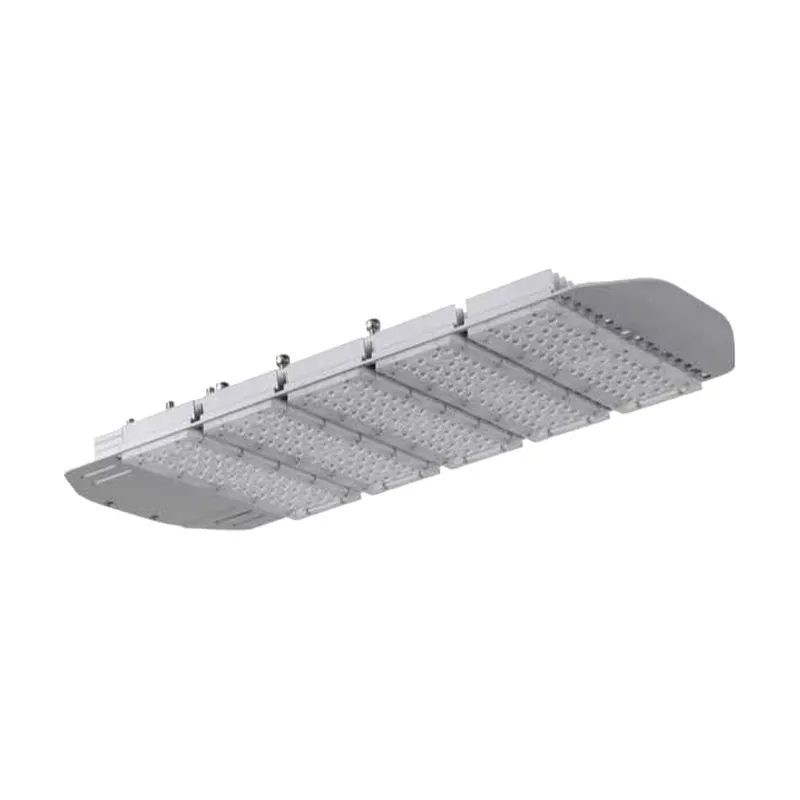
- An LED street light head weighs about 1–4 kg for 20–80 W and about 4–12 kg for 100–350 W, depending on the design. Our lightest 300 W head weighs 5.2 kg; our heaviest 350 W head 12 kg.
- The pole is the heavy part. A tapered steel pole of 8 m with a 3.5 mm wall weighs about 79 kg before its base plate and arm; a 12 m pole with a 4.5 mm wall about 206 kg.
- An aluminium pole of the same dimensions weighs about a third as much as steel, which matters for transport, handling and breakaway safety.
- For solar street lights, the battery decides much of the weight: lead-acid is typically two to three times heavier than LiFePO4 for the same stored energy.
The weight of a street light matters to more people than you might expect: the structural engineer checking an old pole, the contractor choosing a crane or bucket truck, the logistics team planning a container, and the safety reviewer looking at roadside poles. This article gives real weights for LED street light heads from our own data sheets, calculated weights for steel and aluminium poles, and the weight of solar components.
LED street light heads
From our product data sheets:
| Luminaire | Power | Weight |
|---|---|---|
| LDZ30J compact | 20 W | 1.1 kg |
| LDZ30J compact | 40 W | 2.4 kg |
| LDZ30J compact | 80 W | 3.82 kg |
| LDL30G orchid | 30–40 W | 1.6 kg |
| LDL30G orchid | 80 W | 3.5 kg |
| BGLDM30J slim modular | 30–50 W | 2.1 kg |
| BGLDM30J slim modular | 120–150 W | 3.5 kg |
| BGLDM30J slim modular | 300 W | 5.2 kg |
| BGLDM30G modular | 60–100 W | 3.3 kg |
| BGLDM30G modular | 300 W | 7.0 kg |
| LDM30C modular | 60–100 W | 6.0 kg |
| LDM30C modular | 180–200 W | 8.0 kg |
| LDM30C modular | 350 W | 12.0 kg |
Two things explain the spread at the same wattage. First, heat sink mass: a head designed to run its LEDs cooler, for longer life in hot climates, carries more aluminium. Second, housing design: the slim modular BGLDM30J uses an anodised die-cast body with less metal, and is the one we suggest for older poles and long arms. Neither is “better” by weight alone; the right choice depends on the pole, the climate and the service life required.
For comparison, the sodium heads that LED replaces usually carried a ballast, igniter and glass bowl, which made them heavier for the same light output. Replacing them with LED rarely increases the load on the arm.
Poles: calculated from dimensions
Pole weight depends on height, diameter and wall thickness, which vary by supplier and by wind design. To give realistic figures, we calculated the shaft weight of tapered round poles from typical dimensions (steel density 7,850 kg/m³, aluminium 2,700 kg/m³):
| Height | Top / base diameter | Wall | Steel shaft | Aluminium shaft (same dimensions) |
|---|---|---|---|---|
| 6 m | 60 / 130 mm | 3.0 mm | about 42 kg | about 15 kg |
| 8 m | 70 / 160 mm | 3.5 mm | about 79 kg | about 27 kg |
| 10 m | 80 / 190 mm | 4.0 mm | about 133 kg | about 46 kg |
| 12 m | 90 / 220 mm | 4.5 mm | about 206 kg | about 71 kg |
The formula, if you want to check a supplier’s figure:
Shaft weight ≈ π × average diameter × wall thickness × height × density
with all dimensions in metres. For an 8 m steel pole: π × 0.115 × 0.0035 × 8 × 7,850 ≈ 79 kg.
Then add:
- Base plate: a 300 × 300 × 16 mm steel plate weighs about 11 kg; a 400 × 400 × 20 mm plate about 25 kg
- Arm: typically 5–20 kg depending on length and whether it is single or double
- Galvanising: adds a few percent to the steel weight
- Door, stiffeners and fixings: a few kilograms
So an 8 m steel pole with a single arm and base plate typically weighs about 95–110 kg before the luminaire. Our street light pole guide explains how wall thickness and diameter come from the wind load, and our article on galvanized steel light poles covers coatings.
Aluminium, fiberglass and cast poles
- Aluminium poles weigh about a third of steel for the same dimensions, although they often use slightly thicker walls. They are easier to handle and do not rust, and some designs are used as passively safe poles. See cast aluminum light poles.
- Fiberglass poles are lighter still and do not conduct electricity, popular for residential streets and coastal sites. See fiberglass street light poles.
- Cast iron decorative posts are very heavy for their height and are now mostly used for heritage streets, often with a lighter steel core.
Solar street lights
A solar street light adds a panel, a battery and a controller. The panel’s weight depends on its size and frame; a 100–150 Wp panel commonly weighs around 8–12 kg, plus its bracket. The battery is where the big differences are:
| Battery for about 1,100 Wh usable | Typical weight |
|---|---|
| LiFePO4, 12.8 V, about 90 Ah | roughly 10–12 kg |
| Lead-acid or gel, 12 V, about 180 Ah (two batteries) | roughly 50–60 kg |
These are typical data-sheet figures; check the actual battery’s sheet. The difference comes from the chemistry and from the fact that only about half of a lead-acid battery’s capacity is usable, so you need about twice the nominal capacity. A lighter LiFePO4 battery can be mounted at the top of the pole or in the luminaire, while heavy lead-acid batteries usually go in a box at the base or in a buried pit. Our all-in-one solar street lights put a 9–33 Ah lithium battery inside the housing for exactly this reason.
Why weight matters
Structure. The pole and arm must carry the head’s weight and, more importantly, its wind load. The projected area of the head and any panel usually matters more than the kilograms. When reusing old poles, a lighter LED head is often the main reason the retrofit is possible without new poles.
Installation. A 2–4 kg head can be fitted from a small mobile platform by one technician; a 12 kg head on a 12 m pole needs a larger lift and two people. Pole erection needs a crane or truck-mounted hoist for anything above about 6 m in steel.
Transport. A container of poles is often limited by weight before volume, especially for tall steel poles. Heads, by contrast, are limited by volume.
Safety. On fast roads, heavy rigid poles are a hazard to vehicles. Lighter poles and breakaway bases reduce the risk; see our guide to breakaway light pole bases.
Ask for the real figures
For a specific project, ask the supplier for the weight and the projected area (EPA or wind area) of each head, and the weight of each pole with its arm and base plate. We list head weights on every street light product page and can provide pole weights and wind calculations for your design.
Sources
Frequently asked questions
How much does an LED street light head weigh?
Our data sheets range from 1.1 kg (20 W compact head) to 12 kg (350 W modular head). A typical 100 W main-road head weighs 3–6 kg; a 200 W head 4–8 kg. Older sodium heads with their ballast and glass bowl were usually heavier for the same light.
How much does a street light pole weigh?
It depends on height, diameter and wall thickness. Calculated from typical dimensions, a 6 m steel pole weighs about 42 kg, 8 m about 79 kg, 10 m about 133 kg and 12 m about 206 kg, plus the base plate and arm. Aluminium poles of the same size weigh about a third as much.
How much does a complete street light weigh?
Add the head, arm, pole and base plate. An 8 m steel pole with a 100 W LED head, a single arm and a base plate comes to roughly 100 kg. A 12 m pole with a 200 W head is closer to 250 kg.
Why does the weight of a street light head matter?
It affects the pole and arm design, the wind load and the installation method. A lighter head allows longer arms, reuse of older poles and installation from a smaller lift.
Products in this guide
-
 Compact LED Street Light 20–80 W
LDZ30J Specifications and quote →
-
 F-Series Slim LED Street Light 30–300 W
BGLDM30J Specifications and quote →
-
 Modular LED Street Light 30–350 W, IP67
LDM30C Specifications and quote →
-
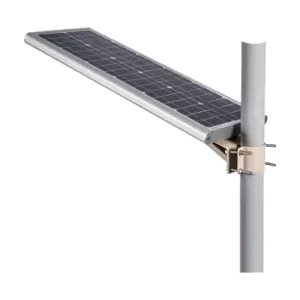 All-in-One Solar Street Light 15–60 W
SL3530C / SL5730C / SL6830C Specifications and quote →