150W LED Street Light: Lumens, Pole Height, Spacing and What It Replaces
What a 150 W LED street light delivers: 16,500 lm at 110 lm/W, 35 m spacing on 10 m poles in our calculator, 400 W HPS replacement savings, and how three 150 W bodies compare.
Key points
- At 110 lm/W a 150 W LED street light gives about 16,500 lm; it is the usual size for 10–12 m poles on urban main roads.
- In our calculator, 150 W on 10 m poles lights a 10 m road to class M3 at 35 m spacing (19.1 lux); 118 W would already meet the target.
- Replacing 100 × 400 W HPS lamps (460 W with ballast) with 150 W LED saves about 135,800 kWh a year at 12 hours a night, 67 %.
- Our 150 W bodies weigh 3.5 kg (BGLDM30J), 4.1 kg (BGLDM30G) and 6.85 kg (LDM30C, IP67).
150 W is one of the most requested sizes in our street light enquiries, usually from buyers replacing 400 W sodium lamps on main roads. It is a useful size, but only when the pole height and road width suit it. This guide puts numbers on what a 150 W LED street light delivers, where it fits, what it saves and how the housings compare.
Lumens: what 150 W actually gives
Light output is power times efficacy:
| Efficacy | Output at 150 W |
|---|---|
| 100 lm/W | 15,000 lm |
| 110 lm/W | 16,500 lm |
| 130 lm/W | 19,500 lm |
Our LDM30C is rated above 110 lm/W, so we use 110 lm/W in our calculations. When comparing offers, check that the figure is the complete luminaire’s output, measured with its lens and driver, not the LED chips’ output. Our average street light lumens article puts these numbers in context.
Where 150 W fits: our calculation
We ran two typical roads through our pole height and spacing calculator at 110 lm/W, lighting class M3 (15 lux average in the calculator’s illuminance version):
| Road | Pole | Layout | Spacing | Average | Per km | Load per km | Power that just meets M3 |
|---|---|---|---|---|---|---|---|
| 10 m, two wide lanes | 10 m | Single side | 35 m | 19.1 lux | 29 | 4.4 kW | 118 W |
| 14 m, four lanes | 12 m | Staggered | 42 m | 17.5 lux | 48 | 7.2 kW | 128 W |
(open the 10 m example · open the 12 m example)
In both cases, spacing is capped at 3.5 times the pole height, which keeps uniformity acceptable. At that spacing the calculator shows 118 W and 128 W would be enough, so 150 W leaves margin rather than being the minimum. That margin is useful: it covers lumen depreciation and dirt, and with dimming the light can run below full power for most of its life. If you want the lowest load instead, the 120 W step suits the 10 m road.
On 8 m poles over a 7 m road, the same calculator needs only about 51 W at 28 m spacing (class M4), so a 150 W head would be wasted there. See light pole vs street light for that example, and street light pole distance calculation for the method.
Replacing 400 W sodium lamps
A 400 W high-pressure sodium lamp draws about 460 W with its ballast (15 % loss, the default in our calculator). We entered 100 lamps, 12 hours a night, at 0.15 per kWh into our LED retrofit savings calculator (open the example):
| Item | 400 W HPS | 150 W LED |
|---|---|---|
| System power | 460 W | 150 W |
| Energy per year | 201,480 kWh | 65,700 kWh |
| Energy saved | — | 135,780 kWh (67 %) |
| Electricity saved | — | about 20,370 per year |
| CO2 avoided (0.5 kg/kWh) | — | about 68 t per year |
We also entered 20 per light per year for HPS lamp changes against 2 for LED, our assumption, which adds about 1,800 a year. We left the LED price out, so no payback is shown; put in your quoted price to see it. Our HPS to LED conversion chart gives the equivalents for other lamp sizes.
Three 150 W bodies compared
| Model | Size | Weight | IP | Efficacy |
|---|---|---|---|---|
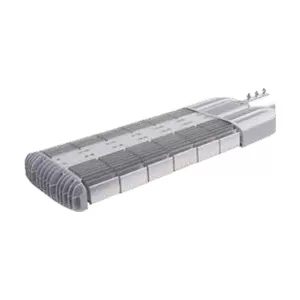
| LDM30C120/150 | 581 × 280 × 105 mm | 6.85 kg | IP67 | > 110 lm/W |
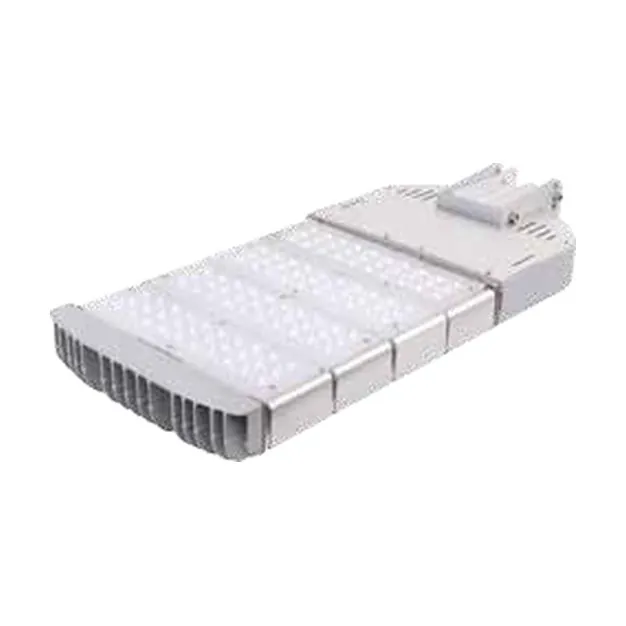
| BGLDM30G120/150 | 280 × 353 × 115 mm | 4.1 kg | IP65 | > 100 lm/W |
| BGLDM30J120/150 | 423 × 258 × 100 mm | 3.5 kg | IP65 | > 100 lm/W |
The LDM30C carries a separate 6063 heat sink on each module and IP67 sealing, which is why it weighs more. The slim BGLDM30J is the lightest, useful on long arms or older poles. The BGLDM30C version of our modular light (60–300 W) holds a CQC product certificate, CQC19010221751. Our LED street light housing article compares all five of our bodies.
Running cost and dimming
At 12 hours a night, one 150 W light uses about 657 kWh a year, or roughly 99 at 0.15 per kWh. Dimming to 50 % after midnight for six hours cuts that by a quarter. Our LED street light dimming controls article shows how the schedules are set.
When 150 W is the wrong choice
- Low poles. Below about 9 m, 150 W gives more light than the spacing can use, and glare rises.
- Narrow residential streets. Classes M5, M6 or P need far less; 40–80 W is typical.
- Wide multi-lane roads on high poles. Above 12 m and over 20 m width, 200–250 W may be needed.
What to send us
Road width and lanes, pole height and spacing (existing or planned), lighting class or target lux, and the lamps being replaced. We will reply with the wattage from our calculator, the savings and the body that suits your poles.
Sources
Frequently asked questions
How many lumens does a 150 W LED street light give?
Multiply power by efficacy. At 110 lm/W, the minimum rating of our LDM30C, that is 16,500 lm. At 100 lm/W it is 15,000 lm. Compare lights by their tested luminaire lumens, not by LED chip lumens.
What pole height suits a 150 W LED street light?
Usually 10–12 m. On 8 m poles a 150 W light is often more than the road needs; on 12 m poles over wide roads it is a common choice for opposite or staggered layouts.
What does a 150 W LED street light replace?
As a rule of thumb, a 400 W high-pressure sodium lamp. 100–120 W LED usually replaces 250 W HPS. A road calculation confirms the wattage for your road width, pole height and spacing.
How far apart should 150 W LED street lights be?
In our calculator, 35 m on 10 m poles over a 10 m road (single-sided), and 42 m on 12 m poles over a 14 m road (staggered), both for class M3.
How much does a 150 W LED street light cost to run?
At 12 hours a night it uses about 657 kWh a year. At 0.15 per kWh, that is about 99 a year in electricity, before any dimming.