Street Light Pole Distance Calculation: Formula, Standard Spacing and Worked Examples
How to calculate the distance between street light poles: the lumen formula, the 3.5 × height limit, worked examples for four road types in metres, and how to count poles on a road.
Key points
- Spacing (m) = lamp lumens × utilisation factor × maintenance factor ÷ (required lux × road width), then capped at about 3.5 × mounting height for uniformity.
- In our calculator, a 7 m residential street with 8 m poles and 60 W LED lights at M4 comes out at 28 m spacing; a 10 m main road with 10 m poles and 100 W at M3 at 29 m.
- Number of poles on one side = road length ÷ spacing + 1. A 1.2 km road at 30 m spacing needs 41 poles on one side, 82 if lit on both sides.
- There is no single standard distance: typical results range from about 20 m for 6 m poles to about 42 m for 12 m poles, depending on width, class and wattage.
The distance between street light poles is the single largest cost driver in a road lighting project. Every extra metre of spacing removes poles, foundations and cable from the bill, but stretch it too far and the road turns into a row of bright pools with dark gaps. This guide gives the formula, the limit that matters in practice, and worked examples in metres from our own pole height and spacing calculator.
The spacing formula
For a straight road lit from one side, the lumen method gives:
Spacing S (m) = Φ × UF × MF ÷ (E × W)
- Φ — luminaire lumens (watts × lumens per watt)
- UF — utilisation factor: the share of the lamp’s light that lands on the road. It depends on the ratio of road width to mounting height and on the optic, typically 0.35–0.55 for LED road lenses
- MF — maintenance factor for dirt and lumen depreciation, commonly 0.8 for sealed LED luminaires
- E — required average illuminance in lux for the lighting class
- W — road width in metres
For a staggered or opposite layout there are two lights per spacing interval, so multiply the top of the formula by 2.
Example: a 100 W LED light at 110 lm/W gives 11,000 lm. On a 10 m road with 10 m poles, UF is about 0.51. For class M3 (15 lux average) and MF 0.8:
S = 11,000 × 0.51 × 0.8 ÷ (15 × 10) = 29.9 m
The second rule: 3.5 × mounting height
The formula only balances the average lux. Road lighting also needs uniformity, meaning the darkest point between poles must not fall too far below the average. With typical LED road optics, uniformity starts to fail when the spacing exceeds roughly 3.5 times the mounting height. So the working spacing is:
S = the smaller of (lumen-method result) and (3.5 × H)
This is why buying a more powerful lamp does not let you remove poles on a low mounting height. A 60 W light on a 6 m pole may “deliver” enough lumens for 53 m on paper, but the calculator caps it at 21 m, and the extra light only raises the average while the gaps stay. In that case the better answer is a lower wattage, as the result below shows.
Worked examples for four roads
We ran four common roads through the calculator with LED luminaires at 110 lm/W and a maintenance factor of 0.8:
| Road | Pole height | LED power | Layout | Spacing from formula | 3.5 × H | Spacing used | Lux achieved | Lights per km |
|---|---|---|---|---|---|---|---|---|
| 6 m lane, M5 (7.5 lux) | 6 m | 30 W | One side | 29.7 m | 21 m | 21 m | 10.6 | 48 |
| 7 m residential street, M4 (11 lux) | 8 m | 60 W | One side | 32.9 m | 28 m | 28 m | 12.9 | 36 |
| 10 m main road, M3 (15 lux) | 10 m | 100 W | One side | 29.7 m | 35 m | 29 m | 15.4 | 35 |
| 14 m multi-lane road, M2 (22 lux) | 12 m | 200 W | Staggered | 44.6 m | 42 m | 42 m | 23.4 | 48 |
Open the main-road example and change the width, height, wattage or class for your road.
Three patterns are worth noticing:
- On short poles the height limit decides. The lane and residential examples both have spare lumens; spacing is set by 3.5 × H.
- On wide roads the lumens decide. The main road needs every lumen of a 100 W light to reach 29 m. With 150 W the same road reaches the 35 m height limit, cutting the count from 35 to 29 lights per km.
- Wide roads switch layout. Once the road is wider than about 1.0–1.5 times the mounting height, one row of lights cannot cover the far side, and the calculator moves to staggered or opposite poles.
When a taller pole pays
Compare the 7 m street lit two ways:
| Option | Pole | LED | Layout | Spacing | Lights per km | kW per km |
|---|---|---|---|---|---|---|
| A | 6 m | 60 W | Staggered (forced by width/height) | 21 m | 96 | 5.76 |
| B | 8 m | 60 W | One side | 28 m | 36 | 2.16 |
| C | 10 m | 60 W | One side | 29 m | 35 | 2.10 |
The 6 m poles push the calculator into a two-sided layout with almost three times as many lights, and the result is 28 lux where 11 is needed. Moving to 8 m poles removes 60 lights per kilometre. Going to 10 m saves only one more light, while each pole costs more, so 8 m is the economic height for this street. Our guide on how tall street lights are lists the usual heights by road type.
Counting poles on a road
Once the spacing is known:
Poles on one side = road length ÷ spacing + 1
A common exam and site question: a straight road is 1.2 km long and solar street lights are installed at 30 m spacing; how many poles are needed?
1,200 ÷ 30 = 40 intervals, plus the pole at the start = 41 poles on one side. Lit on both sides (opposite or staggered), it is 82 poles.
Two practical adjustments:
- Round the spacing down so the intervals come out even. For 1,000 m at a calculated 29 m, 1,000 ÷ 29 = 34.5, so use 35 intervals at 28.6 m (36 poles).
- Add poles at junctions, bends and crossings. Conflict areas usually need a higher class (C classes) and extra lights; on curves of small radius, put poles on the outside of the bend and reduce spacing.
Solar poles: the same formula, a different limit
For solar street lights the geometry is identical, but energy decides the wattage, so spacing usually ends up shorter. A 40 W solar light on a 7 m pole over a 7 m road gives 23 m at M4 and 24 m at M5 in the calculator. Our older guide to solar street light pole height and spacing works through the solar case, and the solar street light calculator then sizes the panel and battery for that wattage.
Doing it in a spreadsheet
The calculation fits in one row of Excel or Google Sheets:
| Cell | Content |
|---|---|
| B1 | Watts |
| B2 | Lumens per watt |
| B3 | UF (from the luminaire’s utilisation chart, or 0.45 as a first guess) |
| B4 | MF (0.8) |
| B5 | Required lux |
| B6 | Road width |
| B7 | Pole height |
| B8 | =MIN(B1*B2*B3*B4/(B5*B6), 3.5*B7) |
| B9 | =ROUNDUP(length/B8,0)+1 |
The weak point is UF. A spreadsheet cannot know how a specific lens throws light across the road, so treat the result as a budget figure. For a tender, ask the supplier for the photometric file and a calculation to EN 13201 or your national standard; our explainer on road lighting classes shows what each class requires.
Common mistakes
- Using lamp watts instead of lumens. Two 100 W lights at 90 and 140 lm/W give very different spacings. Always multiply by the tested efficacy.
- Forgetting the maintenance factor. Designs at MF 1.0 look fine on handover and fall below class within a few years.
- Ignoring trees and arms. Tree canopies block light; a long arm moves the light over the road and changes UF.
- Copying spacing from another road. A spacing that worked on a 7 m street will not work on a 10 m road with the same poles.
What this means for energy
Spacing and wattage together set the energy per kilometre. In the table above, the main road uses 3.5 kW per km; the staggered multi-lane road 9.6 kW per km. Our guide to LED street light power consumption turns those figures into kWh a year.
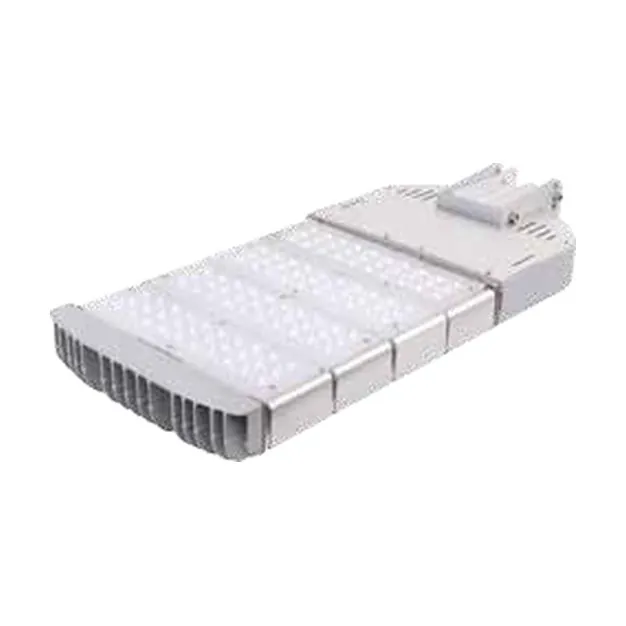
On our LDM30C modular street light the wattage steps from 30 W to 350 W are close together, so the lamp can be matched to the spacing instead of rounded up a size. Send us the road width, length and pole height, and we will return the spacing, pole count and a lighting calculation for the road.
Sources
Frequently asked questions
What is the standard distance between street light poles?
There is no single standard. With modern LED lights, poles of 6 m are usually 18–24 m apart, 8 m poles 24–30 m, 10 m poles 30–35 m and 12 m poles 36–42 m. The exact figure comes from the road width, the lighting class and the lamp's lumens.
How do I calculate the number of street light poles for a road?
Divide the road length by the spacing and add one for the pole at the start. For 1,200 m at 30 m spacing that is 1,200 ÷ 30 + 1 = 41 poles on one side. For a staggered or opposite layout, count each side separately.
Why is spacing limited to about 3.5 times the pole height?
Beyond that distance the light pools under each pole and the road between them becomes dark, so the uniformity requirement fails even if the average lux is met. A brighter lamp cannot fix a spacing that is too wide.
Can I do the street light design calculation in Excel?
Yes. Put the lumens, utilisation factor, maintenance factor, lux and road width in cells and apply the spacing formula, then use MIN(result, 3.5 × height). For tender designs, confirm the result with photometric software and the luminaire's IES file.