Solar Street Light Pole Design: Panel Wind Load, Height and Battery Placement
How a solar street light pole differs from a grid pole: panel size from our solar calculator, wind force and base moment for 60–180 Wp panels, pole height, battery placement and foundations.
Key points
- A solar pole carries a panel at the top, which often has more wind area than the luminaire; that panel, not the light, usually governs the pole and foundation.
- In our solar calculator, Manila's darkest month (3.7 peak sun hours by PVGIS) needs a 120 Wp panel for a 40 W light and 180 Wp for 60 W, with 3 nights of autonomy.
- At a 35 m/s design wind, a 180 Wp panel of about 0.9 m² takes roughly 810 N, which is about 6.5 kN·m at the base of an 8 m pole before the luminaire and pole itself are added.
- Battery placement (in the pole, under the panel or buried) changes access, theft risk and the top-of-pole weight.
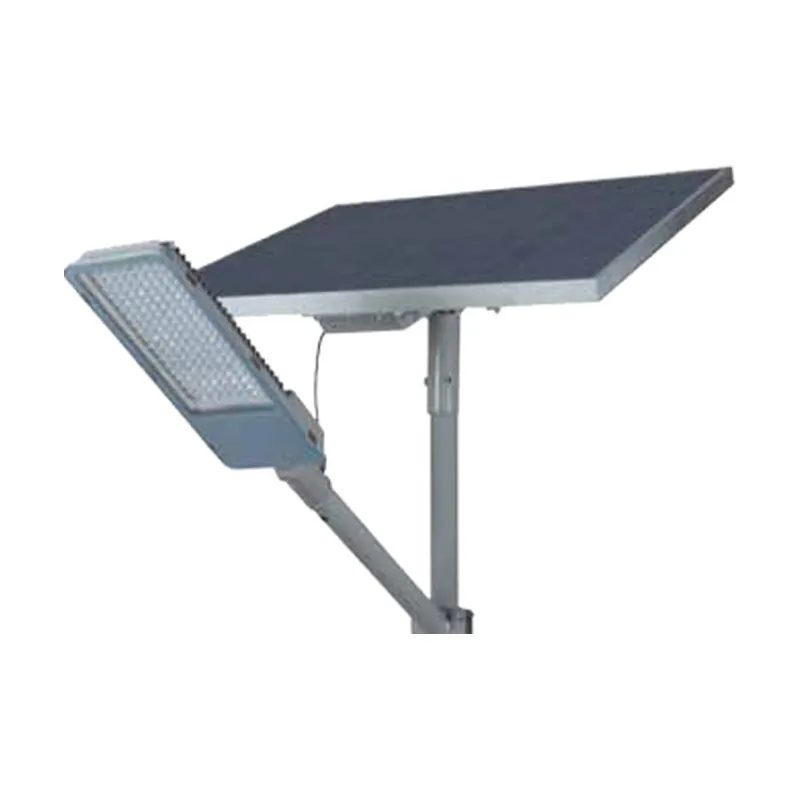
A solar street light pole looks like any other street light pole with a panel on top. Structurally it is a different design problem. The panel is a flat plate several times larger than the luminaire, mounted at the highest point, facing the wind. Its size is set by the energy the light needs, which depends on the site’s sun. This guide works through panel size, wind load, height and battery placement with numbers from our calculators.
Step 1: size the panel first
The pole cannot be designed until you know the panel. We sized four common light powers in our solar street light calculator, for Manila’s darkest month. By PVGIS, December gives 3.7 peak sun hours, the lowest month in our Manila data. The profile is 5 hours at full power then 7 hours at 30 %, three nights of autonomy, lithium iron phosphate battery and MPPT controller:
| Light | Energy per night | Battery | Panel needed | Next standard panel |
|---|---|---|---|---|
| 20 W | 158 Wh | 41 Ah at 12.8 V | 59 Wp | 60 Wp |
| 30 W | 237 Wh | 62 Ah | 89 Wp | 100 Wp |
| 40 W | 316 Wh | 82 Ah | 119 Wp | 120 Wp |
| 60 W | 473 Wh | 123 Ah | 178 Wp | 180 Wp |
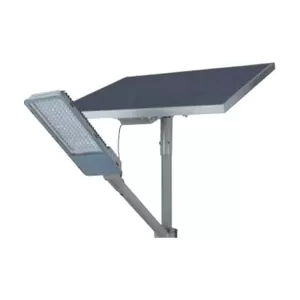
These match the panel range on our SL4830G split solar street light, which pairs 20–60 W lights with 60–180 Wp panels. A sunnier site needs a smaller panel; a site at higher latitude in winter needs a larger one. Our solar panel tilt angle article shows how tilt changes the winter yield.
Step 2: estimate the panel’s wind area
Monocrystalline modules deliver roughly 200 W per square metre of module area (about 20 % efficiency). That gives a first estimate of area:
| Panel | Approximate area |
|---|---|
| 60 Wp | 0.30 m² |
| 90 Wp | 0.45 m² |
| 120 Wp | 0.60 m² |
| 160 Wp | 0.80 m² |
| 180 Wp | 0.90 m² |
Use the real module dimensions once the module is chosen. A tilted panel presents less area to a horizontal wind, but designers usually take the full area as a conservative case, since wind direction varies.
Step 3: wind force and base moment
Wind pressure is about 0.613 × V² pascals, where V is the design wind speed in m/s. At 35 m/s (126 km/h), a moderate design speed in many codes, that is about 751 Pa. Taking a drag coefficient of 1.2 for a flat panel:
| Panel | Force on panel | Moment at base, 6 m pole | Moment at base, 8 m pole |
|---|---|---|---|
| 60 Wp | about 270 N | 1.6 kN·m | 2.2 kN·m |
| 90 Wp | about 405 N | 2.4 kN·m | 3.2 kN·m |
| 120 Wp | about 541 N | 3.2 kN·m | 4.3 kN·m |
| 160 Wp | about 721 N | 4.3 kN·m | 5.8 kN·m |
| 180 Wp | about 811 N | 4.9 kN·m | 6.5 kN·m |
These figures are for the panel alone. Add the luminaire (at the arm end), the battery box if it is on the pole, and the pole shaft itself. Then apply the load factors in your structural code. Coastal and typhoon or cyclone areas use design speeds well above 35 m/s, and force rises with the square of the speed: at 50 m/s, every figure above roughly doubles.
This is a first estimate to compare options. The pole supplier should verify the final design to EN 40, ASCE 7 or the local code, including dynamic effects. Our light pole EPA article explains how effective projected area is used in pole catalogues.
Step 4: pole height and arm
Height comes from the road, not the panel. For split systems with 20–60 W lights, 4–8 m is typical:
| Our SL4830G | 20 W | 30 W | 40 W | 50 W | 60 W |
|---|---|---|---|---|---|
| Mounting height | 4 m | 5 m | 7 m | 8 m | 8 m |
| Panel | 60 Wp | 90 Wp | 120 Wp | 160 Wp | 180 Wp |
Taller poles increase the moment arm, so moving from 6 m to 8 m raises the base moment by a third for the same panel. Keep the panel close to the pole top and avoid long brackets that add eccentric load. Our solar street light pole height and spacing guide covers the lighting side of the choice.
Step 5: battery placement
| Location | Advantages | Drawbacks |
|---|---|---|
| Box under the panel | Short cables, simple | Weight and wind area high on the pole; heat in direct sun |
| Inside the pole base | Protected, low centre of gravity | Needs a large-diameter base and a lockable door |
| Buried box | Cooler, harder to steal | Needs drainage; flooding risk |
| Integrated with panel (all-in-one) | No separate box | Battery size limited by the housing |
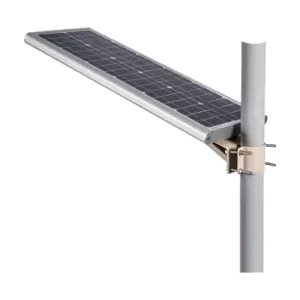
Lead-acid batteries for split systems are heavy, which is one reason buried boxes are common in hot climates. With lithium batteries, the weight falls and pole-top or integrated mounting becomes practical. Our all-in-one SL series puts a 12.8 V lithium battery in the same housing as the panel.
Step 6: foundation
The foundation resists the same base moment. For small solar poles, a reinforced concrete block with cast-in anchor bolts is usual. Its depth and size depend on the moment and the soil’s bearing capacity. Our street light foundation design article gives the method and typical sizes.
Common mistakes
- Using a grid pole’s catalogue rating. It may not include a panel at the top.
- Oversizing the panel for an easy winter. A larger panel than needed adds wind load at every pole.
- Ignoring local wind maps. Coastal and typhoon or cyclone sites need much stronger poles.
- Panel shading from the arm or trees. Even partial shade cuts output sharply; see our solar street light in shade guide.
What to send us
Send the site location (for PVGIS sun data), the road width and class, the hours of lighting and the design wind speed or the local code. We will size the light, panel and battery with our calculator and give the panel area and weight for your pole designer.
Sources
Frequently asked questions
How tall should a solar street light pole be?
Usually 4–8 m for split systems with 20–60 W lights, set by the road width and lighting class. Our SL4830G split solar street light is supplied for 4 m (20 W) up to 8 m (50–60 W).
How do you calculate wind load on a solar street light pole?
Add the projected areas of the panel, luminaire and pole, multiply each by the design wind pressure and a drag coefficient, then by its height above the base. The sum is the base moment the pole and foundation must resist. Local wind codes set the design wind speed.
Where should the battery go on a solar street light?
On the pole under the panel, inside the pole base, or buried in a box. Pole-top boxes are simple but add weight high up; buried boxes resist theft and heat but need drainage. Lithium batteries are often integrated with the panel or luminaire.
Can I put a solar panel on an existing street light pole?
Only after checking the pole for the extra wind area. A grid pole designed for a luminaire alone may not be strong enough for a panel at the top.