Solar Street Lights in Shade: How Much Shade Costs, Winter Shadows and What to Do About It
Why a little shade on a solar street light panel costs a lot, how long winter shadows get at your latitude, how much bigger the panel must be, and when to choose a split design.
Key points
- Shading one part of a panel can cut its output far more than the shaded area suggests, because the cells are wired in series.
- Winter shadows are long: at latitude 30° a 3 m wall casts a 4 m shadow at midday on the shortest day, and at 45° about 7.6 m.
- In our solar calculator, a 30 W light that needs 80 Wp in full sun needs 120 Wp if shade cuts the harvest by 40%, and 180 Wp at 60%.
- If you cannot move the pole or trim the trees, a split light with the panel high on the pole and aimed separately is usually the cheapest fix.
Most solar street light failures we are asked about have one of three causes: an undersized battery, a dirty panel, or shade. Shade is the hardest to spot, because the site often looks sunny when it is surveyed in summer and only becomes a problem when the sun is low in winter. This guide puts numbers on shade: how much it costs, how long the shadows get, and what it means for panel size. The sizing figures come from our solar street light calculator.
Why a small shadow causes a big loss
A solar panel is made of cells wired in series, like a chain. The current through the chain is limited by its weakest link. If a leaf, a pole or the edge of a building’s shadow covers part of one row of cells, that row produces less current, and so does every cell in series with it.
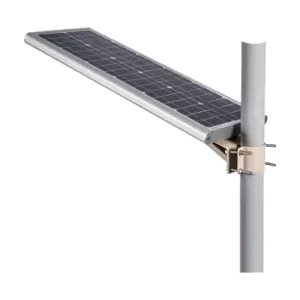
Larger panels have bypass diodes that let current flow around a shaded group of cells, so a partial shadow costs roughly that group’s share of the output. Small panels, such as those built into all-in-one solar street lights, often have only one or two diodes, or none. On those, a shadow across a few cells can cut output by half or more.
In practice:
- Shade on the whole panel reduces output roughly in proportion to how much light is lost. Open shade on a bright day might still give 10–25% of full output.
- Hard shadow on part of the panel can cost much more than its share of the area.
- Shade at midday costs most; the same shadow at 8 am costs little.
How long winter shadows get
Shadows are longest in winter, at exactly the time of year when the days are short and the battery needs the most help. At solar noon on the winter solstice, the sun’s height above the horizon is about 90° − latitude − 23.4°. The shadow length of an obstacle is its height divided by the tangent of that angle:
| Latitude | Sun height at noon, shortest day | Shadow of a 3 m wall | Shadow of a 10 m tree or building |
|---|---|---|---|
| 0° (equator) | 66.6° | 1.3 m | 4.3 m |
| 15° | 51.6° | 2.4 m | 7.9 m |
| 30° | 36.6° | 4.0 m | 13.5 m |
| 45° | 21.6° | 7.6 m | 25.3 m |
These are midday values, the shortest of the day. In the morning and afternoon the shadows are much longer. A 10 m tree 15 m south of a pole is harmless in June at latitude 30° and shades the panel for much of the day in December. Always check the site against the winter sun, not the day of the survey. PVGIS and NOAA’s solar position calculator, both free, show sun paths for any location.
How much bigger the panel must be
We ran a typical 30 W solar street light through the calculator: full power for 5 hours, then 30% for 6 hours, 4.5 peak sun hours, an MPPT controller, a lithium battery and 3 days of autonomy. Then we reduced the effective sun hours to represent shade:
| Shade loss over the day | Effective sun hours | Panel needed | Standard panel | Battery |
|---|---|---|---|---|
| None | 4.5 | 70 W | 80 Wp | 756 Wh (59 Ah at 12.8 V) |
| 25% | 3.4 | 93 W | 100 Wp | unchanged |
| 40% | 2.7 | 117 W | 120 Wp | unchanged |
| 60% | 1.8 | 175 W | 180 Wp | unchanged |
The battery does not change, because it is sized for the nights without sun. The panel has to grow, and by 60% shade it has more than doubled. That is beyond what fits on most all-in-one housings, which is why shade usually decides the product type, not just the panel size.
Shade also slows recovery after cloudy days: with less surplus each sunny day, the battery takes longer to refill, and the light spends more nights in its low-battery dimming mode. Our rainy days guide explains that balance.
Five fixes, cheapest first
- Move the pole. Shifting a pole a few metres along a road, or to the other side, often clears a tree or wall. Do this at the design stage; it costs nothing.
- Trim the trees. Lifting the lower branches or thinning the crown on the sun side can be enough. Agree it with the owner of the trees.
- Raise the panel. A taller pole or a bracket that puts the panel above the obstacle’s shadow line.
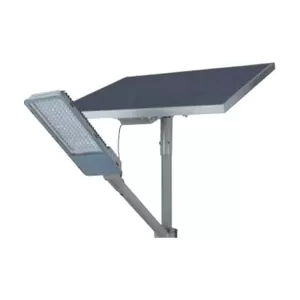
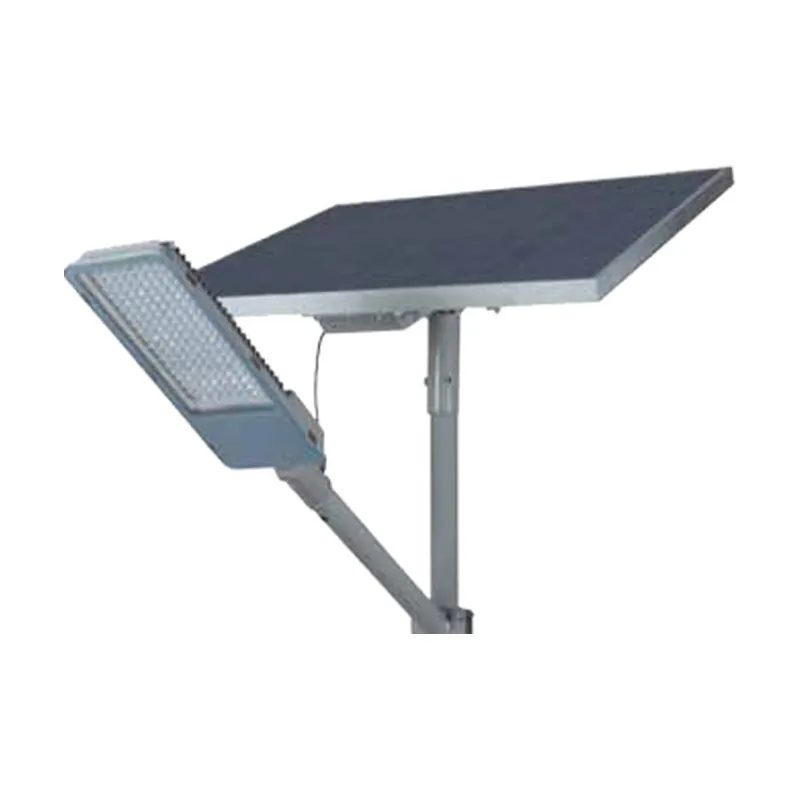
- Split the panel from the lamp. With a split solar street light like the SL4830G, the panel (60–180 Wp) sits on its own bracket at the top of a 4–8 m pole and can be turned towards the sun independently of the lamp head. It also allows a bigger panel than an all-in-one housing.
- Lower the night profile. If a site is shaded and nothing else is possible, reduce the late-night power or use motion sensing so the light needs less energy. Check the result with the calculator.
Which design for which site
| Site | Recommendation |
|---|---|
| Open road, no obstacles | All-in-one solar street light |
| Occasional morning or evening shade | All-in-one with one size larger panel and battery, or a lower profile |
| Trees or buildings shading at midday in winter | Split design with the panel raised and aimed, or move the pole |
| Deep shade most of the day | Grid power or a panel placed elsewhere with a cable run |
Checklist for a shade survey
- Note every tree, wall, building and pole within about three times its height of the planned panel, on the sun side.
- Work out the winter noon shadow from the table above; remember morning and afternoon are longer.
- Allow for tree growth over the life of the light.
- Photograph the sky from panel height towards the sun’s path, or use PVGIS’s horizon tool.
- Size the panel for the shaded harvest, not the open-sky figure.
Summary
Shade costs solar street lights more than it appears, especially on small panels and in winter when shadows are long. Check the site against the winter sun, size the panel for the real harvest, and where a site is shaded at midday, separate the panel from the lamp or move the pole. In our example, 40% shade turns an 80 Wp design into a 120 Wp one; 60% shade more than doubles it.
Sources
Frequently asked questions
Do solar street lights work in the shade?
Only if they are sized for it. Light shade for part of the day reduces the harvest; a panel in shade most of the day will not keep a street light running. Either move the light into the sun, separate the panel from the lamp, or oversize the panel.
How much does shade reduce a solar panel's output?
More than the shaded area suggests. Because cells are in series, a shadow across a row of cells can reduce output by half or more until a bypass diode carries the current around them. Small panels on solar street lights often have few or no bypass diodes, so they are especially sensitive.
Can I put the solar panel away from the light?
Yes, with a split solar street light. The panel sits on its own bracket at the top of the pole, or on a nearby sunny spot, and is connected to the battery and lamp by cable. Keep the cable short and sized for the current to limit losses.
Is morning or afternoon shade worse?
Shade around midday costs the most, because that is when the sun is strongest. Shade early in the morning or late in the afternoon costs much less, often only 10–20% of the day's energy.