Solar Street Light with Built-In Lithium Battery: How Many Nights It Really Runs
How the inbuilt LiFePO4 battery in an all-in-one solar street light is sized, what 12.8 V 18 Ah gives in our calculator under three night profiles, and lithium vs gel at the same capacity.
Key points
- An all-in-one solar street light carries a 12.8 V LiFePO4 battery inside the housing; in our range it is 9–33 Ah, or 115–422 Wh.
- The night profile decides the run time: in our calculator the 30 W model's 18 Ah battery covers 0.97 nights at a heavy profile, 1.5 at a dimmed one and 2.2 at a motion-style one.
- Only the motion-style profile (2 h full, then 15 %) balances on its 45 Wp panel at 4.5 sun hours; full brightness all night needs a split system.
- At the same 18 Ah, a gel battery used to 50 % gives 115 Wh against 207 Wh for LiFePO4 at 90 %.
“Inbuilt lithium battery” is now standard on all-in-one solar street lights, and almost every datasheet promises several rainy days of backup. Whether that holds depends on two things that the datasheet rarely shows together: how much energy the battery stores and how the light uses it through the night. This guide explains how the battery is built, then uses our calculator on our own all-in-one models to show what the numbers mean.
What is inside
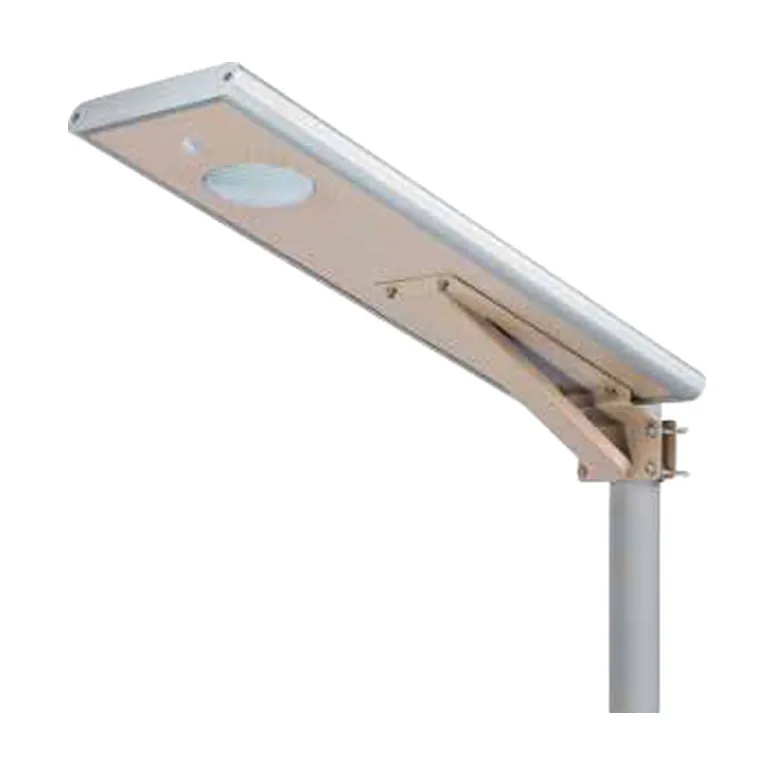
An all-in-one light combines panel, battery, controller and LED head in one aluminium body. The battery is a pack of LiFePO4 (lithium iron phosphate) cells, usually four in series for 12.8 V nominal, with a battery management board that protects against overcharge, deep discharge, short circuit and, in better designs, charging in the cold.
| Our model | LED | Panel | Battery | Energy stored |
|---|---|---|---|---|
| SL3530C015 | 15 W | 20 Wp | 12.8 V / 9 Ah | 115 Wh |
| SL5730C030 | 30 W | 45 Wp | 12.8 V / 18 Ah | 230 Wh |
| SL6830C045 | 45 W | 75 Wp | 12.8 V / 22 Ah | 282 Wh |
| SL6830C060 | 60 W | 75 Wp | 12.8 V / 33 Ah | 422 Wh |
Stored energy is volts × amp-hours. Our calculator takes 90 % of it as usable for LiFePO4, so the 18 Ah pack gives about 207 Wh.
Why LiFePO4
- Deep cycling. LiFePO4 can be used to 80–90 % of its capacity every night. Lead-acid and gel are usually limited to about 50 % to reach a useful life.
- Weight. It matters on a pole: the whole SL5730C030 is 1120 × 325 × 140 mm with the battery inside.
- Thermal stability. LiFePO4 is less prone to thermal runaway than other lithium chemistries, which matters in a sun-heated housing.
Its weakness is cold charging. Most cells must not be charged below about 0 °C, so in cold climates the controller has to block charging until the pack warms. Our outdoor solar lights that work in winter article goes into this.
The calculation: one battery, three night profiles
We ran the SL5730C030 (30 W, 45 Wp panel, 18 Ah LiFePO4) through our battery autonomy calculator with 4.5 peak sun hours, an MPPT controller and 15 % of normal charging on rainy days:
| Night profile | Energy per night | Nights from a full battery | Daily balance on sunny days |
|---|---|---|---|
| 5 h at 100 %, then 7 h at 30 % | 237 Wh | 0.97 | −91 Wh |
| 3 h at 100 %, then 9 h at 20 % | 160 Wh | 1.5 | −14 Wh |
| 2 h at 100 %, then 10 h at 15 % | 117 Wh | 2.2 | +29 Wh |
(open the first profile · open the third profile)
What this shows:
- The battery is not the whole story. At the heavy profile, the panel cannot refill the battery even on sunny days. The light would dim itself or switch off early within a few days.
- The motion-style profile is the design case. Two hours at full power after dusk, then 15 % with motion sensing raising it when someone passes, is what these lights are built for. Then the battery covers about two nights, and the daily surplus refills it after a two-day dull spell in about six and a half sunny days.
- “30–36 hours of operation” on a datasheet means at reduced output. It is not 30 hours at full power: at 30 W, 207 Wh lasts about six hours once driver losses are counted.
The 60 W model behaves the same way. Its 33 Ah pack stores 422 Wh (380 Wh usable), but its 75 Wp panel also limits it to dimmed or motion-sensing profiles at 4.5 sun hours. Our solar street light dimming profile article explains how to choose a profile.
Lithium vs gel at the same capacity
We changed only the battery type in the calculator, keeping 18 Ah and the 3 h + 9 h profile:
| Battery | Usable energy | Nights from full |
|---|---|---|
| LiFePO4 (90 % usable) | 207 Wh | 1.5 |
| Gel (50 % usable) | 115 Wh | 0.83 |
A gel battery would need almost twice the amp-hours to match, which would not fit in an all-in-one housing. That is why split systems with a separate battery box often still use lead-acid or gel, while all-in-one lights use lithium. Our split SL4830G carries 38–100 Ah lead-acid batteries for 3–5 rainy days.
When an inbuilt battery is not enough
Choose a split system, or a larger all-in-one at a lower setting, if:
- the road needs full brightness most of the night;
- the worst month has fewer than about 4 sun hours;
- you need three or more nights of autonomy at a fixed level.
Our all-in-one vs split solar street light comparison and the how many rainy days guide go further. To size for your city, use the solar street light calculator with your worst-month sun hours.
Battery life in years
LiFePO4 cells are commonly rated for 2,000 or more full cycles at moderate temperature. A solar street light cycles once a day, but rarely fully, which helps. Heat inside the housing works the other way. Our all-in-one models have a system design life of 5 years; plan a battery replacement in that window and see solar street light battery replacement for how it is done.
Common mistakes
- Comparing battery Ah across different voltages. 18 Ah at 12.8 V is 230 Wh; 18 Ah at 3.2 V is 58 Wh. Always compare watt-hours.
- Ignoring the panel. A big battery on a small panel never fills.
- Running full brightness all night on a light designed for motion sensing.
What to send us
Your location, the hours of light you need and at what level, and the pole height. We will run both the battery and the panel through our calculators and tell you which model, or which split system, fits.
Sources
Frequently asked questions
What battery is inside an all-in-one solar street light?
Almost always lithium iron phosphate (LiFePO4) at 12.8 V nominal, made of four cells in series. Our SL models use 9, 18, 22 or 33 Ah, which is about 115, 230, 282 and 422 Wh.
How long does the inbuilt lithium battery last on one charge?
It depends on the night profile. In our calculator, the 30 W model's 18 Ah battery lasts about one night at 5 hours full power plus 7 hours at 30 %, and about 2.2 nights at 2 hours full power plus 10 hours at 15 %.
How long does the lithium battery last in years?
LiFePO4 cells are typically rated for 2,000 or more full cycles, but heat shortens their life. Inside a sun-heated housing, plan on a replacement within the system's design life of 5 years for our all-in-one models, and check the warranty.
Can a lithium solar street light work in freezing weather?
It can discharge below 0 °C, but most LiFePO4 cells must not be charged below about 0 °C. A good controller blocks charging when the cells are too cold. Check the cell datasheet for the exact limits.
Is lithium better than gel for solar street lights?
Usually yes: more usable energy per amp-hour, less weight and more cycles. Gel still suits very cold sites and some split systems where the battery is buried and weight does not matter.