Solar Street Light Battery Replacement: When, Which Battery and How
When a solar street light battery needs replacing, how to choose the replacement, what changes from lead-acid to LiFePO4, and a safe step-by-step replacement procedure.
Key points
- The battery is usually the first part of a solar street light to wear out: lead-acid and gel typically after 2–4 years, good LiFePO4 after about 5–8 years or more.
- The main sign is a light that goes dark earlier in the night, especially after one or two cloudy days, while the panel and lamp are fine.
- In our example, a 100 Ah LiFePO4 battery that has faded to 60 Ah lasts about 2.8 nights instead of 4.7, so the light fails in the first rainy spell.
- Replace like for like on voltage, and check that the controller has a charge profile for the new chemistry. Switching from lead-acid to LiFePO4 usually means a new or reprogrammed controller.
Sooner or later, every solar street light needs a new battery. Panels last 20 years or more and LEDs tens of thousands of hours, but batteries wear out with every charge cycle and every hot summer. Replacing them well keeps a project working for its full life; replacing them badly, with the wrong chemistry or capacity, can make things worse. This guide covers when to replace, what to buy and how to do it safely.
How long solar street light batteries last
| Battery | Typical life in solar street lights | What shortens it |
|---|---|---|
| Flooded lead-acid | 1.5–3 years | Deep discharge, heat, low water |
| Sealed lead-acid / AGM | 2–3 years | Deep discharge, heat |
| Gel | 2–4 years | Heat, being left part-charged |
| LiFePO4 (lithium iron phosphate) | 5–8 years or more | Heat above about 45 °C, cheap or recycled cells, charging below 0 °C |
A battery is generally considered worn out when its capacity falls to about 70–80% of new. For a solar street light, that point matters less than whether the remaining capacity still covers your cloudy spells. See how long solar street lights last for the other parts.
Signs the battery needs replacing
- The light goes dark earlier in the night, especially after one or two cloudy days
- It works after a sunny day but not after a dull one, while neighbouring lights are fine
- The controller shows low battery soon after dusk, or the light dims early
- The battery is swollen, leaking or hot, which means replace immediately
- The battery voltage at dawn is low after a full night (for example below about 11.5–11.8 V on a 12 V lead-acid system, or near the low-voltage cut-off on lithium)
Before blaming the battery, rule out the other common causes: a dirty or shaded panel, a loose connection, or a controller fault. Our solar street light troubleshooting guide goes through them in order.
What a worn battery does to autonomy
Take a 40 W light running 5 hours at full power and 7 hours at 30%, with a 150 Wp panel at 4.5 peak sun hours. With its original 100 Ah LiFePO4 battery, the battery autonomy calculator gives about 4.7 nights on battery. Now suppose the battery has faded to 60 Ah of real capacity:
| Battery | Usable energy | Nights on battery | 4 rainy days |
|---|---|---|---|
| New, 100 Ah | about 1,150 Wh | about 4.7 | Passes |
| Faded, 60 Ah | about 690 Wh | about 2.8 | Fails on night 3 |
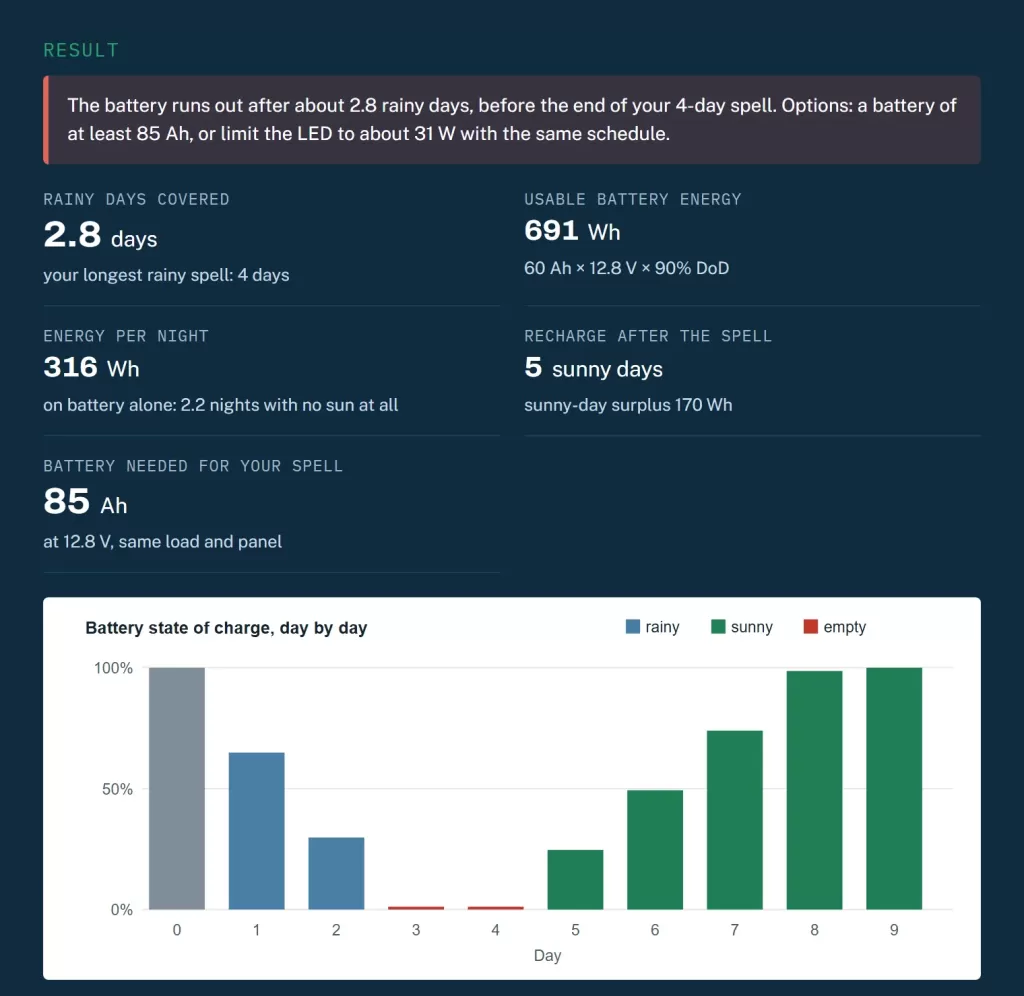
Open the example and enter your own battery and panel.
On a sunny day the faded battery still fills and the light still works. That is why a worn battery is often only noticed in the rainy season.
Choosing the replacement
1. Match the system voltage
Replace a 12 V battery with 12 V (or 12.8 V LiFePO4), a 24 V system with 24 V (or 25.6 V LiFePO4). The controller and LED driver are designed for that voltage.
2. Size the capacity for your cloudy spells
Do not simply copy the old capacity. Check whether the original was big enough; if the lights always struggled in the rainy season, size up. The calculation is in how to calculate solar street light battery capacity. Remember that the panel must also be big enough to refill a larger battery.
3. Compare usable energy, not just Ah
Lead-acid and gel batteries should only be discharged to about 50% regularly; LiFePO4 to about 80–90%. So the same Ah does not mean the same usable energy. In the example above, a gel battery would need about 160 Ah at 12 V to match the usable energy of the 100 Ah LiFePO4 one. See LiFePO4 vs gel batteries.
4. Check the controller
This is the step most often missed. Lead-acid and LiFePO4 need different charging voltages and different low-voltage cut-offs. If you change chemistry:
- Reprogram the controller if it has a LiFePO4 profile, or
- Replace the controller with one that does; it is also a good moment to move to MPPT (see MPPT vs PWM)
A lithium battery on a lead-acid profile may never charge fully, or the controller may cut the load at the wrong time. A lead-acid battery on a lithium profile will be undercharged and sulphate quickly.
5. Check the physical fit and conditions
- Dimensions and weight for the battery box, pole cavity or all-in-one housing
- Ingress protection for where it sits
- Temperature: LiFePO4 must not be charged below 0 °C unless it has a heater or low-temperature protection; in very hot sites, shade and ventilation matter more than chemistry
- A BMS (battery management system) inside the LiFePO4 pack, with protection for over-charge, over-discharge, over-current and temperature
Lead-acid to LiFePO4: is it worth it?
Usually, yes, for split systems that came with lead-acid or gel batteries:
- Longer life, often two to three replacement cycles of lead-acid in the life of one LiFePO4 battery
- More usable capacity per Ah, so a smaller, lighter battery does the same job
- Better tolerance of partial charge, which is normal in the rainy season
- Less maintenance, with no water and no sulphation
The cost per battery is higher, but the cost per year of service is usually lower. Add the cost of the controller change and of the visits to site; fewer visits are where most of the saving comes from.
Replacing the battery safely
- Plan the work in daylight with the correct replacement battery, tools and protective gloves and glasses
- Disconnect in the order the controller maker specifies. A common order is: switch off or disconnect the load, then the solar panel, then the battery. Never short the battery terminals
- Remove the old battery, keeping it upright if it is lead-acid
- Fit the new battery and connect it to the controller first, before the panel, so the controller can detect the system voltage
- Connect the panel, then the load
- Check the controller settings: battery type, voltage, lighting profile and low-voltage cut-off
- Test with the controller’s test function or by covering the panel, then record the date and battery details for the maintenance log
- Recycle the old battery through an authorised collector. Lead-acid and lithium batteries must not go to ordinary waste
For large projects, it is worth replacing the batteries of a whole road at once and planning the next replacement date in the maintenance budget.
All-in-one lights
In an all-in-one solar street light, the battery is a pack inside the housing. Most designs allow it to be replaced by opening the housing, but it must be the matching pack for that model, with the same connector and BMS. Ask the supplier for the battery pack part number when you buy the lights, so spares can be ordered later.
Our split solar street lights can be supplied with lead-acid or lithium batteries, and our all-in-one solar street lights use 12.8 V lithium packs. Send us the existing battery, controller and panel details, and we will recommend a replacement battery and controller setting that fits.
Sources
Frequently asked questions
How often do solar street light batteries need replacing?
Lead-acid and gel batteries typically last 2–4 years in solar street lights, less in hot climates or if they are often deeply discharged. Good LiFePO4 batteries typically last 5–8 years or more, depending on temperature, depth of discharge and cell quality.
Can I replace a lead-acid battery in a solar street light with lithium?
Yes, and it is usually worth it, but check the controller first. A controller set for lead-acid charges at the wrong voltages for LiFePO4. Use a controller with a LiFePO4 profile (or reprogram it), use a battery with its own BMS, and match the system voltage (12 V lead-acid to 12.8 V LiFePO4).
How do I know if a solar street light battery is bad?
If the light goes dark earlier than it used to, especially after a cloudy day, and the panel is clean and unshaded, the battery has probably lost capacity. Confirm by measuring the battery voltage at dawn after a full night, or by a capacity test: charge it fully and discharge it at a known load.