Explosion-Proof Emergency Light: How to Choose the Fitting, Battery and Duration
How to choose an explosion-proof emergency light: self-contained or central battery, Ex marking, 1 h vs 90 min vs 3 h duration, cold-weather batteries, and a compressor-house example.
Key points
- An explosion-proof emergency light is a normal Ex fitting plus a battery and charger inside the certified enclosure; the whole unit, battery included, must carry the Ex marking for the zone.
- Duration is set by the code your site follows: 1 hour minimum under EN 1838, 90 minutes under NFPA 101, and 3 hours in many oil, gas and chemical company specifications.
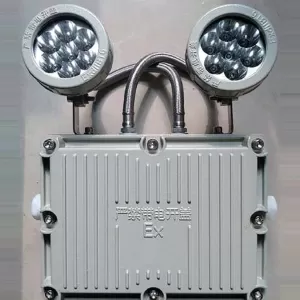
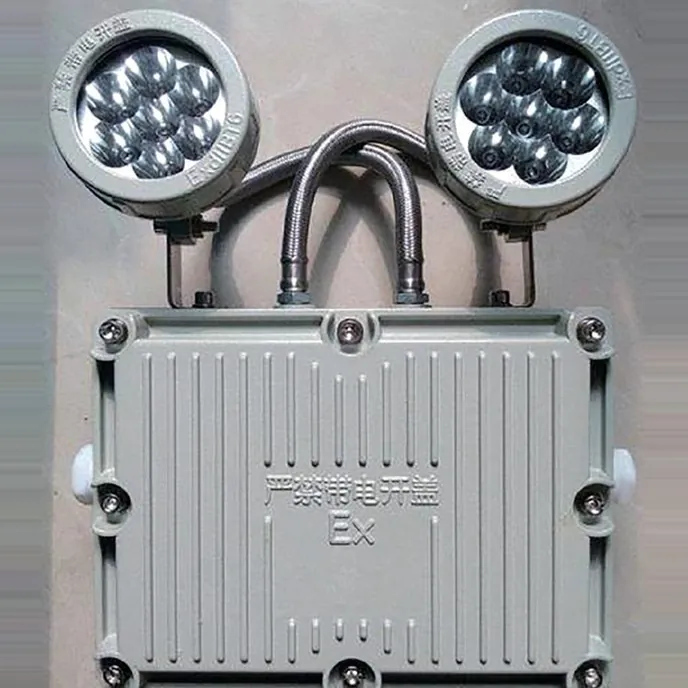
- Our BG-FBYJ10A is a 10 W twin-head unit marked Ex d IIC T4 with 2 hours of emergency operation and a −30 °C to +50 °C operating range.
- In an 18 × 9 m compressor house our lighting calculator gives 8 normal fittings of 60 W; the emergency units are then placed at doors, changes of direction and safety equipment, not on the same grid.
When the mains supply trips in a refinery pump house or a chemical store, people still have to find the door. An explosion-proof emergency light makes that possible without adding an ignition source. This guide covers what makes these fittings different, how to choose the duration and battery, and how many units a typical process building needs.
What an explosion-proof emergency light is
An emergency light has three parts that a normal fitting does not: a rechargeable battery, a charger, and a changeover circuit that switches to battery when mains is lost. In a hazardous area all three must sit inside the protected enclosure, usually flameproof (Ex d) or a combination of Ex d, Ex e and encapsulation (Ex m).
That has two consequences:
- The Ex marking applies to the whole unit. A standard emergency pack added to an Ex fitting by an installer voids the certificate. Buy the unit as one certified product.
- The battery is part of the temperature assessment. Cells and charging circuits get warm. The temperature class on the label (T4, T6 and so on) already includes them, which is why you should not swap battery types later.
Our guide on reading an Ex marking explains the gas group and temperature class in the label.
Self-contained or central battery?
| Self-contained units | Central battery system | |
|---|---|---|
| Where the battery is | Inside each fitting | In one battery room, usually outside the hazardous area |
| Cabling | Normal lighting circuit | Fire-resistant cable to every fitting |
| Testing | Each unit tested at its location | Tested centrally |
| Typical use | Small plants, scattered buildings, retrofits | Large plants with a safe-area battery room |
| Hazardous-area issue | Each unit must be Ex rated with its battery | Fittings inside zones must be Ex rated; battery room usually is not |
Most process plants we quote for use self-contained units because the buildings are spread out and a central system needs a long run of fire-resistant cable into every zone.
How long it must run
The duration is set by the code the site follows:
| Code or document | Minimum duration on escape routes |
|---|---|
| EN 1838 (Europe and many export projects) | 1 hour |
| NFPA 101 (United States) | 90 minutes |
| Many oil, gas and chemical company specifications | 3 hours |
Our BG-FBYJ10A gives 2 hours. That meets EN 1838 and NFPA 101 with a margin, but not a 3-hour specification. On a 3-hour project, say so in the enquiry and we will propose a solution that meets it rather than stretching a 2-hour unit. Our article on how long emergency lights last explains how battery capacity falls with age, which is why rated duration should exceed the minimum.
Light levels in emergency mode
The duration is only half of it; the light level must also be met at the end of that time.
- EN 1838: at least 1 lux on the centre line of escape routes up to 2 m wide, 0.5 lux in open (anti-panic) areas, and for high-risk task areas 10 % of the normal level and at least 15 lux.
- NFPA 101: an average of 1 foot-candle (about 10.8 lux) at the start, with a minimum of 0.1 foot-candle, falling to no less than 0.6 foot-candle average at the end of 90 minutes.
Ask for the emergency-mode light output and a photometric file. The mains output is not the figure that matters here. Our escape route lighting guide shows how the spacing check is done.
The battery in a hazardous area
Batteries are the part that fails first, and in hazardous areas they also face heat, cold and corrosion.
- Temperature range. The BG-FBYJ10A is rated for −30 °C to +50 °C. Outside that range, battery capacity falls or charging stops. For units in direct sun on a desert pipe rack, mount them on the shaded side of a column.
- Charging time. After a discharge, most units need about 24 hours to recharge fully. If your site tests by discharging for the full duration, plan the test so the area is not left without emergency light afterwards.
- Replacement. Opening an Ex d enclosure to change a battery is maintenance on certified equipment. Do it under a permit, with the area confirmed gas-free, and only with the battery type named by the manufacturer. Our maintenance guide covers flamepath inspection when the cover is refitted.
Worked example: an 18 × 9 m compressor house
Assume a Zone 2 compressor house 18 m long and 9 m wide, lights mounted at 5 m, with a target of 150 lux for normal operation. With our BDE507 at 60 W and 110 lm/W, our lighting calculator gives:
| Result | Value |
|---|---|
| Room index | 1.43 |
| Fittings | 8 (4 × 2) |
| Spacing | 4.5 m × 4.5 m |
| Average illuminance | about 153 lux |
| Power density | 2.96 W/m² |
The emergency lights are not placed on that grid. EN 1838 asks for emergency lighting at specific points first:
- each exit door (2 doors in this building);
- each change of direction on the escape route (1, where the walkway turns past the compressor skid);
- fire-fighting equipment and manual call points (2);
- first-aid point (1).
That gives 6 BG-FBYJ10A units, before the spacing check. If the photometric check shows a dark section between two points on the route, add a unit there. The twin heads can be aimed separately, so one unit at the turn can light both legs of the route.
Maintained or non-maintained?
- Non-maintained units light only when mains fails. They are the usual choice in plant rooms that already have normal lighting.
- Maintained units light all the time and stay on during a failure. They suit exit points that must always be visible.
Our article on emergency light types explains the third option, sustained units.
Testing in a hazardous area
Routine tests are the same as in any building, a short function test monthly and a full-duration test yearly, but in a hazardous area:
- use the unit’s test switch or a remote test system rather than opening covers;
- record the result per unit, with the tag number from the hazardous-area register;
- replace a unit that fails its duration test rather than repairing it on site, unless the work is done under the manufacturer’s instructions.
What to send us
- Area drawing with zones and gas groups
- Required duration (1 h, 90 min, 3 h)
- Escape route plan with doors and safety equipment marked
- Ambient temperature range
- Certificate scheme required (IECEx, ATEX or national)
For the wider picture, including exit signs, see explosion-proof emergency and exit lights. Send the five items above and we will reply with a unit count and a layout check like the example.
Sources
Frequently asked questions
What is an explosion-proof emergency light?
It is a light fitting certified for a hazardous area that keeps working on its own battery when the mains supply fails. The battery, charger and LED driver sit inside the protected enclosure, so the complete unit carries one Ex marking.
How long must an emergency light run in a hazardous area?
EN 1838 sets a minimum of 1 hour for escape routes and NFPA 101 sets 90 minutes. Many refinery and chemical plant specifications ask for 3 hours. The project specification decides, so check it before choosing a unit.
Can I use a normal emergency light outside the hazardous zone and skip the Ex rating?
Yes, if the fitting is genuinely outside every classified zone on the area drawing. Escape routes often cross zone boundaries, though, so any unit inside a zone must be rated for it.
What is the Ex marking of your explosion-proof emergency light?
The BG-FBYJ10A is marked Ex d IIC T4, with 2 hours of emergency operation. Its certificate is supplied with the quotation. Our own explosion-proof certificate ZJEx23.0914 covers the BED series, not this model.