Solar Panel Tilt Angle for Street Lights: Design for the Worst Month
What tilt angle to use for a solar street light panel, why to tilt for the worst month, PVGIS data for Lahore, Cape Town, Lagos and Nairobi, and how tilt changes panel size.
Key points
- Solar street lights must work every night, so tilt the panel for the worst month (usually winter), not for the best annual total.
- A good starting point is latitude plus 10–15°, facing the equator, with a minimum of about 10–15° so rain washes the panel.
- In Lahore, tilting from flat to 30° raises the worst-month sun from 3.28 to 4.98 peak sun hours, and a 40 W light needs a 100 Wp panel instead of 150 Wp.
- Near the equator the gain is small, but a slight tilt still matters for cleaning; in Lagos the worst month is in the rainy season and steeper tilts make it worse.
A grid-tied solar plant is tilted to produce the most energy over a year. A solar street light has a different job: it has to light the road on the worst night of the worst month. That changes the best tilt angle, and getting it right can save a whole panel size.
Why street lights tilt for the worst month
The battery and panel of a solar street light are sized for the month with the least sun (see how to size a solar street light battery). Extra energy in June is no use if the light goes dark in December. So the question is not “which angle gives the most kWh per year”, but “which angle gives the most sun in the worst month”, which is almost always a steeper angle that faces the low winter sun.
What the data says: four cities
We took monthly irradiation from the European Commission’s PVGIS database for panels facing the equator at different tilts. The figures are peak sun hours per day: the annual average and the worst month.
| City (latitude) | Flat (0°) | Tilted options | Best for worst month |
|---|---|---|---|
| Lahore, Pakistan (31.5° N) | 5.12 / 3.28 (Jan) | 15°: 5.65 / 4.25 · 30°: 5.88 / 4.98 · 45°: 5.79 / 4.51 (Jul) | about 30° |
| Cape Town, South Africa (33.9° S) | 5.34 / 2.40 (Jun) | 15°: 5.79 / 3.13 · 35°: 5.93 / 3.84 · 50°: 5.66 / 4.13 | about 50° |
| Lagos, Nigeria (6.5° N) | 5.07 / 4.03 (Jun) | 10°: 5.12 / 3.82 · 20°: 5.08 / 3.55 | flat to 10° |
| Nairobi, Kenya (1.3° S) | 5.46 / 4.05 (Jun) | 10°: 5.36 / 4.24 · 20°: 5.15 / 4.35 | 15–20° |
Three things stand out:
- At mid-latitudes, tilt is worth a lot. In Lahore the worst month rises from 3.28 to 4.98 peak sun hours, about 50% more, by tilting to 30°. In Cape Town the June figure rises from 2.40 to 4.13 at 50°.
- The best angle for the worst month is steeper than the best angle for the year. Cape Town’s annual total peaks around 35°, but its winter is best at 50°. In Lahore, 45° is already too steep: the worst month moves to July and drops to 4.51.
- Near the equator, the worst month is the rainy season, not winter. In Lagos the poorest month is June, when the sun is high in the north and clouds are thick. Tilting the panel south makes June slightly worse (4.03 → 3.55 at 20°). In Nairobi, just south of the equator, a north-facing tilt helps June a little (4.05 → 4.35 at 20°).
How the angle changes the panel you need
Take a 40 W solar street light (full power 5 hours, then 30% for 7 hours, 3 nights of battery). Using the worst-month figures in our solar street light calculator:
| Site and tilt | Worst month (PSH) | Panel needed | Standard size |
|---|---|---|---|
| Lahore, flat | 3.28 | about 134 Wp | 150 Wp |
| Lahore, 30° | 4.98 | about 88 Wp | 100 Wp |
| Cape Town, flat | 2.40 | about 183 Wp | 200 Wp |
| Cape Town, 50° | 4.13 | about 106 Wp | 120 Wp |
| Lagos, flat | 4.03 | about 109 Wp | 120 Wp |
| Lagos, 10° | 3.82 | about 115 Wp | 120 Wp |
| Nairobi, 20° | 4.35 | about 101 Wp | 120 Wp |
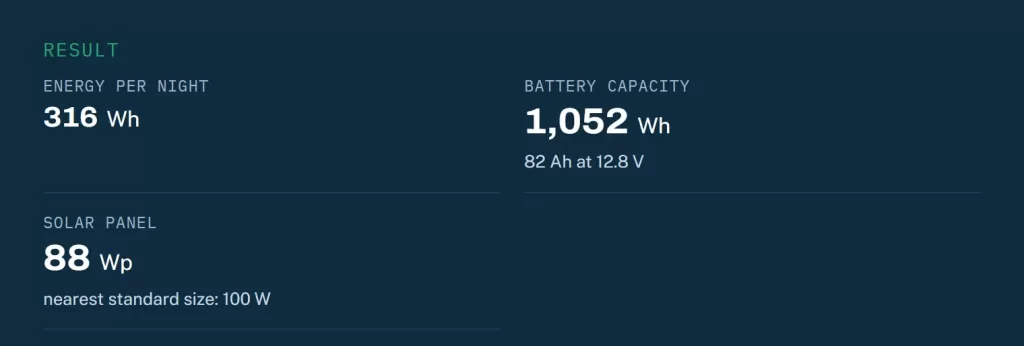
Open the Lahore example and change the peak sun hours to the flat figure (3.28) to see the difference.
In Lahore and Cape Town, the right tilt saves one or two panel sizes, which also means a lighter pole load. In Lagos, the panel size is the same either way, so the tilt is chosen for cleaning.
A practical rule of thumb
- Face the equator: south in the northern hemisphere, north in the southern hemisphere. A deviation of 15–20° costs little.
- Start at latitude + 10–15° for sites beyond about 15° latitude, then check the worst month in PVGIS and adjust in 5° steps.
- Between about 15° N and 15° S, find out which month is worst. If it is the rainy season with the sun overhead or on the other side, keep the tilt low.
- Never go below about 10–15°. A flat panel holds water, dust and leaves; in dusty places, dirt can cost more energy than any tilt gains. See our solar street light troubleshooting guide for what dirt does to a system.
- Check shading at the chosen angle, especially from trees, buildings and the lamp arm itself in winter, when the sun is lowest.
Split vs all-in-one lights
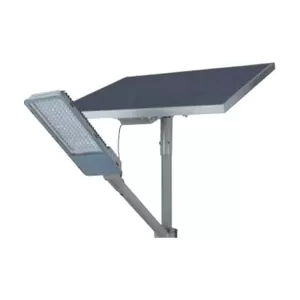
A split solar street light has its panel on a separate bracket at the top of the pole, so it can be set to any angle and turned to face the equator regardless of which way the road runs. This is the main reason split systems are preferred at higher latitudes and for winter-critical projects.
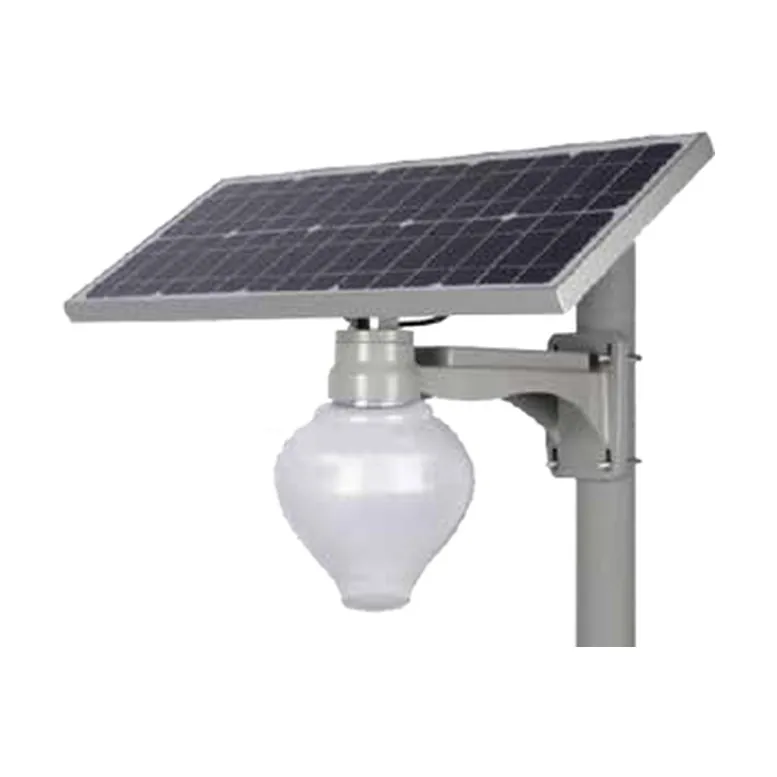
An all-in-one light has the panel on top of the lamp body. The lamp has to face the road, so the panel’s direction and tilt depend on the bracket. Many all-in-one lights have an adjustable bracket for some tilt, but on a road running north–south, the panel may face east or west. That costs energy, which the design should allow for. Our semi-integrated solar street light guide covers the options in between.
How to look up your own site in PVGIS
- Open PVGIS from the European Commission and choose Monthly data.
- Click your location on the map.
- Tick the irradiation on an inclined plane and enter the angle you want to test; leave the azimuth facing the equator.
- Read the daily value for each month in kWh/m²/day; that number is the peak sun hours.
- Repeat for a few angles and choose the one with the highest worst month.
Our split solar street lights come with a panel bracket set to the tilt for your site. Send us the project location and the burning hours, and we will check the worst month in PVGIS, state the tilt and size the panel and battery to match.
Sources
Frequently asked questions
What is the best tilt angle for a solar street light panel?
For year-round reliability, tilt the panel towards the equator at about your latitude plus 10–15°, which favours the low winter sun. Check the worst month in PVGIS for your exact site, and never go below about 10–15°, so rain can wash dust off the panel.
Which direction should a solar street light panel face?
Towards the equator: due south in the northern hemisphere and due north in the southern hemisphere. Within about 15–20° of that direction the loss is small; facing east or west costs more, especially in winter.
Should solar street light panels be flat near the equator?
Not completely flat. The energy gain from tilting is small near the equator, and in some places tilting reduces the worst month slightly, but a flat panel collects dust, water and bird droppings. A tilt of about 10–15° keeps it self-cleaning with very little energy cost.