Lighting Market Brief, 23 November 2026: Lithium Slips to RMB 88,000, LME Aluminium Hits One-Year Low, Dominican Highway Gets 3,500 Solar Lamps
Lithium carbonate slips to RMB 88,000/t and 100 Ah LFP cells to RMB 0.400/Wh, freight falls 3%, aluminium hits a one-year low, and highways in the Caribbean and Philippines go solar.
Five things that matter to people who buy road and area lighting this week. Each item covers what happened, why it matters for a lighting project, and where to read more. Sources are listed at the end.
Key numbers this week
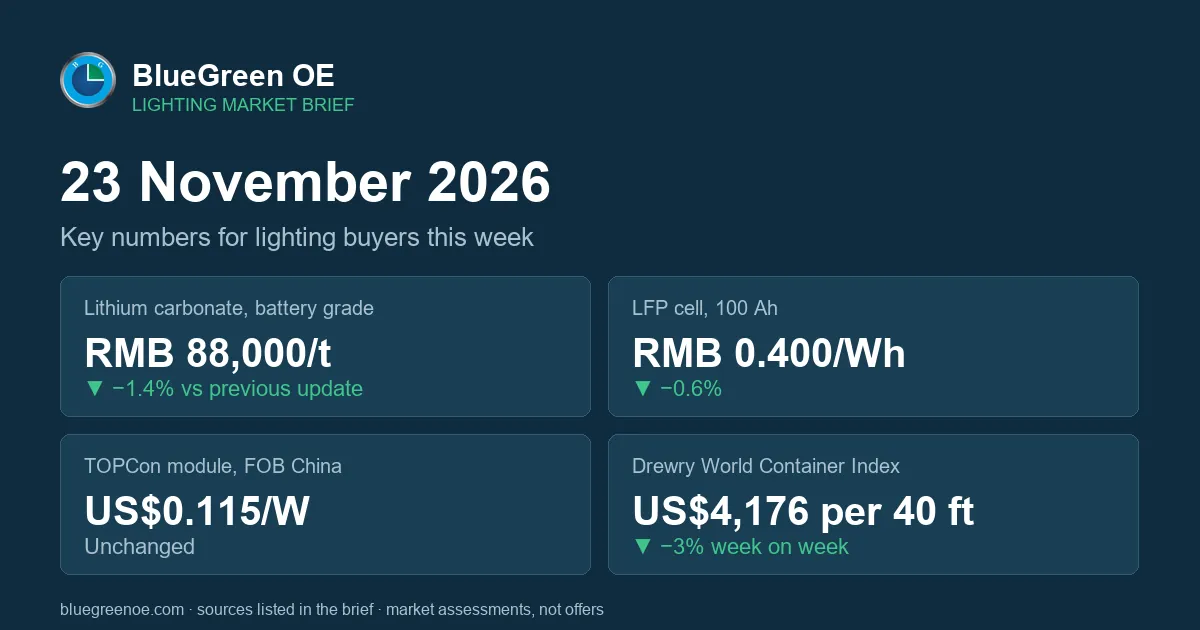
| Indicator | Latest | Change | What it affects |
|---|---|---|---|
| Lithium carbonate, battery grade (China, InfoLink) | RMB 88,000/t (18 Nov) | −1.4% vs previous update | Future cell prices |
| LFP cell, 100 Ah (China, InfoLink) | RMB 0.400/Wh (18 Nov) | −0.6% | Battery cost of solar street lights |
| TOPCon module, FOB China (InfoLink) | US$0.115/W (12–18 Nov) | Unchanged | Solar panel cost |
| Drewry World Container Index | US$4,176 per 40 ft (19 Nov) | −3% week on week | Freight cost per shipment |
| Aluminium, benchmark CFD | US$2,839.75/t (20 Nov) | About −6% vs 13 Nov | Luminaire housings and heat sinks |
The full weekly series for these indicators, with a chart and the cell and panel cost of a reference light, is on our solar street light cost index.
1. Lithium and cells edge lower; China sets a 2030 storage target
What happened. InfoLink’s update of 18 November put battery-grade lithium carbonate at an average of RMB 88,000 per tonne (range RMB 86,000–90,000), down 1.4% in a week. 100 Ah LFP cells averaged RMB 0.400/Wh (−0.6%) and 280 Ah and 314 Ah cells RMB 0.345/Wh (−0.7%). InfoLink describes a renewed price war among cell makers, with some adjusting quotes for new orders, and says that “a significant price rebound for these formats” is unlikely. The same report notes that China’s NDRC and NEA published an implementation plan for new-type energy storage on 13 November, targeting 300 million kW (300 GW) of installed capacity by 2030.
Why it matters. Small cells continue to drift down slowly: from RMB 0.420/Wh on 14 October to RMB 0.400/Wh now, or about RMB 15 on a 768 Wh (25.6 V, 30 Ah) street light pack. The national storage target supports long-term demand for the large cell formats, not the 100 Ah cells used in street lights, so it is unlikely to change street light battery prices in the near term. The bigger cost item for 2027 shipments is still the end of China’s battery export rebate on 1 January (see the 2 November brief); ask suppliers which rebate assumption a quotation uses.
Read more: How to calculate solar street light battery capacity · Brief of 16 November · Battery autonomy calculator
2. Panels unchanged; freight falls for a fourth week, Europe surcharges announced
What happened. InfoLink’s assessment for 12–18 November had China-made TOPCon modules for European projects unchanged at US$0.115/W FOB, with the average outside China at US$0.114/W. Drewry’s World Container Index fell 3% to US$4,176 per 40 ft container on 19 November, its fourth weekly fall, though still 126% higher than a year earlier. The fall came mainly on transpacific routes: Shanghai–New York −9% to US$8,194. Shanghai–Rotterdam was unchanged at US$3,496 and Shanghai–Genoa rose 6% to US$4,436. Drewry notes that carriers have announced peak season surcharges of US$1,000–1,600 per 40 ft on Asia–Europe and Mediterranean routes for December and expects rates on those routes to rise in the coming weeks.
Why it matters. Panel prices have been flat for several weeks, so panel cost is not a reason to delay an order. Freight is the item to watch: the falling headline index is driven by US routes, while European and Mediterranean lanes may turn up in December. For CIF quotations valid into December, confirm whether the freight figure includes any surcharge, and ask for a rate on your own lane, because Drewry’s index does not cover Africa, the Gulf or South America.
Read more: Solar street light price guide · Solar street light calculator · Contact us for a CIF quotation
3. LME aluminium falls to a one-year low
What happened. SMM reported that three-month LME aluminium fell 3.8% to US$2,822.5/t on 18 November, its fifth daily fall in a row and the lowest since November 2025, down 8.0% since 11 November. SMM attributes the fall to expectations of a future surplus from new smelting capacity outside China and restarts in the Middle East, and to expectations of US interest rate rises; it lists low Chinese inventories and firm spot premiums as support. The benchmark CFD tracked by Trading Economics was US$2,839.75/t on 20 November. Official LME prices published by Westmetall show the cash price on 20 November at US$3,184.50/t against US$2,831.50/t for three months, so the gap noted last week has widened further.
Why it matters. Forward aluminium is now clearly cheaper than a month ago, but metal for immediate delivery is not. Die-cast housings and heat sinks for LED street lights and floodlights, and many poles, are made from metal bought for prompt delivery, so factory costs may fall less than the headline figure suggests. For large orders with an aluminium adjustment clause, check which price is used (cash, three-month or Shanghai) and on which date.
Read more: Cast aluminium light poles · Our LED street lights · Contact us
4. Dominican Republic: 3,500 solar lamps along the Duarte Highway
What happened. DR1 reported on 16 November that the RD Vial trust and the Ministry of Public Works, under the National Road Lighting Programme, are installing 3,500 solar lamps along more than 120 km of the Duarte Highway, which links Santo Domingo with the Cibao region. More than 1,400 solar streetlights have been installed between km 9 and km 32, 304 luminaires on about 25 km from the Pedro Brand toll plaza to Villa Altagracia, and 178 around the Piedra Blanca overpass. The reasons given are night-time safety, operation “even during power outages” and lower electricity costs. The report does not give wattage, pole height or cost.
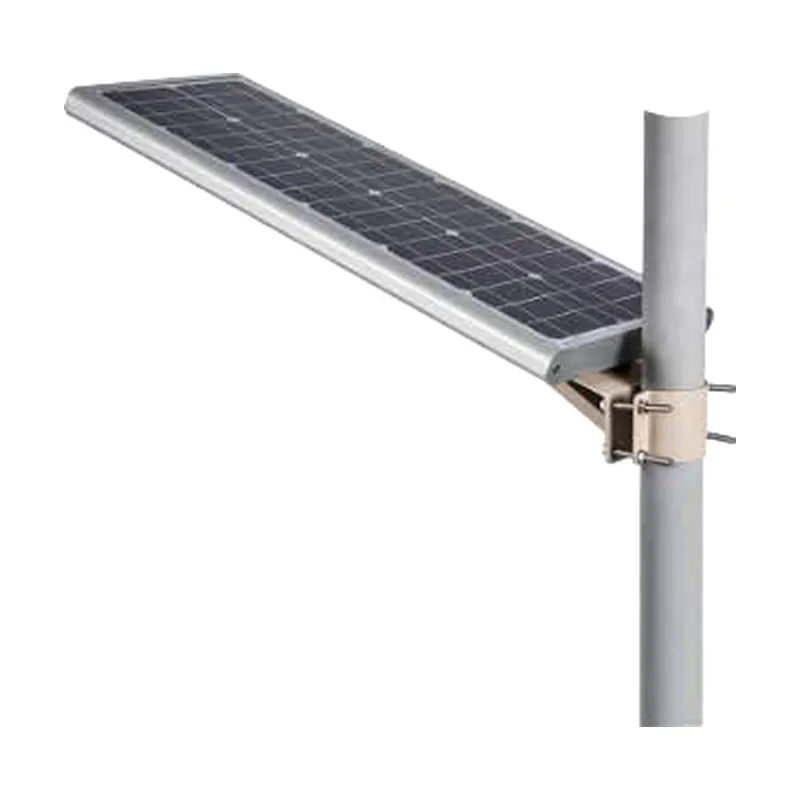
Why it matters. Highway lighting is a demanding use for standalone solar: wide carriageways, high poles and lights expected to run all night. Programmes of this size usually need a higher-wattage light with a larger panel and battery than village roads, or a split design with the panel mounted separately. When specifying, set the road lighting class and the number of autonomy days first, then size the system for the worst month at the site.
Read more: Highway solar street lights · Our solar street lights · Solar street light pole height and spacing
5. Philippines and Solomon Islands: district and community solar programmes
What happened. Negros Weekly reported on 23 November that 1,000 solar streetlights have been installed along major highways in the Third District of Negros Occidental, half of the 2,000 units targeted for 2026, with further stretches between Talisay and Silay planned under the 2027 national budget. In the Solomon Islands, the Australian High Commission said on 18 November (published by Solomon Times Online) that 120 solar streetlights funded by the Solomon Islands–Australia Community Partnerships programme now serve more than 700 people in 18 communities in West Guadalcanal; community members installed all 120 lights in 10 days. Neither report gives the cost or the light specification.
Why it matters. The two projects show the range of solar street lighting buyers: a district programme funded through the national budget, and a donor-funded project installed by residents. Where local people install the lights, the product must be simple to mount and wire, with clear instructions, pre-set controllers and fixings that need only common tools. Agree spare parts and who replaces a failed battery before the handover, not afterwards.
Read more: Rural solar street lights · All-in-one vs split solar street lights · Our projects
The market brief is compiled by the BlueGreen OE team from the public sources listed below. Prices are market assessments, not offers. Send us your project details for a current quotation.
Sources
- InfoLink — Energy storage cell price war heats up again; China rolls out 15th Five-Year implementation plan for new-type energy storage (18 Nov 2026)
- InfoLink — PV spot price (12–18 Nov 2026)
- Drewry — World Container Index (19 Nov 2026)
- SMM — LME aluminium hits one-year low on Fed hike bets (20 Nov 2026)
- Westmetall — LME aluminium cash and three-month prices (18–20 Nov 2026)
- Trading Economics — Aluminium (20 Nov 2026)
- DR1 — RD Vial announces installation of thousands of solar lamps on Duarte Highway (16 Nov 2026)
- Negros Weekly — 3rd District highways get 1K solar lights (23 Nov 2026)
- Solomon Times Online — Solar streetlights installed for 18 communities in West Guadalcanal (18 Nov 2026)
Frequently asked questions
What is the price of lithium carbonate and LFP cells in late November 2026?
InfoLink's update of 18 November 2026 put battery-grade lithium carbonate at an average of RMB 88,000/t (range RMB 86,000–90,000, −1.4% in a week), 100 Ah LFP cells at RMB 0.400/Wh (−0.6%) and 280/314 Ah cells at RMB 0.345/Wh (−0.7%).
Why did aluminium prices fall in November 2026?
SMM reported that three-month LME aluminium fell 3.8% to US$2,822.5/t on 18 November 2026, its lowest since November 2025, on expectations of a future surplus from new capacity outside China and of US interest rate rises. The benchmark CFD tracked by Trading Economics was US$2,839.75/t on 20 November.