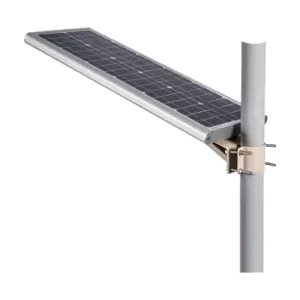
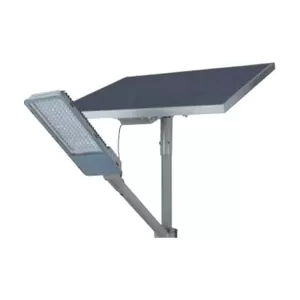
Lighting Market Brief, 16 November 2026: Lithium Steadies Near RMB 89,000, LME Aluminium Backwardation Widens, Cable Theft Darkens Grid Street Lights
Lithium carbonate steadies near RMB 89,000/t and 100 Ah LFP cells reach RMB 0.403/Wh, freight falls 2%, LME aluminium backwardation widens, and cable theft pushes cities towards solar.
Five things that matter to people who buy road and area lighting this week. Each item covers what happened, why it matters for a lighting project, and where to read more. Sources are listed at the end.
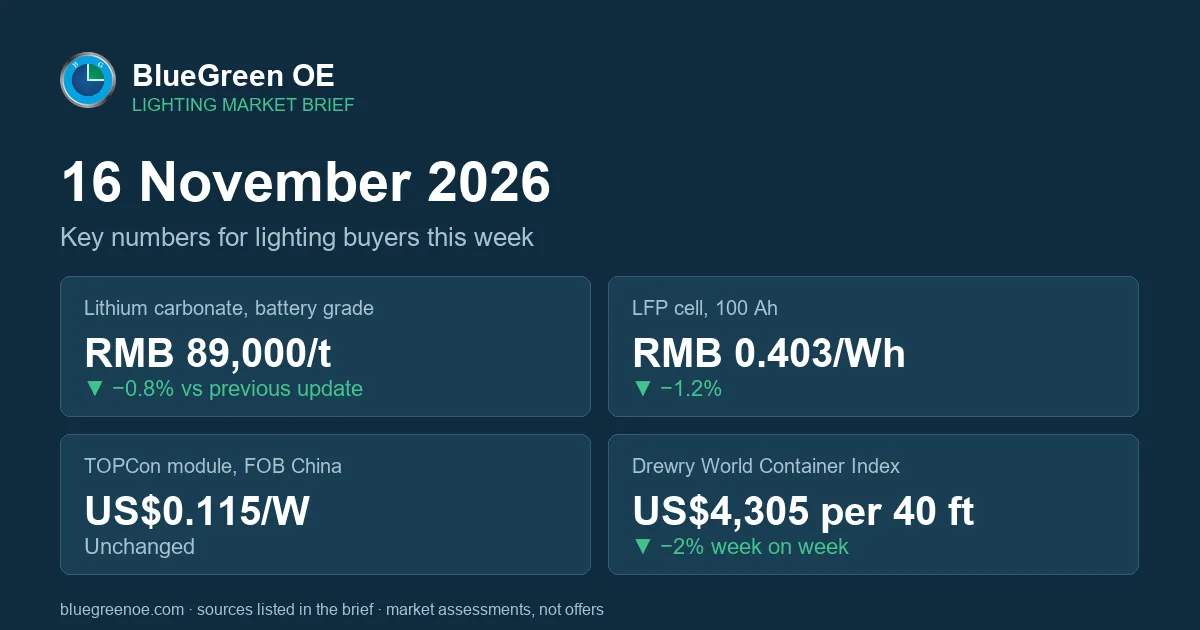
Key numbers this week
| Indicator | Latest | Change | What it affects |
|---|---|---|---|
| Lithium carbonate, battery grade (China, InfoLink) | RMB 89,000/t (11 Nov) | −0.8% vs previous update | Future cell prices |
| LFP cell, 100 Ah (China, InfoLink) | RMB 0.403/Wh (11 Nov) | −1.2% | Battery cost of solar street lights |
| TOPCon module, FOB China (InfoLink) | US$0.115/W (5–11 Nov) | Unchanged | Solar panel cost |
| Drewry World Container Index | US$4,305 per 40 ft (12 Nov) | −2% week on week | Freight cost per shipment |
| Aluminium, benchmark CFD | about US$3,009/t (13 Nov) | About −2% in a week | Luminaire housings and heat sinks |
The full weekly series for these indicators, with a chart and the cell and panel cost of a reference light, is on our solar street light cost index.
1. Lithium carbonate steadies; cells keep slipping
What happened. InfoLink’s update of 11 November put battery-grade lithium carbonate at an average of RMB 89,000 per tonne (range RMB 88,000–91,000), down 0.8% in a week after a 7.2% fall the week before. SMM’s average on 12 November was RMB 90,650/t. 100 Ah LFP cells averaged RMB 0.403/Wh (−1.2%) and 280 Ah and 314 Ah cells RMB 0.348/Wh (−1.4%). InfoLink says lithium prices “are expected to fluctuate at low levels” in the near term, with the main futures contract between RMB 80,000 and 96,000/t, and that cheaper materials are sharpening competition among cell makers.
Why it matters. The raw material has stopped falling quickly, but cells are still catching up. Since 14 October, 100 Ah cells are down from RMB 0.420/Wh to RMB 0.403/Wh. On a 768 Wh pack (25.6 V, 30 Ah) that is about RMB 13 per light, which is still smaller than the RMB 0.03–0.04/Wh that Mysteel estimated the end of China’s battery export rebate on 1 January 2027 could add (see the 2 November brief). For orders shipping in January or later, ask the supplier to state which rebate assumption the price uses.
Read more: How to calculate solar street light battery capacity · Brief of 9 November · Battery autonomy calculator
2. Panels flat, freight down again, more blank sailings
What happened. InfoLink’s assessment for 5–11 November had China-made TOPCon modules for European projects unchanged at US$0.115/W FOB, and the average outside China unchanged at US$0.114/W. InfoLink notes that manufacturers are pushing shipments out to meet annual targets, that China’s year-end installation rush should end in early December, and that Middle East deliveries are still delayed.
Drewry’s World Container Index fell 2% to US$4,305 per 40 ft container on 12 November. Shanghai–Rotterdam fell 3% to US$3,504 and Shanghai–Genoa was stable at US$4,168. Carriers have announced eight blank (cancelled) sailings for the coming week, up from four, and Drewry expects rates to fall further because demand is weak.
Why it matters. Neither panels nor freight are rising, so there is no cost reason to rush an order. Blank sailings are the practical risk: a booked sailing can be cancelled and the cargo moved to the next vessel. If the site date is fixed, build in some float and agree who bears the cost of a rolled container. Drewry’s index does not cover Africa, the Gulf or South America, so ask for a rate on your own lane.
Read more: Solar street light price guide · Solar vs grid street lights: cost comparison · Contact us for a CIF quotation
3. LME aluminium: spot metal now costs far more than forward metal
What happened. On 13 November the official LME aluminium cash settlement was US$3,150.50/t, while the three-month price was US$3,018/t, according to the LME prices published by Westmetall. Discovery Alert reported that cash aluminium fell 2.11% on 12 November and that the gap between cash and three-month metal (the “backwardation”) had widened to a level not seen since 1990, as reported by that site. The benchmark CFD tracked by Trading Economics was about US$3,009/t on 13 November, roughly 2% lower than a week earlier.
Why it matters. A wide backwardation means metal for immediate delivery is scarce relative to metal for later delivery. Aluminium is the die-cast housing and heat sink of an LED street light or floodlight, and the material of many poles. Factories buying ingots for prompt delivery pay closer to the cash price, so the softer headline figure may not reach housing costs straight away. If a large order is priced on an aluminium index, check whether it uses cash, three-month or a Shanghai price.
Read more: Cast aluminium light poles · Our LED street lights · Contact us
4. Cable theft leaves new grid lights dark; Gwadar moves some lights to solar
What happened. The Quezon City government reported on 11 November that police arrested two suspects for stealing electric wire from new streetlights on Quezon Avenue near Agham Road, part of the recently completed QC ReVibe project, and recovered more than 35 m of cable. In Los Angeles, FOX 11 reported on 10 November that copper wire had been stripped from street light poles in Chatsworth, leaving the lights out, and that the city told residents repairs could take eight to twelve months. In Pakistan, the Daily Independent reported on 13 November that the Gwadar Development Authority has shifted several streetlights to solar power, partly to reduce the impact of load-shedding, high electricity costs and cable theft. None of the reports gives the number of lights affected.
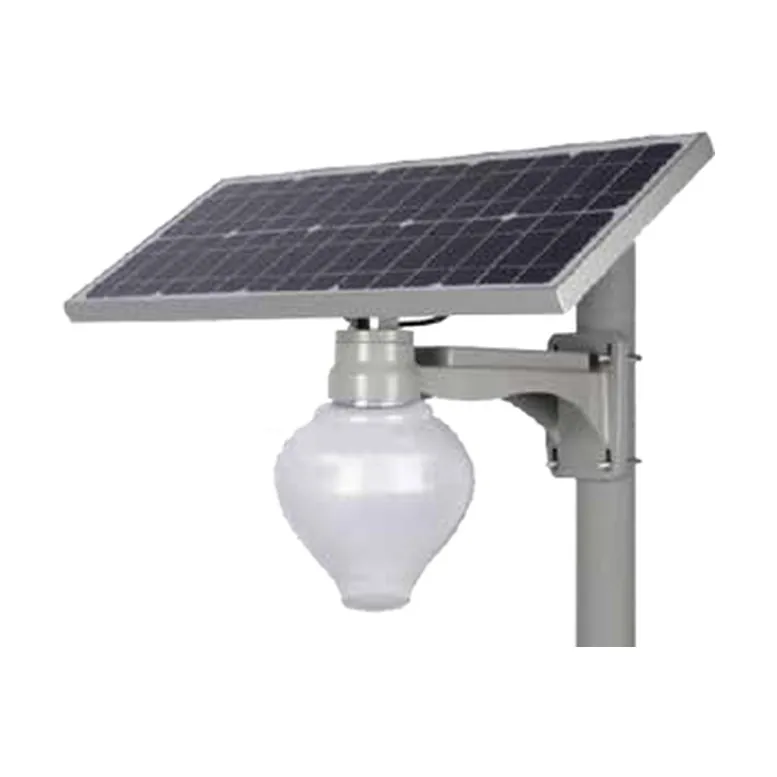
Why it matters. Earlier briefs covered thieves taking solar lights and batteries. This week shows the other side: grid lighting is exposed at every junction box and cable run, and one theft can darken a whole circuit for months. Standalone solar lights remove the cable but move the risk to the panel and battery on the pole. Either way, the specification should say how the weak point is protected: locked access panels and junction boxes for grid circuits, high-mounted batteries and tamper-resistant fasteners for solar.
Read more: Off-grid solar powered street lights · Our solar street lights · Solar street light calculator
5. Kerala: a 2.5 m lane gets standalone solar lights
What happened. Onmanorama reported on 10 November that residents of Iyyannikkattil Road in Mundathikode, Thrissur, now have streetlights after years without them. The road is about 2.5 m wide, which ruled out conventional poles and lines, so standalone solar units were installed. Part of the cost came from the CSR fund of a local company and the rest was pooled by residents. The report does not give the number of lights or the cost.
Why it matters. Narrow lanes, footpaths and village roads are where grid extension is hardest and where small solar lights make the most sense. A 2.5 m lane does not need a road-lighting luminaire; a low-wattage all-in-one light on a short pole, or on a wall where the owner agrees, is usually enough. Keep the poles out of the carriageway, check that panels are not shaded by roofs or trees, and size the battery for the worst month, not the average.
Read more: Rural solar street lights · All-in-one vs split solar street lights · Solar street light pole height and spacing
The market brief is compiled by the BlueGreen OE team from the public sources listed below. Prices are market assessments, not offers. Send us your project details for a current quotation.
Sources
- InfoLink — Lithium prices fluctuate at low levels; falling material costs intensify cell price competition (11 Nov 2026)
- SMM — Battery-grade lithium carbonate price (12 Nov 2026)
- InfoLink — Polysilicon futures sway pricing sentiment; wafer prices soften again (11 Nov 2026)
- InfoLink — PV spot price (5–11 Nov 2026)
- Drewry — World Container Index (12 Nov 2026)
- Westmetall — Official LME prices (13 Nov 2026)
- Trading Economics — Aluminium (13 Nov 2026)
- Discovery Alert — Aluminium backwardation hits 36-year high as cash price falls (13 Nov 2026)
- Quezon City Government — Streetlight electric wire theft (11 Nov 2026)
- FOX 11 Los Angeles — Video captures copper wire theft from Chatsworth street lights; residents told repairs could take a year (10 Nov 2026)
- Daily Independent — Gwadar expands solar-powered street lighting to improve urban facilities (13 Nov 2026)
- Onmanorama — Solar streetlights illuminate Iyyannikkattil road in Thrissur (10 Nov 2026)
Frequently asked questions
What is the price of lithium carbonate and LFP cells in mid-November 2026?
InfoLink's update of 11 November 2026 put battery-grade lithium carbonate at about RMB 89,000/t (−0.8% in a week), 100 Ah LFP cells at RMB 0.403/Wh (−1.2%) and 280/314 Ah cells at RMB 0.348/Wh (−1.4%). SMM's average on 12 November was RMB 90,650/t.
What are container freight and aluminium prices in November 2026?
Drewry's World Container Index fell 2% to US$4,305 per 40 ft container on 12 November 2026, and Drewry expects a further fall. On 13 November the official LME aluminium cash price was US$3,150.50/t against US$3,018/t for three months, an unusually wide gap; the benchmark CFD tracked by Trading Economics was about US$3,009/t.