Do Solar Panels Work on Heat or Light? Light, and Heat Costs You Output
Solar panels make electricity from light, not heat, and lose output as they get hot. We show it with PVGIS data for Pakistani cities and a 45 W panel at 25, 45 and 70 °C cell temperature.
Key points
- Solar panels convert light into electricity; heat does not help and in fact lowers the output.
- A typical crystalline panel loses about 0.3–0.4% of its power for every degree its cells are above 25 °C. Using 0.35%/°C, a 45 W panel gives about 41.8 W at a cell temperature of 45 °C and 37.9 W at 70 °C.
- PVGIS shows that light, not air temperature, sets the harvest: Lahore gets 6.78 kWh/m² a day in June but only 3.28 in January, so a solar light there collects about twice as much in summer even though the panel runs hotter.
- For solar lights, size on the weakest month of sunshine, mount panels with air behind them, and keep them clean.
A common belief is that solar panels run on heat, so hot countries must be the best places for them and a hot day must be the best day. The physics says otherwise: a photovoltaic panel makes electricity from light, and heat reduces its output. Where hot places do well, it is because they are also sunny.
This matters when choosing and installing solar lights, so here is the explanation with numbers.
How a solar panel uses light
A solar cell is a thin slice of silicon. When light falls on it, each particle of light (a photon) with enough energy knocks an electron loose, and the cell’s built-in electric field pushes those electrons round a circuit. More light means more electrons and more current.
Heat plays no part in that process. Infrared from a warm object does not have enough energy per photon to free electrons in silicon. That is why a panel produces nothing on a hot night, and why a panel in a hot dark shed gives no output.
Why heat lowers the output
Heat does have an effect, and it is negative. As the cells warm up, their voltage drops. The current rises very slightly, but not enough to make up for it, so power falls.
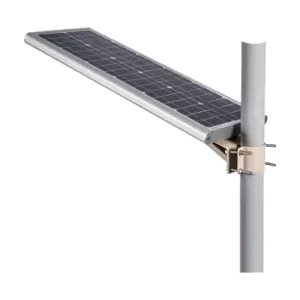
Panel datasheets give this as a temperature coefficient of power, typically around −0.3% to −0.4% per °C for crystalline silicon. Panels are rated at a cell temperature of 25 °C. Using −0.35%/°C as an example, here is what happens to a 45 W panel, the size fitted to our SL5730C030 all-in-one solar street light:
| Cell temperature | Output factor | Power from a 45 W panel in full sun |
|---|---|---|
| 25 °C (rating condition) | 100% | 45.0 W |
| 45 °C (mild day) | 93% | 41.8 W |
| 65 °C (hot day) | 86% | 38.7 W |
| 70 °C (very hot, poor airflow) | 84% | 37.9 W |
Cells in full sun usually run 20–35 °C above the air. On a 40 °C afternoon in Sindh or Punjab, 65–75 °C cell temperature is normal. The panel loses roughly a seventh of its rated power just from heat.
But light still decides the harvest
If heat lowers output, why do solar lights work better in summer? Because the summer sun is higher and the days are longer, so far more light arrives. PVGIS, the European Commission’s solar database, gives the monthly irradiation for cities in Pakistan:
| City | January | May | June | December |
|---|---|---|---|---|
| Quetta | 3.96 | 7.92 | 8.09 | 3.94 |
| Lahore | 3.28 | 7.12 | 6.78 | 3.38 |
| Karachi | 4.53 | 7.42 | 6.58 | 4.36 |
| Peshawar | 3.01 | 6.91 | 7.22 | 3.15 |
(kWh per m² per day, the same as peak sun hours.)
Lahore’s June gives more than twice the light of January. Even after losing 10–15% to heat, a panel there collects far more in summer. Using the 72% system factor we use for an MPPT controller, the 45 W panel collects about 220 Wh a day in a Lahore June and 106 Wh in a Lahore January. That system factor already includes typical temperature and wiring losses.
Look also at Quetta. It sits at about 1,700 m, with cooler air and clear skies, and it has the highest June figure in the table at 8.09. Clear, cool, high-altitude places are among the best solar sites in the world, not the hottest lowland ones.
Light versus heat: some everyday cases
- Bright winter day in the mountains: strong light, cold panel. Excellent output for the sun’s angle.
- Hot, hazy summer afternoon: plenty of heat, light reduced by haze and dust, hot panel. Lower output than you would expect.
- Warm cloudy day: little direct light, so little output, whatever the temperature.
- Under a street light at night: a little light, but far too little to matter. We worked through that case in can a street light charge a solar panel.
What it means for solar lights
- Size on the weakest month of light, not on heat. For most cities that is a winter or monsoon month. Our solar street light calculator takes the sun hours for that month and sizes the panel and battery.
- Let air reach the back of the panel. A panel mounted flat against a roof or wall runs hotter than one with airflow behind it, so leave a gap where the mounting allows it.
- Keep the panel clean. Dust can cost more output than heat in dry climates. Our article on solar street lights in Pakistan covers cleaning intervals for dusty sites.
- Tilt for the season that matters. Our guide to solar panel tilt angle for street lights shows how much a steeper tilt helps in winter.
- Protect the battery from heat. Heat does more harm to batteries than to panels. Lithium iron phosphate cells tolerate heat better than other lithium types, and the battery should be shaded from direct sun.
Heat and batteries: the bigger worry
In hot climates, the battery is usually the part that suffers first. High temperatures speed up ageing in all battery chemistries. For solar street lights in hot regions, ask where the battery sits, whether it is shaded, and what its rated temperature range is. Our article on solar street light battery specifications explains what to check.
Solar panels versus solar water heaters
The confusion is partly because two technologies share the word “solar”. A solar water heater does use heat: a dark absorber warms water. A solar photovoltaic panel uses light to make electricity. Some systems combine both, but a solar light only uses the photovoltaic kind.
For buyers and installers
When customers ask whether hot weather is good for their solar lights, the answer is: sunshine is good, heat is not. In our quotations we size panels on PVGIS data for the site’s weakest month and allow for heat in the system factor. If you send us your city, pole height and lighting hours, we will show you the monthly harvest and how the light runs in the hottest and the darkest months.
Sources
Frequently asked questions
Do solar panels work better in hot or cold weather?
For the same sunlight, a cold panel gives more power than a hot one. Bright, cool days are ideal. In practice summer still gives more energy in most places, because the days are longer and the sun is higher.
Can solar panels work without sunlight but with heat?
No. A photovoltaic panel needs light. A warm night or a hot room without light produces nothing. Solar thermal collectors, which heat water, are a different technology.
Do solar panels work on cloudy days?
Yes, from the diffuse light that passes through cloud, but at a fraction of their sunny output. That is why solar lights carry a battery reserve for several dull days.
How hot does a solar panel get?
In full sun, cells commonly run 20–35 °C above the air temperature, more if there is no air behind the panel. On a 40 °C day the cells can reach 65–75 °C.