Solar Street Light Battery Specifications: How to Read Volts, Ah, Wh, Cycles and BMS
How to read a solar street light battery specification: voltage, Ah and Wh, usable capacity, cycle life, temperature limits, BMS and test reports, with worked examples from real datasheets.
Key points
- Compare batteries in watt-hours, not amp-hours: Wh = V × Ah. A 12.8 V 18 Ah lithium battery stores about 230 Wh.
- Usable energy depends on chemistry: about 90% for LiFePO4 and about 50% for lead-acid, so a 12 V 50 Ah lead-acid battery gives about 300 Wh and a 12.8 V 50 Ah LiFePO4 about 576 Wh.
- Hours-of-operation claims depend on the dimming level: the same 207 usable Wh run a 30 W light for about 6 hours at full power, or about 30 hours at under 20%.
- Check the charging temperature range: lithium cells should not be charged below 0 °C without a heater or a controller that blocks cold charging.
- Ask for UN38.3 transport test reports for lithium batteries, and the BMS protection list.
The battery is the part of a solar street light that fails first and costs most to replace. Its specification line is also the easiest to misread: “12 V 100 Ah”, “30–36 hours of operation” and “2,000 cycles” all sound clear, but each depends on conditions that the line does not show. This guide explains every figure you are likely to see, with examples from real datasheets, including our own.
Voltage
The nominal voltage depends on the chemistry and the number of cells in series:
| Battery | Cells | Nominal voltage |
|---|---|---|
| LiFePO4, 4 cells in series | 4 × 3.2 V | 12.8 V |
| LiFePO4, 8 cells in series | 8 × 3.2 V | 25.6 V |
| Lithium-ion (NMC), 3 cells | 3 × 3.7 V | 11.1 V |
| Lead-acid or gel | 6 × 2 V | 12 V |
| Small lithium-ion pack | 1 × 3.7 V | 3.7 V |
The battery voltage must match the controller and the LED driver. Most street lights use 12.8 V; larger systems use 25.6 V to keep currents lower.
Ah and Wh
Amp-hours (Ah) measure charge at the battery’s voltage. Watt-hours (Wh) measure energy, and they are what the light actually uses:
Wh = nominal voltage × Ah
| Datasheet line | Energy |
|---|---|
| 12.8 V / 18 Ah LiFePO4 | 230 Wh |
| 12.8 V / 33 Ah LiFePO4 | 422 Wh |
| 12 V / 50 Ah lead-acid | 600 Wh |
| 3.2 V / 100 Ah single cell | 320 Wh |
Always convert to Wh before comparing two offers. A “100 Ah” battery at 3.2 V stores a quarter of the energy of a 100 Ah battery at 12.8 V.
Usable capacity and depth of discharge
Not all of the stored energy can be used every night without shortening the battery’s life:
| Chemistry | Typical usable share | 50 Ah battery: usable energy |
|---|---|---|
| LiFePO4 | about 90% | 12.8 V × 50 Ah × 0.9 = 576 Wh |
| Lead-acid or gel | about 50% | 12 V × 50 Ah × 0.5 = 300 Wh |
So the same “50 Ah” on two datasheets can mean almost twice the usable energy. We ran both in our battery autonomy calculator for a 30 W light with a 90 Wp panel on a 5 h full + 7 h dimmed profile at 4.5 peak sun hours. The lead-acid version covers about 1.6 nights from full; the LiFePO4 version about 3.0. Our LiFePO4 vs gel comparison explains the other differences.
“Hours of operation” claims
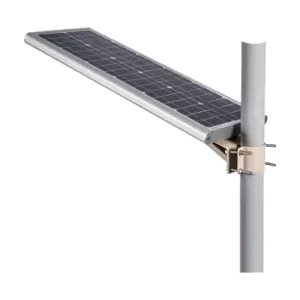
Many datasheets, including ours, give a figure such as “30–36 hours of operation from a full battery”. Read it carefully, because it always assumes a dimming level. Take our all-in-one solar street light SL5730C030: 30 W, 12.8 V / 18 Ah LiFePO4.
- Stored energy: 12.8 × 18 = 230 Wh; usable at 90%: about 207 Wh
- At full power, the light draws about 33 W from the battery (30 W at 90% driver efficiency): about 6 hours
- At 30% power: about 21 hours
- At under 20% power, for example a motion-sensor standby level: about 30 hours or more
All three are true. Which one matters depends on how the light is programmed. When you compare offers, ask for the hours at the power profile you will actually use, or calculate them yourself from the usable Wh.
Cycle life
A street light charges and discharges its battery every day, so about 365 cycles a year. A cycle-life figure is only meaningful with its test conditions:
- depth of discharge (a battery cycled to 80% lasts fewer cycles than one cycled to 30%);
- temperature (heat shortens life);
- end-of-life definition (usually when capacity falls to 70% or 80% of new).
Cell datasheets for LiFePO4 commonly quote 2,000 cycles or more at 80% depth; lead-acid gel batteries quote far fewer at 50%. In a street light, the nightly depth is often much lower than 80% because the battery is sized for several nights of autonomy, which helps life.
Temperature limits
Lithium cells have separate limits for charging and discharging. Typical LiFePO4 limits are:
| Operation | Typical range |
|---|---|
| Charging | 0 °C to about 45 °C |
| Discharging | about −20 °C to 60 °C |
Charging below 0 °C can damage lithium cells permanently. In cold climates, ask for a controller with low-temperature charge protection or a battery heater. In hot climates, keep the battery out of direct sun; a battery box on a sunny pole can be far hotter than the air.
The BMS
Every lithium pack needs a battery management system. Check the specification lists:
- over-charge and over-discharge protection;
- over-current and short-circuit protection;
- over-temperature and low-temperature charge protection;
- cell balancing, so all cells in series stay at the same charge.
A missing or poor BMS is a common reason for packs that lose capacity quickly or stop working after a deep discharge.
Cells, construction and enclosure
- Cell format: cylindrical cells (such as 32650 or 32700) or prismatic cells. Both work; ask which cells and from which maker.
- Configuration: for example 4S10P means 4 in series and 10 in parallel. More parallel cells mean more connections to check.
- Enclosure: IP65 or IP67 for batteries outside the luminaire, with a breather to avoid condensation.
- Mounting: inside the luminaire, on the pole, inside the pole or buried in a box; each affects temperature and theft risk.
Test reports and documents
| Document | Why |
|---|---|
| UN38.3 test summary | Required to ship lithium batteries by air and sea |
| MSDS / SDS | Dangerous-goods paperwork and handling |
| IEC 62619 or equivalent safety report | Industrial lithium battery safety, often requested in tenders |
| Cell datasheet | Cycle life, temperature limits and capacity basis |
A checklist for comparing offers
- Convert every battery to Wh at its nominal voltage.
- Apply the usable share for its chemistry.
- Divide by the nightly load at your profile to get nights of autonomy.
- Check cycle life at the depth and temperature you expect.
- Check charging limits for your climate.
- Ask for the BMS functions and the UN38.3 report.
For the sizing step itself, our guide on how to calculate solar street light battery capacity works through the method from the load upwards.
Ordering
Send us the light power, the hours and dimming profile, the site location and the nights of autonomy you need. We will propose the battery and panel, and send the battery datasheet and transport documents with the quotation.
Sources
Frequently asked questions
What battery specification does a solar street light need?
Enough usable watt-hours for the nightly load times the nights of autonomy you want. A 40 W light dimmed after 5 hours uses about 316 Wh a night; three nights need about 1,050 Wh usable, which is about 82 Ah at 12.8 V in LiFePO4.
Is Ah or Wh more important for a solar battery?
Wh. Amp-hours only mean something at a given voltage. A 3.2 V 100 Ah cell and a 12.8 V 25 Ah battery both store about 320 Wh.
How many cycles should a solar street light battery have?
A street light cycles the battery every night, about 365 times a year. LiFePO4 cells are commonly rated for 2,000 cycles or more at 80% depth of discharge; lead-acid gel batteries for far fewer at 50%. Check the cycle figure together with the depth of discharge and temperature it was tested at.
What is a BMS in a solar street light battery?
A battery management system: the electronics that protect a lithium battery from over-charge, over-discharge, over-current, short circuit and extreme temperature, and balance the cells. Without it, a lithium pack can be damaged or become unsafe.