LED High Bay Light Specifications: Reading a Data Sheet Line by Line
What each line of an LED high bay specification means, from power and lm/W to beam, IP, ambient rating and power factor, with two of our data sheets compared on a 60 × 30 m hall.
Key points
- Power in watts tells you the electricity bill; luminous efficacy (lm/W) times power tells you the light. Compare fittings on lumens, not watts.
- In our calculator, a 60 × 30 m hall with a 12 m ceiling needs 40 high bays of 200 W for 200 lux at 100 or 110 lm/W, but only 28 at 130 lm/W, cutting the load from 4.4 to 3.1 W/m².
- Beam angle, IP rating and operating temperature decide where a fitting can go: our GKP40J is IP44 for dry halls, while the GKP40F is IP65 for dusty or damp areas.
- Lines that are missing matter too: ask for the photometric file, the driver make and surge rating, and the conditions behind any lifetime figure.
A high bay data sheet is a short table, but almost every line changes how many fittings you buy, where they can hang and how long they last. This guide reads a specification line by line, compares two of our own data sheets, and shows in our calculator what the numbers do to a real hall.
Two data sheets side by side
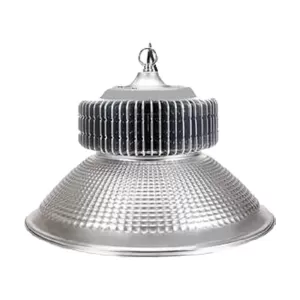
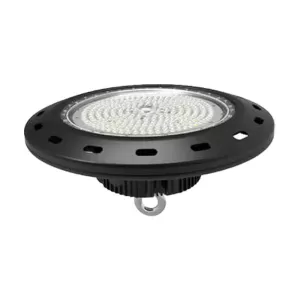
| Line | GKP40J | GKP40F (UFO) |
|---|---|---|
| Power | 60 / 100 / 150 / 200 / 250 W | 100 / 150 / 200 W |
| Input voltage | AC 180–265 V, 47/63 Hz | AC 180–265 V, 47/63 Hz |
| Power factor | > 0.90 | > 0.90 |
| Luminous efficacy | > 110 lm/W | > 100 lm/W |
| Colour temperature | 3,000 / 4,000 / 5,000 / 6,000 K | same |
| CRI | Ra 70 / 80 / 90 | same |
| Beam angle | 45° / 60° / 90° / 120° | same |
| Ingress protection | IP44 (dry indoor) | IP65 |
| Body | Aluminium fin heat sink | Die-cast aluminium |
| Operating temperature | −10 °C to +50 °C | −10 °C to +50 °C |
Both come from our product pages: the GKP40J and the GKP40F UFO high bay. They look similar until you reach the IP line.
Power and efficacy: the light you actually get
Power (W) is what the fitting draws. Efficacy (lm/W) is how much light each watt makes. Multiply them for the lumen output:
- 200 W at 110 lm/W ≈ 22,000 lm
- 200 W at 130 lm/W ≈ 26,000 lm
So two “200 W high bays” can differ by almost a fifth in light. Check that the efficacy is for the complete fitting (measured to a method such as IES LM-79), not for the bare LED chip, which is always higher.
What it does to a hall. We ran a 60 × 30 m hall with a 12 m ceiling, 200 lux target, medium beam and medium reflectances through our high bay lighting calculator with 200 W fittings:
| Efficacy | Fittings | Calculated average | Power density |
|---|---|---|---|
| 100 lm/W | 40 (8 × 5) | about 226 lux | 4.4 W/m² |
| 110 lm/W | 40 (8 × 5) | about 248 lux | 4.4 W/m² |
| 130 lm/W | 28 (7 × 4) | about 205 lux | 3.1 W/m² |
Between 100 and 110 lm/W the grid stays the same and the extra light becomes margin. At 130 lm/W the count drops by 12 fittings. Higher efficacy pays off when it changes the grid; otherwise it buys headroom, or lets you choose a lower wattage.
Input voltage and power factor
Input voltage must cover the supply with margin. A 180–265 V range suits 220–240 V countries and 208/240 V circuits in North America, but not 120 V or 347 V; check before ordering for those markets.
Power factor above 0.9 keeps the current drawn close to the real power, which matters on large installations where utilities penalise low power factor. Many tenders ask for 0.95 or more; say so at inquiry.
Colour temperature and CRI
4,000–5,000 K is common in warehouses and factories; 3,000 K is rare in high bays except in retail. CRI Ra 80 suits most industrial work; choose Ra 90 where colours must be judged, for example in printing, textiles or paint inspection. Higher CRI costs a little efficacy.
Beam angle: matching the height
The beam spreads light from the mounting height. As a guide, about 120° for 4–6 m, 90° for 6–8 m, 60° for 8–12 m and 45° for higher ceilings or tall racking. In our calculator the beam changes the usable light only slightly in an open hall, but it changes the maximum spacing: at 11.2 m above the working plane, a medium beam allows about 13.4 m between fittings and a narrow beam about 10 m. In racking aisles, narrow beams over the aisle centre put the light where it is needed. Our article on high bay reflectors and lenses covers the optics.
IP rating: where it can hang
- IP44: protected against splashing; for clean, dry indoor halls. The GKP40J is in this class.
- IP65: dust-tight and protected against water jets; for dusty factories, food plants with wash-down and covered outdoor areas. The GKP40F is IP65.
Fitting an IP44 high bay in a cement plant or a wash-down area shortens its life sharply. Our guide to wet location high bay lights explains the damp-area choices.
Operating temperature
The ambient range is the air temperature around the fitting, not the outdoor weather. Under a hot roof the air can be far warmer than the floor. Both fittings above are rated −10 °C to +50 °C; freezer stores below −10 °C and furnace halls above +50 °C need fittings rated for them.
What the sheet should also tell you
Data sheets are often silent on lines that matter just as much. Ask for:
- Photometric file (IES or LDT) for a layout calculation.
- Driver make, model and surge rating, since drivers fail before LEDs.
- Lifetime conditions: a lifetime figure means little without the lumen maintenance level and temperature behind it.
- Weight and mounting options: hook, chain, bracket or pendant.
- Dimming: 0–10 V, DALI or none.
Our LED high bay buying guide turns these into a comparison checklist.
For buyers and specifiers
Send us the hall dimensions, ceiling height, environment and target light level, and we will propose the series, wattage and beam, with the calculator layout and the data sheet lines that matter for your tender.
Sources
Frequently asked questions
What specifications matter most for an LED high bay?
Lumen output (power times efficacy), beam angle for the mounting height, IP rating for the environment, the maximum ambient temperature, and the driver quality. These decide how many fittings you need and how long they last.
What does lm/W mean on a high bay data sheet?
Luminous efficacy: lumens of light per watt of electricity. A 200 W fitting at 110 lm/W gives about 22,000 lm; at 130 lm/W it gives about 26,000 lm.
Which beam angle should I choose for a high bay?
Roughly 120° for 4–6 m, 90° for 6–8 m, 60° for 8–12 m and narrower beams for very high ceilings or racking aisles. A photometric layout confirms the choice.
What does IP65 mean for a high bay?
The fitting is dust-tight and protected against water jets from any direction. It suits dusty factories, wash-down areas and covered outdoor spaces. IP44 is for dry, clean indoor halls.