High Bay Reflector or Lens? Choosing the Optic and Beam Angle for the Mounting Height
Reflector or lens on an LED high bay: how each shapes the beam, glare and maintenance, and our calculator results for a 60 × 30 m hall at 6 m and 14 m with wide, medium and narrow beams.
Key points
- Reflectors shape the beam with a polished metal or coated cone around the LEDs; lenses shape it with a moulded optic over each LED. Both can give narrow or wide beams; they differ in glare, sealing and how they age.
- By our high bay calculator, a 60 × 30 m hall at 6 m needs 45 fittings of 150 W with a wide beam for 200 lux, 50 with a medium beam, and 91 with a narrow beam, because the narrow beam forces a 4.7 m spacing.
- At 14 m with 200 W fittings, the order reverses: a narrow beam needs 40 fittings against 45 for wide and medium.
- Choose the optic for the mounting height and the task, then check glare: low halls need diffused light, high halls need focused light.
Two LED high bays with the same wattage and lumens can light the same hall very differently. The difference is the optic: the reflector or lens that decides where the light goes. Choosing the wrong one gives either bright spots and dark gaps or light wasted on the walls and in the eyes of workers. This guide compares reflectors and lenses, then uses our high bay calculator to show how the beam choice changes with mounting height.
How reflectors work
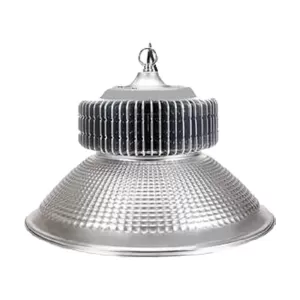
A reflector is a cone or dome of polished aluminium or white coated metal around the LED board. Light leaving the LEDs at wide angles hits the reflector and is redirected downward. The depth and shape set the beam:
- Shallow reflectors give wide beams.
- Deep, narrow reflectors give tight beams and cut light at high angles, reducing glare.
Strengths: the bright LEDs are set back inside the cone, so the luminous surface seen from a distance is larger and softer. There is no plastic in the light path apart from an optional cover, so nothing yellows. Weaknesses: dust settles inside an open reflector, and beam control is less precise than with a lens.
How lenses work
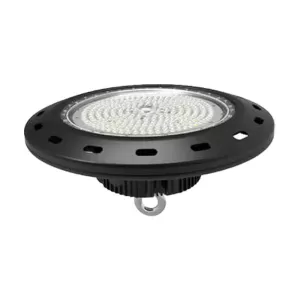
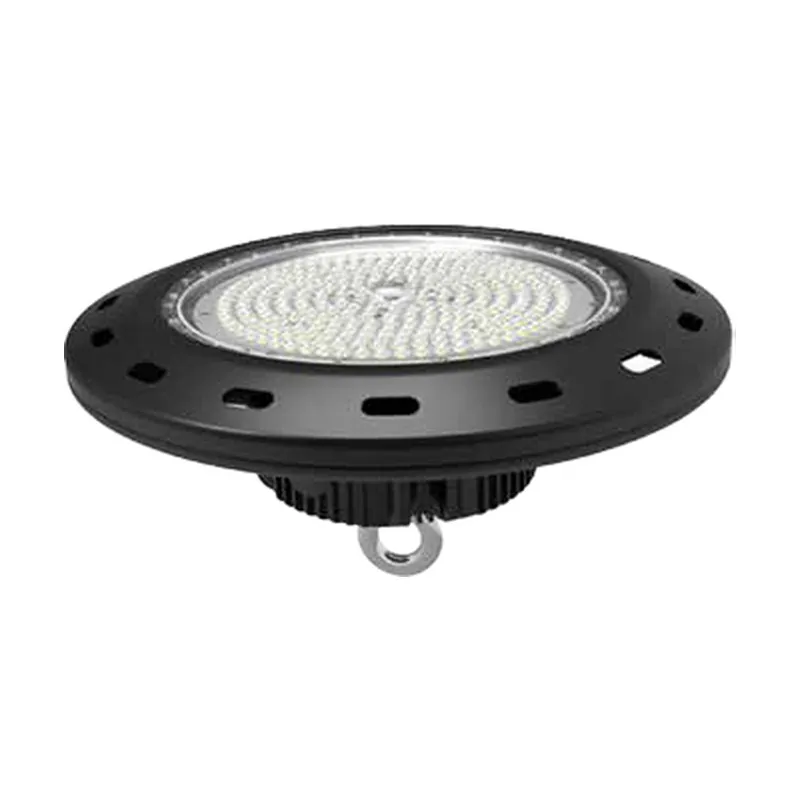
A lens high bay has a moulded optic over each LED or group of LEDs, usually in PMMA (acrylic) or polycarbonate, sometimes glass. Each lens bends the light into a defined beam: our UFO and fin high bays offer 45°, 60°, 90° and 120°.
Strengths: precise, repeatable beams; the lens plate seals the LED board, which helps with IP65 and wash-down areas. Weaknesses: each LED is visible as a bright point, so glare can be higher at low mounting heights; polycarbonate can yellow in sustained heat or strong UV.
Reflector and lens compared
| Point | Reflector | Lens |
|---|---|---|
| Beam precision | Moderate | High |
| Glare at low height | Lower (larger luminous area) | Higher unless frosted |
| Sealing | Needs a cover glass for IP65 | Lens plate seals the LEDs |
| Ageing | Metal, does not yellow | PC can yellow; PMMA and glass better |
| Dust | Collects inside open cones | Flat surface, easy to wipe |
| Typical use | Sports halls, retail, low glare | Warehouses, aisles, wet areas |
Our calculation: beam versus height
We used our high bay lighting calculator for a 60 × 30 m hall with a 200 lux target, medium reflectances, a 0.8 m working plane, 100 lm/W fittings and a maintenance factor of 0.8. The calculator’s beam settings stand roughly for optics of about 120° (wide), 90° (medium) and 60° or less (narrow); this mapping is our approximation. It limits the spacing to 1.5, 1.2 and 0.9 times the height above the working plane.
At 6 m, 150 W fittings:
| Beam | Fittings | Grid | Average illuminance | Maximum spacing | W/m² |
|---|---|---|---|---|---|
| Wide | 45 | 9 × 5 | 220 lux | 7.8 m | 3.75 |
| Medium | 50 | 10 × 5 | 255 lux | 6.2 m | 4.17 |
| Narrow | 91 | 13 × 7 | 482 lux | 4.7 m | 7.58 |
At 14 m, 200 W fittings:
| Beam | Fittings | Grid | Average illuminance | Maximum spacing | W/m² |
|---|---|---|---|---|---|
| Wide | 45 | 9 × 5 | 229 lux | 19.8 m | 5.0 |
| Medium | 45 | 9 × 5 | 241 lux | 15.8 m | 5.0 |
| Narrow | 40 | 8 × 5 | 225 lux | 11.9 m | 4.44 |
What the numbers mean
- Low halls need wide beams. At 6 m, a narrow beam would force 91 fittings just to keep the circles of light overlapping, and the hall would be lit to more than twice the target. The wide beam meets 200 lux with 45.
- High halls reward narrow beams. At 14 m, a wide beam sends much of its light onto the walls. The narrow beam puts it on the floor and saves five fittings.
- Medium is the safe middle for 7–10 m, which is why it is the default in most quotations.
Racking changes the picture. In narrow aisles between tall racks, a narrow or special aisle optic puts light on the rack faces instead of the rack tops. Our guide to warehouse lighting lux levels explains how to treat racking.
Glare: the other half of the decision
The lumen method says nothing about glare. In low halls, people look across the space and see the fittings directly. There:
- choose a reflector, a frosted lens or a fitting with a diffuser;
- avoid narrow, very intense lens beams that make each LED a bright point;
- aim for the UGR limit in EN 12464-1 for the task, which we can check in a photometric calculation.
In high halls the fittings are well above the line of sight, and precise lens optics are rarely a glare problem.
Environment and maintenance
- Food, chemical and wash-down areas: sealed lens plates or glass covers, easy to wipe.
- Hot roof spaces and foundries: glass or metal reflectors, or PMMA rather than polycarbonate.
- Dusty halls: closed optics; open reflectors collect dust and lose output.
- Sports halls: reflectors or diffused optics with impact guards.
Our article on high ceiling industrial lighting covers fittings for very tall buildings, and our guide to 200 W high bay coverage shows the lumen method in detail.
Our options
Our GKP40F UFO high bay (100–200 W, IP65) and GKP40J high bay (60–250 W, IP44) are available with 45°, 60°, 90° and 120° optics. Tell us the mounting height, the task and whether glare is a concern, and we will recommend the optic.
What to send for a quotation
Send the hall size, mounting height, any racking layout, the light level and the activity in each area. We will run the layout for two or three beam options and show the fitting count, average lux and glare check for each.
Sources
Frequently asked questions
Is a lens or reflector better on a high bay?
Neither is better everywhere. Lenses give precise, repeatable beams and seal the LEDs; reflectors spread brightness over a larger surface and avoid plastic ageing in hot or chemical environments. Choose by height, glare needs and environment.
What beam angle should a high bay have?
As a rule of thumb, wide beams (around 120°) for mounting heights below about 7 m, medium (around 90°) for 7–10 m, and narrow (60° or less) above 10 m or over racking aisles. Check with a calculation for your hall.
Do polycarbonate lenses turn yellow?
Polycarbonate can yellow over years under strong heat or UV, which reduces output and shifts colour. PMMA and glass resist this better. In hot roof spaces, ask what the lens material is.
Why does a narrow beam need more fittings at low height?
A narrow beam lights a small circle under each fitting. At low mounting heights the circles do not overlap unless the fittings are close together, so the spacing limit, not the lumens, sets the number of fittings.