
200W LED High Bay: How Much Area One Light Covers
How many square metres one 200 W LED high bay lights at 150, 200 and 300 lux, the right mounting height and spacing, a 40 × 25 m warehouse worked example, and what 200 W replaces.
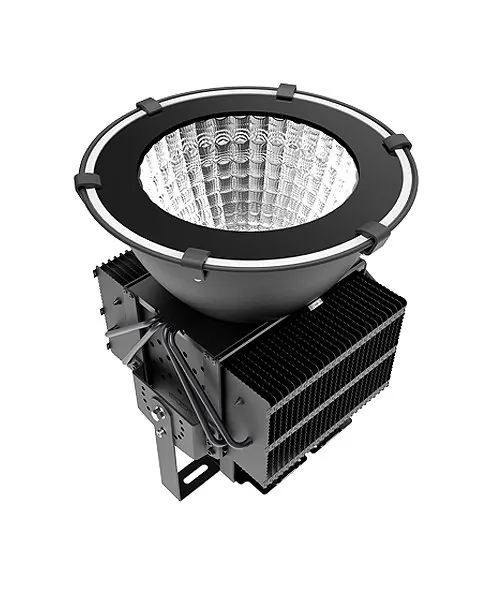
Key points
- A 200 W high bay at 140 lm/W gives about 28,000 lumens, enough for about 65–70 m² at 200 lux in a typical warehouse at 10 m.
- In a 40 × 25 m hall at 10 m, 15 high bays of 200 W give about 210 lux; 300 lux needs 24.
- 200 W suits mounting heights of about 8–12 m; below 8 m, two 100 W lights usually give more even light.
- 200 W LED typically replaces a 400 W metal halide high bay.
200 W is the most common size of LED high bay for warehouses and factories with ceilings around 8–12 m. The question buyers ask is always the same: how much floor does one light cover? This guide works it out with the lumen method and our high bay lighting calculator.
From watts to lumens
Light on the floor depends on lumens, not watts:
| Efficacy (complete luminaire) | Lumens from 200 W |
|---|---|
| 110 lm/W (older or high-temperature models) | 22,000 lm |
| 130 lm/W | 26,000 lm |
| 140 lm/W | 28,000 lm |
| 150 lm/W | 30,000 lm |
So “200 W” from two suppliers can differ by a third in light output. Always compare the measured luminaire lumens in the photometric report.
How much area one light covers
The lumen method links lumens to area:
Area per light = lumens × utilisation factor × maintenance factor ÷ target lux
For a warehouse 40 × 25 m with fittings at 10 m, medium surfaces and a medium beam, the utilisation factor is about 0.62. With a maintenance factor of 0.8 and 28,000 lm per light:
| Target | Area per 200 W light | Approximate spacing |
|---|---|---|
| 150 lux (storage) | about 93 m² | about 9.5 m |
| 200 lux (general warehouse) | about 69 m² | about 8.3 m |
| 300 lux (packing, workshops) | about 46 m² | about 6.8 m |
| 500 lux (assembly, inspection) | about 28 m² | about 5.3 m |
The spacing must also stay below the beam’s limit: about 1.2 × the mounting height above the work plane for a medium beam. At 10 m that is about 11 m, so the light level, not the beam, sets the spacing here.
Worked example: a 40 × 25 m warehouse
Our calculator gives, for 200 W at 140 lm/W and a medium beam:
| Mounting height | Target | Lights | Layout | Average |
|---|---|---|---|---|
| 8 m | 200 lux | 15 | 5 × 3 | about 225 lux |
| 10 m | 200 lux | 15 | 5 × 3 | about 210 lux |
| 12 m | 200 lux | 20 | 5 × 4 | about 260 lux |
| 10 m | 150 lux | 12 | about 167 lux | |
| 10 m | 300 lux | 24 | about 334 lux |
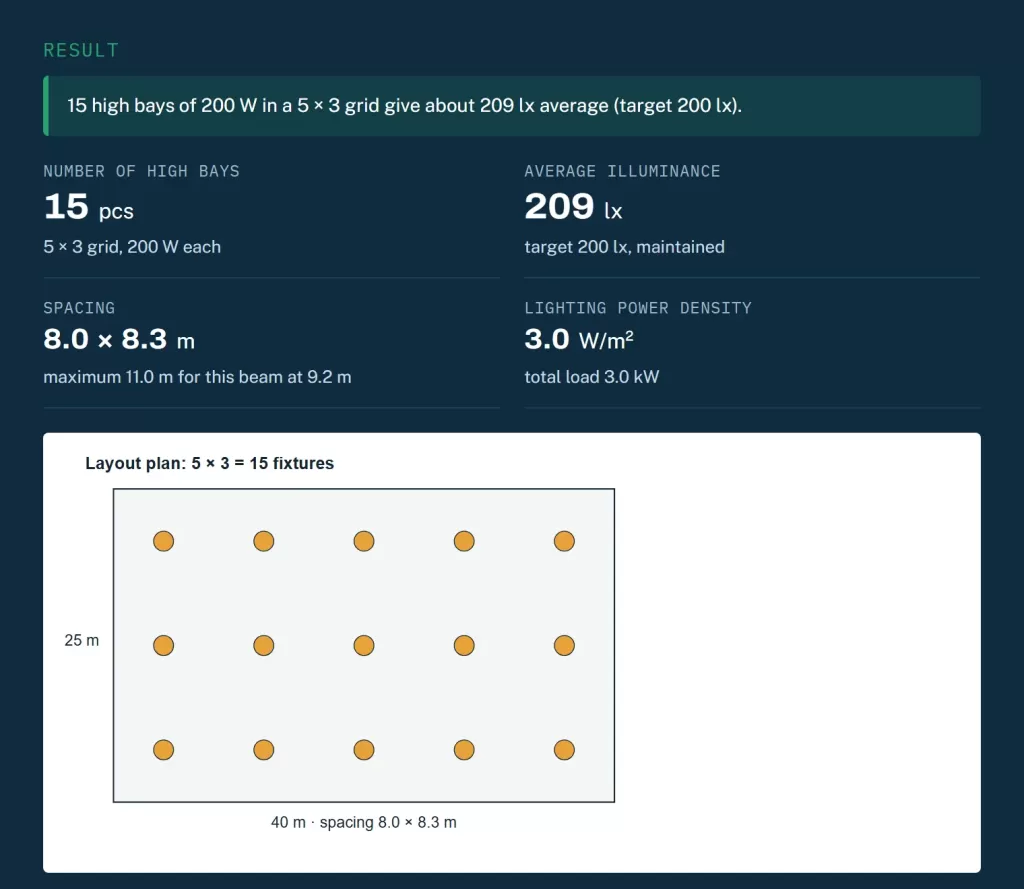
Open the example and enter your own building.
Notice the 12 m row: higher mounting loses more light to the walls (a lower utilisation factor) and the beam’s spacing limit grows only slowly, so you need more lights, not fewer. For high ceilings, narrower beams recover much of that light.
Choosing the mounting height and beam
| Mounting height | Beam | Comment |
|---|---|---|
| 6–8 m | 90–120° | 200 W is on the strong side; 150 W or 2 × 100 W may be more even |
| 8–10 m | 90° | The sweet spot for 200 W |
| 10–12 m | 60–90° | Medium beam; consider 60° over racking aisles |
| 12–15 m | 60° | Or 250–300 W; see high-temperature high bays for hot roofs |
Below about 8 m, the area per light (60–90 m²) can exceed what a single fitting lights evenly, and the bright source is closer to people’s eyes. Two 100 W fittings in the same area usually give better uniformity.
Energy and running cost
In the 40 × 25 m example at 200 lux, 15 high bays of 200 W draw 3.0 kW, or 3 W/m². The 400 W metal halide fittings they typically replace draw about 450 W each with the ballast, so the same 15 positions use about 6.75 kW.
At 4,000 hours a year (two shifts) and US$0.15/kWh, the difference is about 15,000 kWh and US$2,250 a year, before motion sensors. Dimming aisles and storage areas to 20% when nobody is there can save another third or more of the remaining energy. The LED retrofit savings calculator shows the payback with your own prices and hours.
What 200 W replaces
| Old lamp | Power with ballast | LED replacement |
|---|---|---|
| 250 W metal halide | about 290 W | 100–150 W |
| 400 W metal halide | about 450 W | 150–200 W |
| 400 W high-pressure sodium | about 460 W | 150–200 W |
| 1,000 W metal halide | about 1,080 W | 300–500 W |
Metal halide also loses light quickly with age, so LED at the same lumens gives more light in practice. The HPS to LED conversion chart covers the other sizes, and our retrofit calculator shows the payback.
What to check in a 200 W high bay
- Measured luminaire lumens and efficacy, at least 130 lm/W for a modern fitting
- Beam options to match your height, ideally 60°, 90° and 120°
- Heat management and rated ambient temperature; heavy fins or heat pipes keep the LEDs cool
- Driver: rated life, surge protection, dimming (1–10 V or DALI) if you want sensors
- Weight and mounting: a 200 W high bay can weigh 5–10 kg; check the hook or bracket
- Glare: UGR or a diffuser option for areas where people look up
Our heat-pipe high bays and UFO high bays are available at 200 W with several beam angles. Send us the floor plan, mounting height and target lux, and we will run the layout and send the photometric file.
Sources
Frequently asked questions
How many lumens is a 200W LED high bay?
It depends on efficacy. At 130–150 lm/W, a 200 W high bay gives about 26,000–30,000 lumens. Check the luminaire's measured lumens, not the LED chip rating.
How much area does a 200W LED high bay cover?
At 200 lux in a typical warehouse with fittings at 10 m, about 65–70 m² per light, so a spacing of about 8 m. For 300 lux, about 45 m² per light; for 150 lux, about 85 m².
How high should a 200W LED high bay be mounted?
Usually between about 8 and 12 m. Lower than 8 m, the light becomes uneven and glaring unless the beam is wide; higher than 12 m, use narrower beams or higher wattage.
What does a 200W LED high bay replace?
Typically a 400 W metal halide or high-pressure sodium high bay, which draws about 450 W with its ballast.